2016 · Slezák — Preventive and Therapeutic Application of Molecular Hydrogen in Situations with Excessive Production of Free Radicals
Super-Abstract
This review from Slovak researchers covers the antioxidant, anti-inflammatory, and anti-apoptotic mechanisms of molecular hydrogen (H₂), summarising animal experiments and clinical observations that suggest H₂ may prevent oxidative stress-related diseases. It is a literature review, not a new clinical trial, and draws on preclinical and early clinical evidence.
Commentary
Published in Physiological Research, this review by Slezák and colleagues provides a mechanistic overview of how H₂ operates as a selective antioxidant. The key claim is selectivity: H₂ reacts preferentially with the most harmful oxidants — hydroxyl radicals (·OH) and nitrosyl radicals (ONOO⁻) — without disturbing beneficial reactive oxygen species needed for normal cell signalling. The review also highlights a second tier of H₂'s mechanism: beyond direct radical scavenging, H₂ modulates gene expression to upregulate endogenous antioxidant systems. Additionally, H₂'s small size allows it to diffuse rapidly across cell membranes and even into mitochondria and nuclei — places where conventional antioxidants cannot easily reach. The review draws on both animal studies and „clinical observations,“ though the latter term is used loosely for what were primarily small-scale or pilot human studies at the time of writing. As a mechanistic review, it is a useful synthesis, but clinical evidence has grown substantially since 2016.
Key quotes
- „Molecular hydrogen (H₂) reacts with strong oxidants, such as hydroxyl and nitrosyl radicals, in the cells, that enables utilization of its potential for preventive and therapeutic applications.“ — the core mechanism: selective reaction with the most damaging radicals
- „H₂ rapidly diffuses into tissues and cells without affecting metabolic redox reactions and signaling reactive species.“ — explaining H₂'s selectivity advantage over broad-spectrum antioxidants
- „There is a growing body of evidence based on the results of animal experiments and clinical observations that H₂ may represent an effective antioxidant for the prevention of oxidative stress-related diseases.“ — the authors' overall assessment — cautious, not categorical
Our assessment
This is a review article, not a clinical trial. Its primary contribution is a mechanistic synthesis explaining why H₂ is a selective rather than broad antioxidant, and how it reaches intracellular compartments. The evidence base cited is a mix of animal experiments and early-stage clinical observations. The review's conclusion is appropriately cautious: H₂ „may represent“ an effective antioxidant — not a proven therapy. Since 2016, considerably more clinical data have accumulated. Readers should treat this as a useful mechanistic primer, not as up-to-date clinical guidance.
Study design
- Type: narrative review · n: n/a (literature analysis) · H₂ delivery: multiple methods discussed (not specified per study)
- Outcome: narrative synthesis; key mechanistic conclusions: H₂ selectively scavenges ·OH and ONOO⁻; modulates antioxidant gene expression; shows anti-inflammatory and anti-apoptotic properties in animal/early clinical evidence
Abstract
Excessive production of oxygen free radicals has been regarded as a causative common denominator of many pathological processes in the animal kingdom. Hydroxyl and nitrosyl radicals represent the major cause of the destruction of biomolecules either by a direct reaction or by triggering a chain reaction of free radicals. Scavenging of free radicals may act preventively or therapeutically. A number of substances that preferentially react with free radicals can serve as scavengers, thus increasing the internal capacity/activity of endogenous antioxidants and protecting cells and tissues against oxidative damage. Molecular hydrogen (H(2)) reacts with strong oxidants, such as hydroxyl and nitrosyl radicals, in the cells, that enables utilization of its potential for preventive and therapeutic applications. H(2) rapidly diffuses into tissues and cells without affecting metabolic redox reactions and signaling reactive species. H(2) reduces oxidative stress also by regulating gene expression, and functions as an anti-inflammatory and anti-apoptotic agent. There is a growing body of evidence based on the results of animal experiments and clinical observations that H(2) may represent an effective antioxidant for the prevention of oxidative stress-related diseases. Application of molecular hydrogen in situations with excessive production of free radicals, in particular, hydroxyl and nitrosyl radicals is relatively simple and effective, therefore, it deserves special attention.
Source & links
Screenshot of the PubMed page
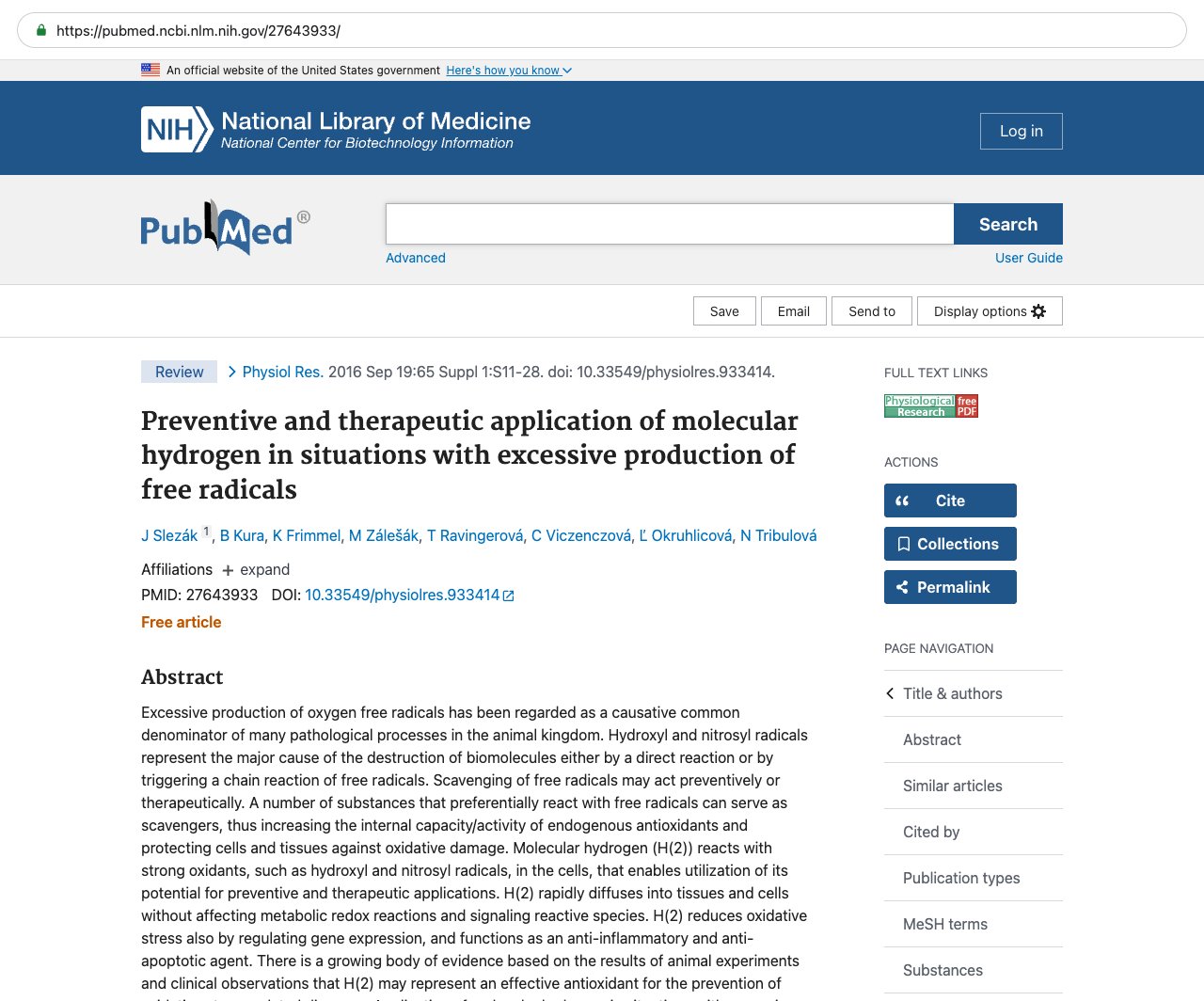
This page mirrors the published abstract (© the authors / publisher) for reference and citation. The canonical source is the PubMed record linked above. This is not medical advice.