2008 · Song — A role for IOP1 in mammalian cytosolic iron-sulfur protein biogenesis.
Super-Abstract
This in-vitro cell study identified IOP1 — a mammalian protein homologous to bacterial iron-only hydrogenases — as essential for the maturation of cytosolic iron-sulfur (Fe-S) proteins in human cells. Reducing IOP1 levels impaired cytosolic aconitase and xanthine oxidase activity, revealing a eukaryotic pathway for Fe-S cluster assembly outside mitochondria. (The Journal of Biological Chemistry, 2008.)
Commentary
This is a fundamental cell biology paper about iron-sulfur (Fe-S) cluster assembly — a process critical to many enzymes. The protein studied (IOP1) is structurally homologous to bacterial iron-only hydrogenases — enzymes that catalyze H₂ production in anaerobic bacteria. However, IOP1 in mammals has apparently lost its hydrogenase function; instead it supports Fe-S protein maturation in the cell cytoplasm. The connection to H₂ is evolutionary and structural — IOP1 belongs to a protein family originally associated with H₂ metabolism in bacteria, but in mammals it serves a different biochemical role. This paper does not investigate therapeutic H₂ in any form. It is relevant to fundamental cell biology and iron metabolism, not to H₂ therapy.
Key quotes
- „One of these is Nar1, which intriguingly is homologous to iron-only hydrogenases, ancient enzymes that catalyze the formation of hydrogen gas in anaerobic bacteria.“ — the evolutionary link to H₂ — IOP1 is related to bacterial hydrogenases but functions differently in mammals
- „knockdown of IOP1 in both HeLa and Hep3B cells decreases the activity of cytosolic aconitase, an Fe-S protein, but not that of mitochondrial aconitase.“ — the specific cellular function found: IOP1 is needed for cytosolic (not mitochondrial) Fe-S proteins
- „these results provide evidence that IOP1 is involved in mammalian cytosolic Fe-S protein maturation.“ — the main conclusion — new role for a hydrogenase-family protein in mammalian iron metabolism
Our assessment
This paper is not relevant to therapeutic molecular hydrogen (H₂). It investigates a mammalian protein that is evolutionarily related to bacterial hydrogenases but performs a completely different function (Fe-S cluster assembly). The study is valuable fundamental biochemistry about iron metabolism, but does not bear on H₂ therapy in any way.
Study design
- Type: in-vitro cell study (gene knockdown + enzyme activity assays) · Model: HeLa and Hep3B human cell lines; IOP1/IOP2 siRNA knockdown · H₂ connection: evolutionary only — IOP1 is homologous to bacterial hydrogenases but does not produce H₂ in mammals
- Result: IOP1 knockdown decreased cytosolic aconitase and xanthine oxidase activity, increased transferrin receptor 1 mRNA, decreased ferritin protein — establishing IOP1 as required for cytosolic Fe-S cluster maturation in mammalian cells
Abstract
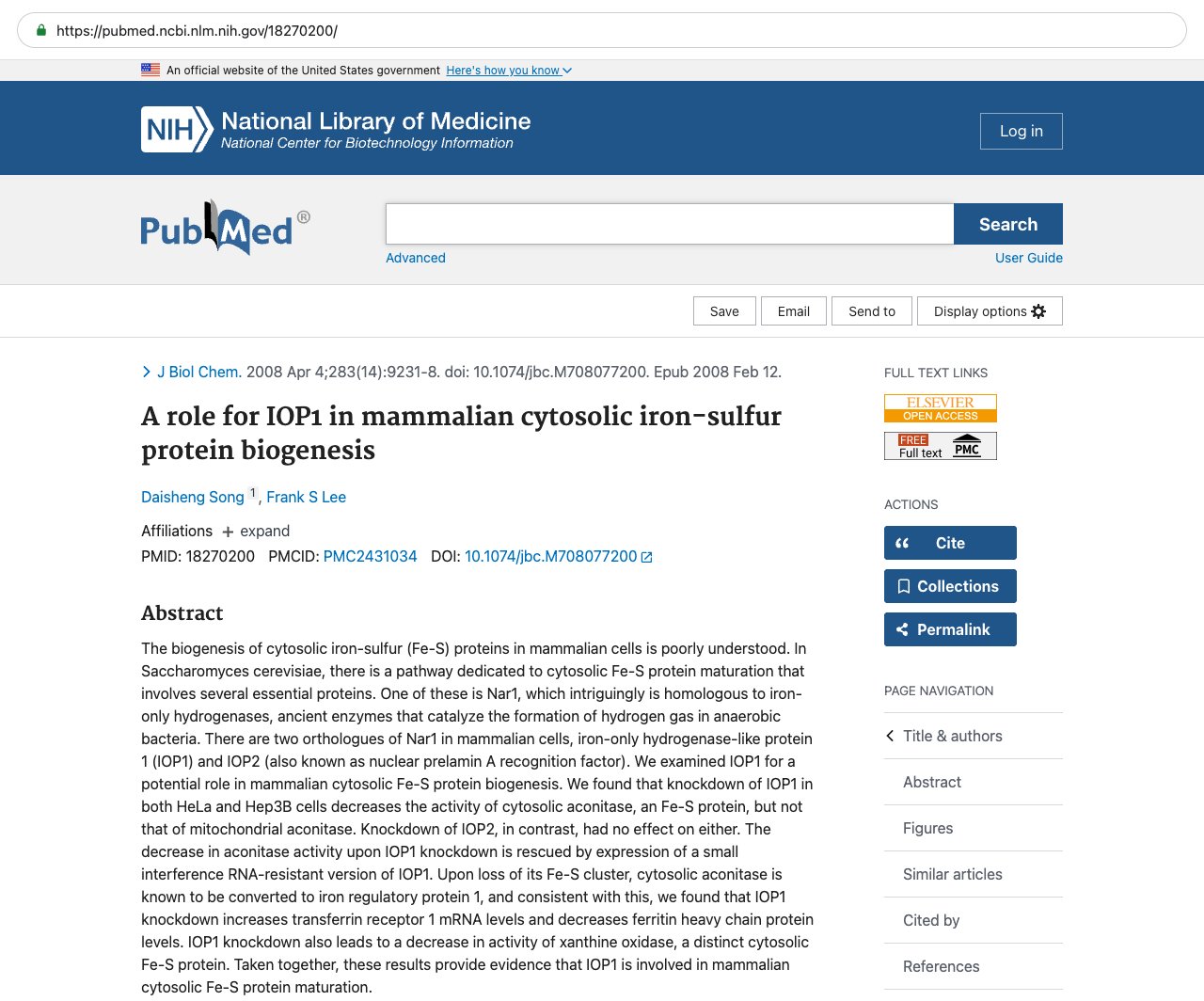
The biogenesis of cytosolic iron-sulfur (Fe-S) proteins in mammalian cells is poorly understood. In Saccharomyces cerevisiae, there is a pathway dedicated to cytosolic Fe-S protein maturation that involves several essential proteins. One of these is Nar1, which intriguingly is homologous to iron-only hydrogenases, ancient enzymes that catalyze the formation of hydrogen gas in anaerobic bacteria. There are two orthologues of Nar1 in mammalian cells, iron-only hydrogenase-like protein 1 (IOP1) and IOP2 (also known as nuclear prelamin A recognition factor). We examined IOP1 for a potential role in mammalian cytosolic Fe-S protein biogenesis. We found that knockdown of IOP1 in both HeLa and Hep3B cells decreases the activity of cytosolic aconitase, an Fe-S protein, but not that of mitochondrial aconitase. Knockdown of IOP2, in contrast, had no effect on either. The decrease in aconitase activity upon IOP1 knockdown is rescued by expression of a small interference RNA-resistant version of IOP1. Upon loss of its Fe-S cluster, cytosolic aconitase is known to be converted to iron regulatory protein 1, and consistent with this, we found that IOP1 knockdown increases transferrin receptor 1 mRNA levels and decreases ferritin heavy chain protein levels. IOP1 knockdown also leads to a decrease in activity of xanthine oxidase, a distinct cytosolic Fe-S protein. Taken together, these results provide evidence that IOP1 is involved in mammalian cytosolic Fe-S protein maturation.
Source & links
Screenshot of the PubMed page
This page mirrors the published abstract (© the authors / publisher) for reference and citation. The canonical source is the PubMed record linked above. This is not medical advice.