2021 · Spanoghe et al. — Microbial Food from Light, Carbon Dioxide and Hydrogen Gas: Kinetic, Stoichiometric and Nutritional Potential of Three Purple Bacteria
Super-Abstract
Purple bacteria can grow using light, CO₂, and hydrogen gas as their sole energy and carbon sources, producing protein-rich biomass with complete dietary amino acid profiles. This is a biotechnology/food science study on sustainable microbial protein production — not a study on hydrogen therapy or the health effects of H₂ in humans or animals.
Commentary
The global protein transition — shifting from animal toward sustainable plant and microbial protein sources — is one of the major challenges in food systems research. This study investigates the photohydrogenotrophic growth of three purple non-sulfur bacteria (Rhodobacter capsulatus, Rhodobacter sphaeroides, and Rhodopseudomonas palustris) that can convert H₂ and CO₂ into protein biomass under light. The measured growth rates (2.3–2.7 per day), protein productivities (0.09–0.12 g protein/L/day), and protein yields (2.6–2.9 g protein per gram of H₂ consumed) compare favorably with microalgae and aerobic hydrogen-oxidizing bacteria. Importantly, all three species produce protein with a complete amino acid profile meeting human dietary requirements, and their fatty acid content is dominated by vaccenic acid. This work belongs entirely to the sustainable food biotechnology domain. H₂ gas here is a biological substrate for bacterial metabolism, not a therapeutic agent. There is no relevance to hydrogen water, inhalation therapy, or biomedical H₂ research.
Key quotes
- „The three tested species obtained promising growth rates (2.3-2.7 d-1 at 28°C) and protein productivities (0.09-0.12 g protein L-1 d-1), rendering them likely faster and more productive than microalgae.“ — the key performance finding: competitive protein production rates compared to microalgae
- „All species provided full dietary protein matches for humans and their fatty acid content was dominated by vaccenic acid (82-86%).“ — nutritional quality: complete amino acid profile meeting human dietary requirements
- „Given its kinetic and nutritional performance we recommend to consider Rhodobacter capsulatus as a high-potential sustainable source of microbial food.“ — the practical recommendation: one species stands out for scale-up potential
Our assessment
This is a sound biotechnology study with clear relevance to sustainable protein production. The results are well-characterized and the comparison with competing microbial systems is methodologically appropriate. Relevance to H₂ medicine: none. Molecular hydrogen is a bacterial substrate here, not a health intervention. This study was likely retrieved by keyword search on H2 in the context of its role as a bacterial energy source. It should not be cited as evidence for any health effect of hydrogen on humans or animals.
Study design
- Type: in-vitro biotechnology study · n: three bacterial species tested in photobioreactors · H₂ role: bacterial growth substrate (photohydrogenotrophic metabolism) — not therapeutic
- Species: Rhodobacter capsulatus, Rhodobacter sphaeroides, Rhodopseudomonas palustris · Endpoints: growth rate, protein productivity, protein yield per H₂, amino acid and fatty acid profiles · Result: competitive protein production; no biomedical relevance
Abstract
The urgency for a protein transition towards more sustainable solutions is one of the major societal challenges. Microbial protein is one of the alternative routes, in which land- and fossil-free production should be targeted. The photohydrogenotrophic growth of purple bacteria, which builds on the H2- and CO2-economy, is unexplored for its microbial protein potential. The three tested species (Rhodobacter capsulatus, Rhodobacter sphaeroides and Rhodopseudomonas palustris) obtained promising growth rates (2.3-2.7 d-1 at 28°C) and protein productivities (0.09-0.12 g protein L-1 d-1), rendering them likely faster and more productive than microalgae. The achieved protein yields (2.6-2.9 g protein g-1 H2) transcended the ones of aerobic hydrogen oxidizing bacteria. Furthermore, all species provided full dietary protein matches for humans and their fatty acid content was dominated by vaccenic acid (82-86%). Given its kinetic and nutritional performance we recommend to consider Rhodobacter capsulatus as a high-potential sustainable source of microbial food.
Source & links
Screenshot of the PubMed page
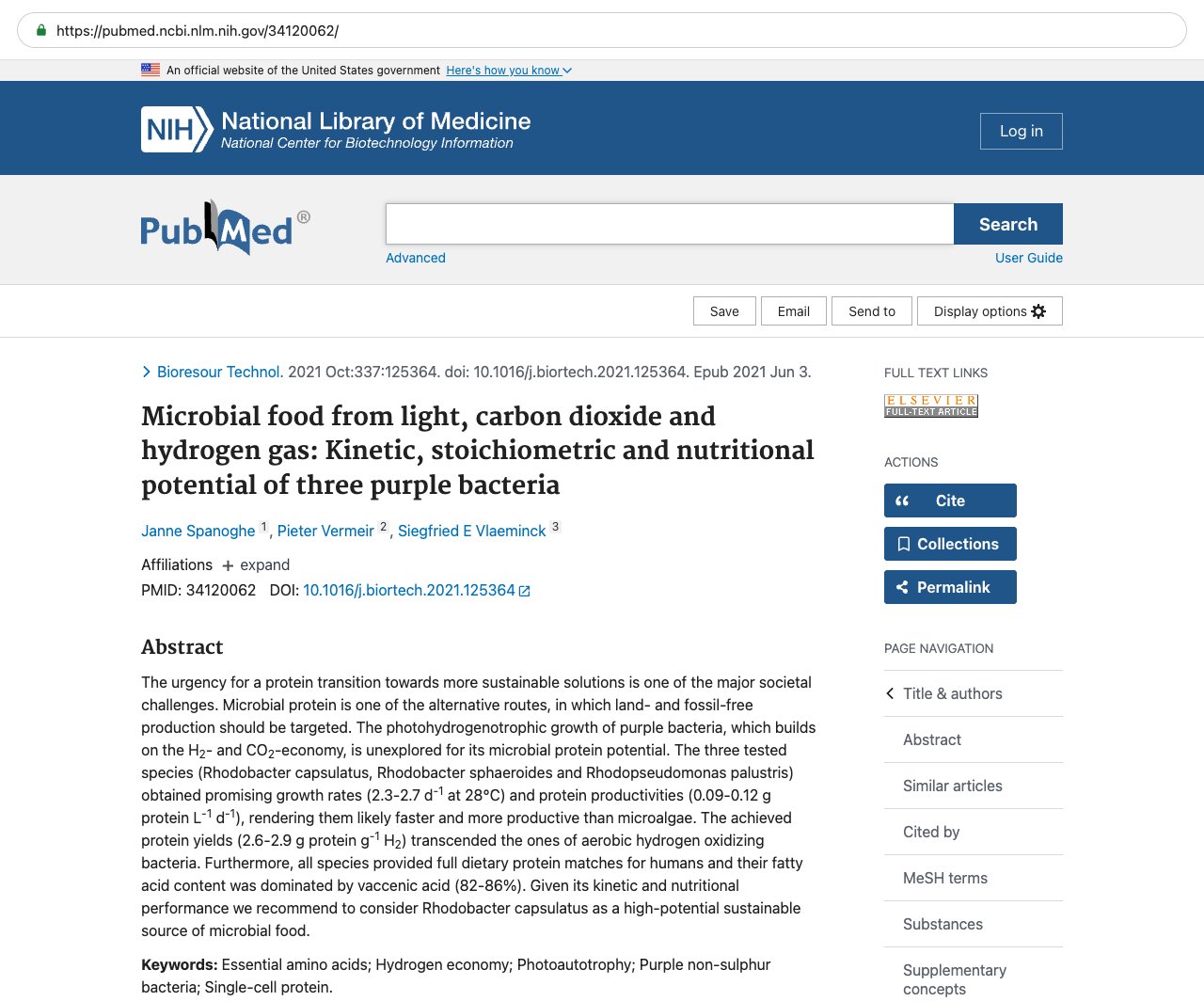
This page mirrors the published abstract (© the authors / publisher) for reference and citation. The canonical source is the PubMed record linked above. This is not medical advice.