2020 · Sun — Photoactivated H₂ Nanogenerator for Enhanced Chemotherapy of Bladder Cancer
Super-Abstract
Researchers designed nanoparticles that generate H₂ gas inside cancer cells when activated by a 660 nm laser, finding in cell culture and mouse models that H₂ produced in this way significantly enhanced the efficacy of the chemotherapy drug gemcitabine against bladder cancer. The mechanism involves H₂-induced inhibition of mitochondrial function and reduction of a drug-efflux pump, making cancer cells less able to expel the chemotherapy drug. This is an in-vitro and animal study — not a human clinical trial. (ACS Nano, 2020.)
Commentary
This is a sophisticated nano-medicine engineering study published in a high-impact materials science journal. The innovation is a self-assembling nanoparticle system ([FeFe]TPP/gemcitabine/fluorinated chitosan) that exploits the tumour microenvironment (enhanced permeability, folate receptor-mediated endocytosis) for selective cancer-cell uptake, then generates H₂ in situ via photocatalysis upon laser irradiation. The dual mechanism — oxidative stress mitigation by H₂ combined with chemotherapy enhancement via P-gp efflux pump inhibition — is conceptually novel. However, both in-vitro and the in-vivo murine xenograft results need to be interpreted cautiously: nanoparticle pharmacology and cancer drug resistance are highly context-dependent, and the gap between mouse tumour models and human bladder cancer therapy is large.
Key quotes
- „H2 gas in hydrogen chemotherapy can inhibit mitochondrial function, hinder ATP synthesis, and cause a reduction of the P-gp efflux pump function, which finally attenuates P-gp protein drug transport capacity in cancer cells.“ — proposed mechanism: H₂ sensitises cancer cells to chemotherapy by blocking drug efflux
- „The [FeFe]TPP/GEM/FCS NPs exhibit excellent transmucosal and tumor cell penetration capacities after intravesical instillation into the bladder.“ — delivery route: intravesical instillation with selective tumour cell uptake
- „significantly enhances the efficacy of hydrogen chemotherapy of cancer in vitro and in vivo.“ — overall efficacy claim — in cell culture and mouse models only
Our assessment
This is an in-vitro and animal study — specifically a mouse xenograft model — in the field of nano-oncology. The concept is scientifically creative, but all results are preclinical. No conclusions about efficacy or safety in human bladder cancer patients can be drawn. The delivery system (intravesical laser irradiation of nanoparticles) involves significant engineering complexity and safety questions that would require extensive preclinical and clinical development before any human application. The H₂ here acts as a chemotherapy sensitiser via a specific engineered nanoparticle mechanism — not as a standalone therapeutic.
Study design
- Type: in-vitro + in-vivo (mouse xenograft) nano-oncology study · Model: human bladder cancer cell lines + murine xenograft tumour model · H₂ delivery: in situ photocatalytic generation from [FeFe]TPP nanoparticles activated by 660 nm laser after intravesical instillation
- Result: enhanced cancer cell proliferation suppression with H₂ + gemcitabine vs. either alone; mechanism: H₂ inhibits mitochondrial function, ATP synthesis, and P-gp drug efflux pump; in-vitro and murine in-vivo efficacy demonstrated
Abstract
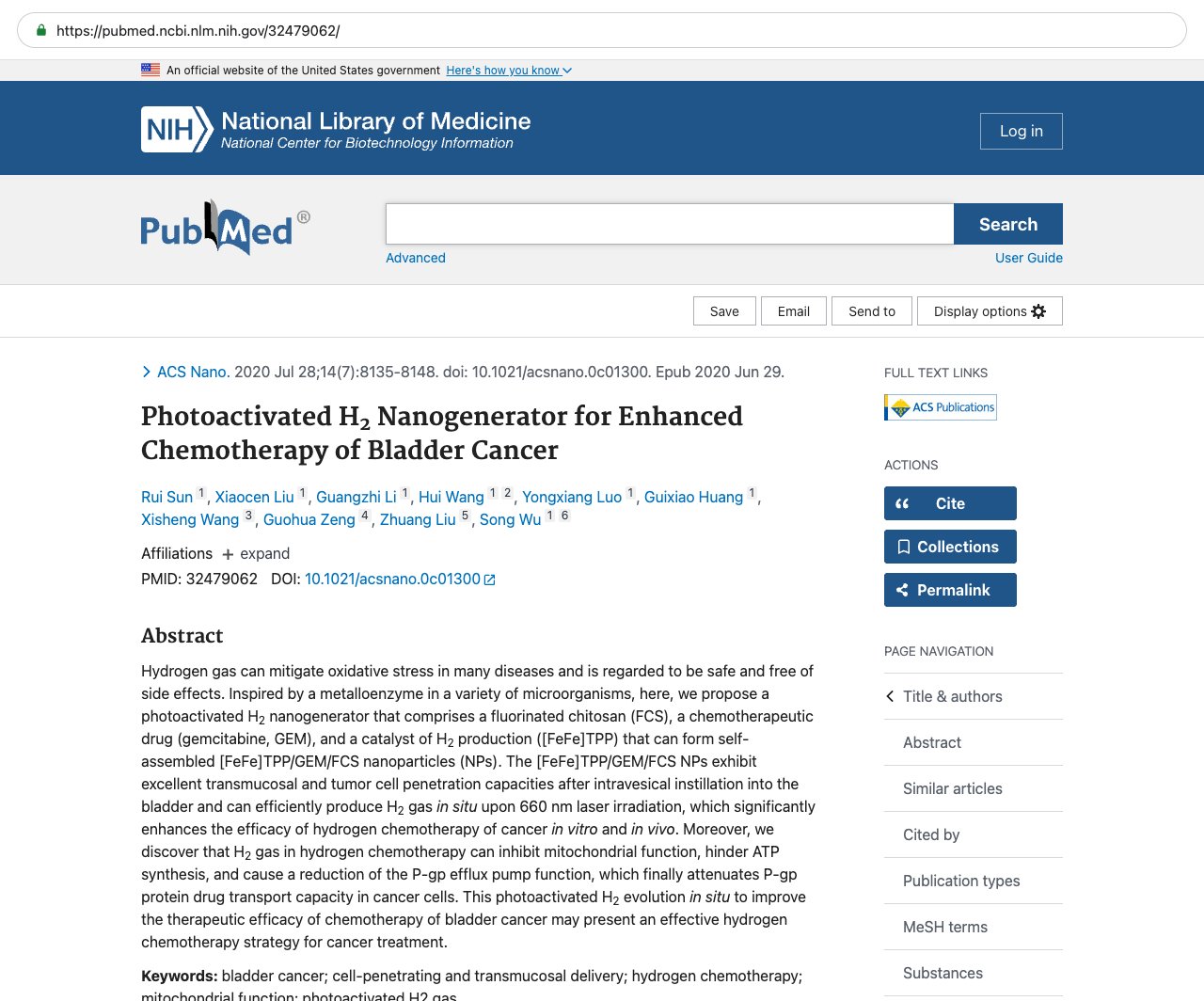
Hydrogen gas can mitigate oxidative stress in many diseases and is regarded to be safe and free of side effects. Inspired by a metalloenzyme in a variety of microorganisms, here, we propose a photoactivated H2 nanogenerator that comprises a fluorinated chitosan (FCS), a chemotherapeutic drug (gemcitabine, GEM), and a catalyst of H2 production ([FeFe]TPP) that can form self-assembled [FeFe]TPP/GEM/FCS nanoparticles (NPs). The [FeFe]TPP/GEM/FCS NPs exhibit excellent transmucosal and tumor cell penetration capacities after intravesical instillation into the bladder and can efficiently produce H2 gas in situ upon 660 nm laser irradiation, which significantly enhances the efficacy of hydrogen chemotherapy of cancer in vitro and in vivo. Moreover, we discover that H2 gas in hydrogen chemotherapy can inhibit mitochondrial function, hinder ATP synthesis, and cause a reduction of the P-gp efflux pump function, which finally attenuates P-gp protein drug transport capacity in cancer cells. This photoactivated H2 evolution in situ to improve the therapeutic efficacy of chemotherapy of bladder cancer may present an effective hydrogen chemotherapy strategy for cancer treatment.
Source & links
Screenshot of the PubMed page
This page mirrors the published abstract (© the authors / publisher) for reference and citation. The canonical source is the PubMed record linked above. This is not medical advice.