2009 · Suzuki — Are the effects of alpha-glucosidase inhibitors on cardiovascular events related to elevated levels of hydrogen gas in the gastrointestinal tract?
Super-Abstract
This theoretical paper proposes that the cardiovascular benefits of alpha-glucosidase inhibitors (such as acarbose) may partly be explained by increased H₂ production in the gut. When these diabetes drugs prevent carbohydrate digestion in the small intestine, colonic bacteria ferment the undigested sugars — producing H₂ gas. The authors suggest this endogenous H₂ might act as an antioxidant and reduce oxidative stress linked to cardiovascular disease. (FEBS Letters, 2009.)
Commentary
This is a hypothesis paper — not an interventional study. The key clinical observation behind the idea is real: the STOP-NIDDM trial showed that acarbose reduced cardiovascular events in patients with impaired glucose tolerance. Suzuki and colleagues propose an intriguing parallel: acarbose also markedly increases intestinal H₂ production, and the authors had just published their landmark 2007 Nature Medicine paper showing H₂ is a selective antioxidant. The hypothesis is biologically plausible — H₂ produced by fermentation could be absorbed and exert systemic antioxidant effects. However, this remains speculative at the time of publication. No experiment was conducted to test the causal link between acarbose-induced H₂ and cardiovascular protection. Subsequent research has partially explored this direction but causality has not been firmly established.
Key quotes
- „We propose that the cardiovascular benefits of alpha-glucosidase inhibitors are partly attributable to their ability to neutralise oxidative stress via increased production of H(2) in the gastrointestinal tract.“ — the core hypothesis of the paper
- „Acarbose, which is an alpha-glucosidase inhibitor, markedly increased H(2) production, with a weaker effect on methane production.“ — the empirical basis: acarbose substantially raises gut H₂
- „Our hypothesis is based on our recent discovery that H(2) acts as a unique antioxidant, and that when inhaled or taken orally as H(2)-dissolved water it ameliorates ischaemia-reperfusion injury and atherosclerosis development.“ — linking to the authors' earlier foundational H₂ research
Our assessment
This is a theory/hypothesis paper, not an experimental study. It offers a stimulating idea connecting gut microbiome H₂ production to cardiovascular health via an antioxidant mechanism — but presents no new experimental data. The connection between acarbose, H₂, and cardiovascular protection remains an unproven hypothesis. It is historically interesting as an early attempt to integrate endogenous H₂ into clinical pharmacology thinking. No human or animal experiments were performed; direct causality cannot be inferred from this paper alone.
Study design
- Type: theoretical/hypothesis paper · n: n/a (no experiment conducted) · H₂ source: endogenous gut fermentation (acarbose-induced)
- Result: hypothesis only — acarbose markedly increases gut H₂; authors propose this may mediate cardiovascular protection via antioxidant mechanisms; no causal evidence provided
Abstract
The major side-effect of treatment with alpha-glucosidase inhibitors, flatulence, occurs when undigested carbohydrates are fermented by colonic bacteria, resulting in gas formation. We propose that the cardiovascular benefits of alpha-glucosidase inhibitors are partly attributable to their ability to neutralise oxidative stress via increased production of H(2) in the gastrointestinal tract. Acarbose, which is an alpha-glucosidase inhibitor, markedly increased H(2) production, with a weaker effect on methane production. Our hypothesis is based on our recent discovery that H(2) acts as a unique antioxidant, and that when inhaled or taken orally as H(2)-dissolved water it ameliorates ischaemia-reperfusion injury and atherosclerosis development.
Source & links
Screenshot of the PubMed page
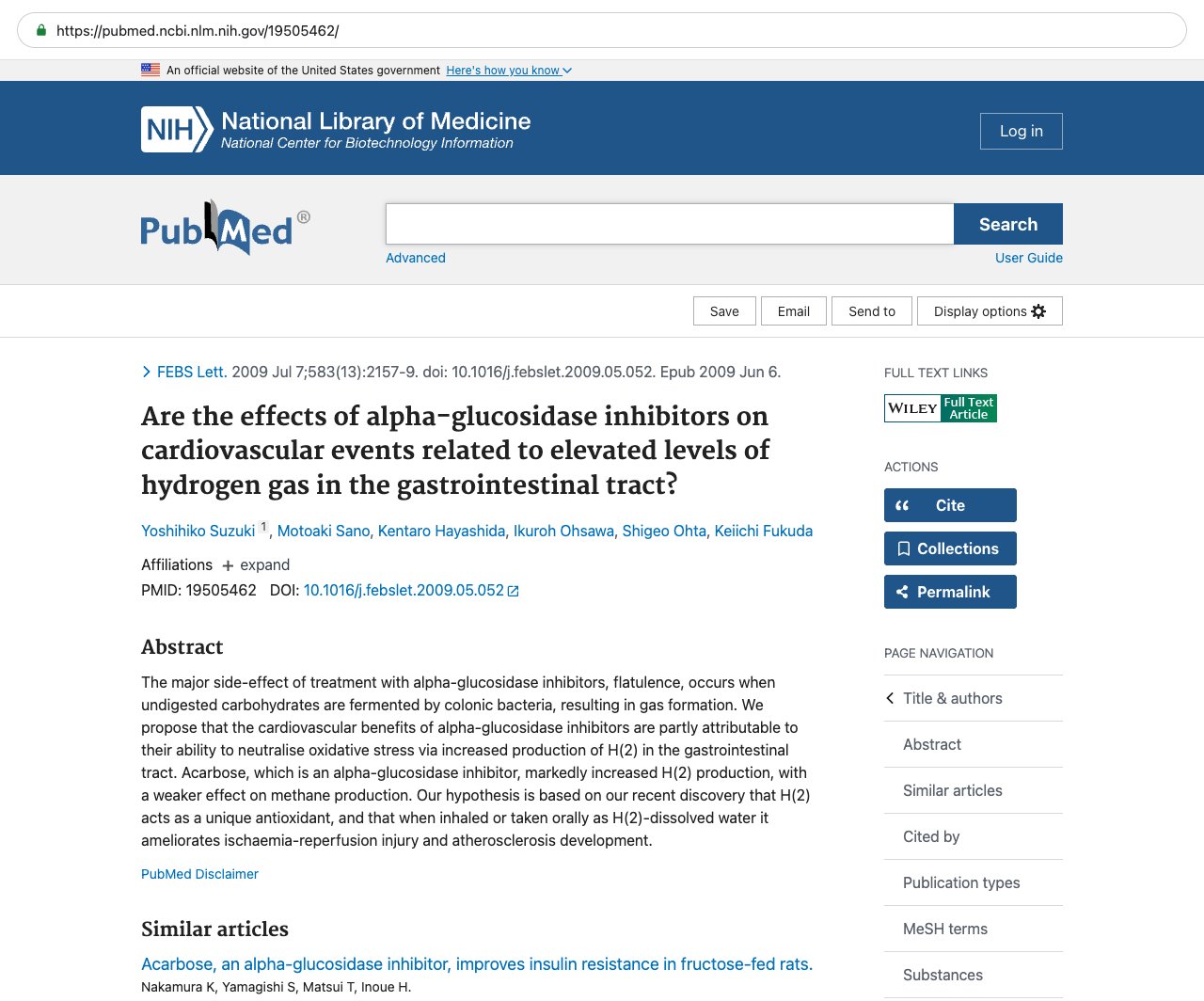
This page mirrors the published abstract (© the authors / publisher) for reference and citation. The canonical source is the PubMed record linked above. This is not medical advice.