2021 · Tallima — Cell surface sphingomyelin: key role in cancer initiation, progression, and immune evasion.
Super-Abstract
This review examines how excess sphingomyelin (SM) on the outer surface of cancer cells enables tumors to evade the immune system, resist apoptosis, and ignore growth-suppressor signals. The authors propose that targeting SM metabolism may open new avenues for cancer therapy. Note: molecular hydrogen is not a primary focus of this paper. (Lipids in Health and Disease, 2021.)
Commentary
Sphingomyelin is a phospholipid normally found in cell membranes. This review argues that abnormally high SM content on cancer cell surfaces creates a rigid „molecular shield“ — impeding cell-to-cell contact inhibition (a key brake on uncontrolled proliferation) and blocking immune-cell recognition. The connection to H₂ biology here is indirect: the SM network is stabilized in part by inter-molecular hydrogen bonds, and the paper touches on hydrogen bond dynamics in membranes. Tallima et al. position SM synthesis and hydrolysis as underappreciated drivers of carcinogenesis, alongside the well-known immunotherapy challenges (lack of tumor-specific antigens, MHC-I downregulation, Fas evasion). The review is largely mechanistic and does not provide new experimental data. It is primarily relevant to the H₂-medicine field as background on tumor-cell surface biochemistry, not as a direct H₂ intervention study.
Key quotes
- „Surface membrane SM readily forms inter- and intra- molecular hydrogen bond network, which excessive tightness would impair cell-cell contact inhibition“ — the proposed mechanism: too much SM rigidifies the membrane and disables a fundamental tumor-suppressive signal
- „SM synthesis and hydrolysis are increasingly implicated in initiation of carcinogenesis and promotion of metastasis.“ — central claim of the review: SM is an underappreciated cancer driver
- „the review aims to provide evidence for surface membrane SM levels and roles in cells resistance to death, failure to respond to growth suppressor signals, and immune escape“ — scope of the paper
Our assessment
This is a narrative review, not a clinical or experimental study. It presents a biochemical hypothesis about SM's role in cancer — an area of genuine scientific interest — but does not report new data and does not test H₂ as an intervention. The connection to molecular hydrogen in this paper is limited to the role of hydrogen bonds in membrane physics, not to H₂ therapy. Readers seeking evidence for H₂ as an anti-cancer agent should consult dedicated H₂ intervention studies; this review provides relevant tumor-biology context only.
Study design
- Type: narrative review · Scope: biochemical and immunological literature on sphingomyelin in cancer · H₂ relevance: indirect (hydrogen bonds in SM membrane networks, no H₂ intervention tested)
- Conclusion: excess surface SM promotes cancer initiation, metastasis, and immune evasion; SM metabolism proposed as a therapeutic target
Abstract
Cell surface biochemical changes, notably excessive increase in outer leaflet sphingomyelin (SM) content, are important in cancer initiation, growth, and immune evasion. Innumerable reports describe methods to initiate, promote, or enhance immunotherapy of clinically detected cancer, notwithstanding the challenges, if not impossibility, of identification of tumor-specific, or associated antigens, the lack of tumor cell surface membrane expression of major histocompatibility complex (MHC) class I alpha and β2 microglobulin chains, and lack of expression or accessibility of Fas and other natural killer cell immune checkpoint molecules. Conversely, SM synthesis and hydrolysis are increasingly implicated in initiation of carcinogenesis and promotion of metastasis. Surface membrane SM readily forms inter- and intra- molecular hydrogen bond network, which excessive tightness would impair cell-cell contact inhibition, inter- and intra-cellular signals, metabolic pathways, and susceptibility to host immune cells and mediators. The present review aims at clarifying the tumor immune escape mechanisms, which face common immunotherapeutic approaches, and attracting attention to an entirely different, neglected, key aspect of tumorigenesis associated with biochemical changes in the cell surface that lead to failure of contact inhibition, an instrumental tumorigenesis mechanism. Additionally, the review aims to provide evidence for surface membrane SM levels and roles in cells resistance to death, failure to respond to growth suppressor signals, and immune escape, and to suggest possible novel approaches to cancer control and cure.
Source & links
Screenshot of the PubMed page
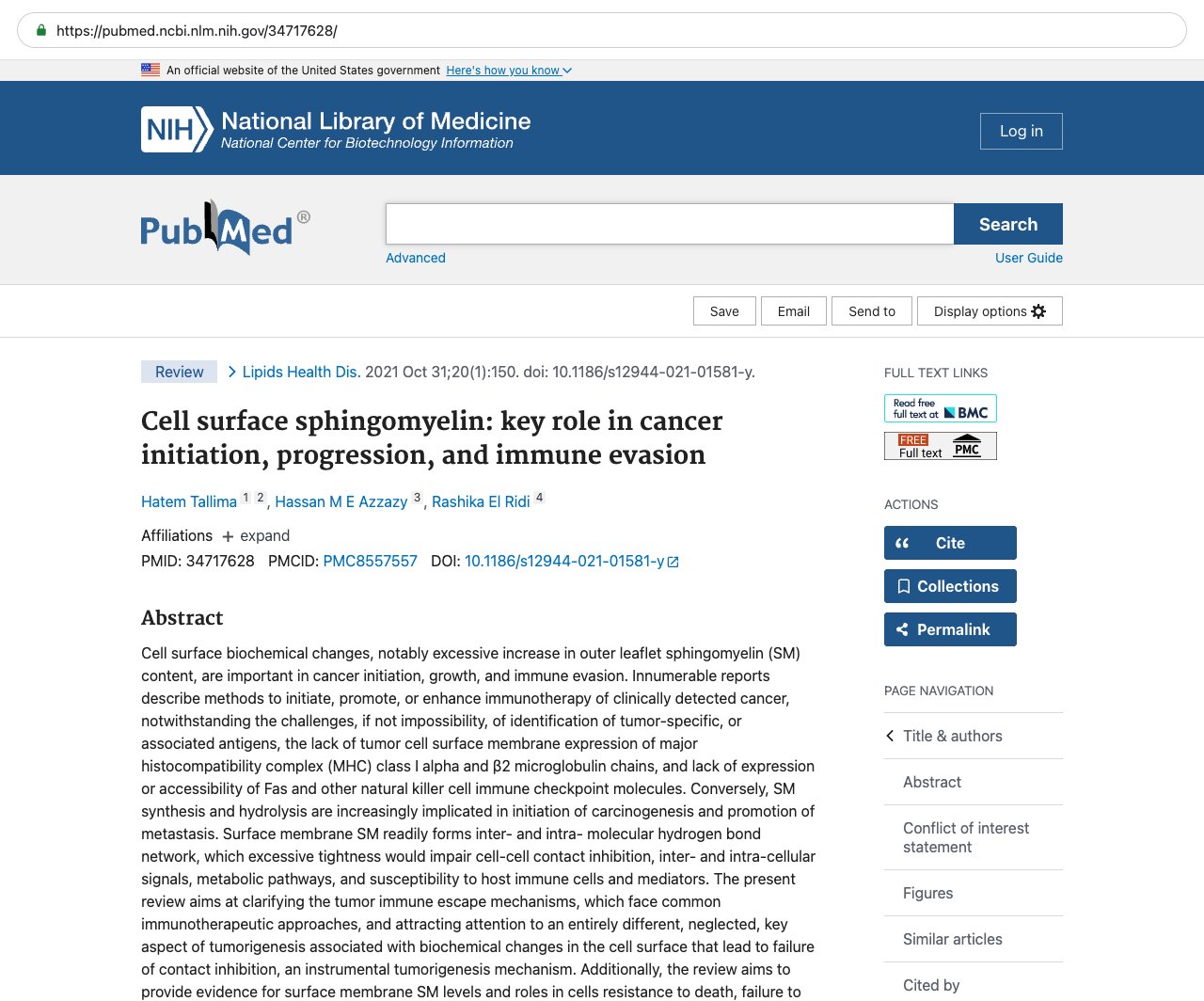
This page mirrors the published abstract (© the authors / publisher) for reference and citation. The canonical source is the PubMed record linked above. This is not medical advice.