1999 · Tamori — Role of calcitonin gene-related peptide and capsaicin-sensitive afferents in central thyrotropin-releasing hormone-induced hepatic hyperemia.
Super-Abstract
This animal study in anesthetized rats demonstrates that central (intracisternal) injection of a TRH analogue increases hepatic blood flow via capsaicin-sensitive afferent neurons and CGRP — and that blocking either pathway completely abolishes this effect. Molecular hydrogen was used exclusively as a measurement tool (hydrogen gas clearance) to quantify liver blood flow, not as a therapeutic agent. (European Journal of Pharmacology, 1999.)
Commentary
This study investigates the neuronal pathway by which centrally acting thyrotropin-releasing hormone (TRH) stimulates hepatic blood flow. The work uses a standard pharmacological approach: injecting a TRH analogue into the cisterna magna and measuring the downstream effects. Two blocking strategies — systemic capsaicin pretreatment (to desensitize afferent neurons) and intravenous CGRP receptor antagonist — completely prevented the hepatic hyperemia. The hydrogen gas clearance method was used as the blood-flow measurement technique. H₂ here is a pharmacological tracer for blood flow measurement, not a therapeutic intervention. This is a basic neurophysiology/pharmacology study in rats with no direct clinical translation for H₂ therapy.
Key quotes
- „Both systemic capsaicin pretreatment and intravenous administration of CGRP receptor antagonist, human CGRP-(8-37), completely abolished the stimulatory effect of hepatic blood flow induced by intracisternal injection of TRH analog.“ — both intervention arms prevented TRH-induced hepatic hyperemia — confirming CGRP and capsaicin-sensitive afferents as required mediators
- „These data demonstrate the involvement of capsaicin-sensitive afferent neurons and CGRP in the central TRH-induced stimulation of hepatic blood flow.“ — conclusion: neuronal circuit TRH → afferents → CGRP → hepatic vasodilation identified
Our assessment
This is an animal neurophysiology/pharmacology study — it is not a therapeutic H₂ study. Molecular hydrogen was used solely as a measurement tool (clearance method) for hepatic blood flow, not as an intervention. The findings relate to a specific neuronal signalling pathway for liver perfusion regulation — not to any H₂ health effect. Results are not transferable to human clinical practice without further study. The hydrogen connection is purely methodological.
Study design
- Type: animal study · Model: urethane-anesthetized rats · Intervention: intracisternal TRH analogue (RX-77368, 100 ng) ± systemic capsaicin pretreatment or IV CGRP-(8-37) receptor antagonist
- H₂ role: hydrogen gas clearance method used to measure hepatic blood flow only · Result: TRH analogue increased hepatic blood flow; effect completely blocked by capsaicin desensitisation or CGRP antagonism — confirming CGRP/afferent pathway
Abstract
The involvement of capsaicin-sensitive afferent neurons and calcitonin gene-related peptide (CGRP) in the central thyrotropin-releasing hormone (TRH)-induced hepatic hyperemia was investigated in urethane anesthetized rats. Both systemic capsaicin pretreatment and intravenous administration of CGRP receptor antagonist, human CGRP-(8-37), completely abolished the stimulatory effect of hepatic blood flow induced by intracisternal injection of TRH analog (RX-77368; p-Glu-His-(3,3'-dimethyl)-Pro-NH2, 100 ng), assessed by the hydrogen gas clearance method. These data demonstrate the involvement of capsaicin-sensitive afferent neurons and CGRP in the central TRH-induced stimulation of hepatic blood flow.
Source & links
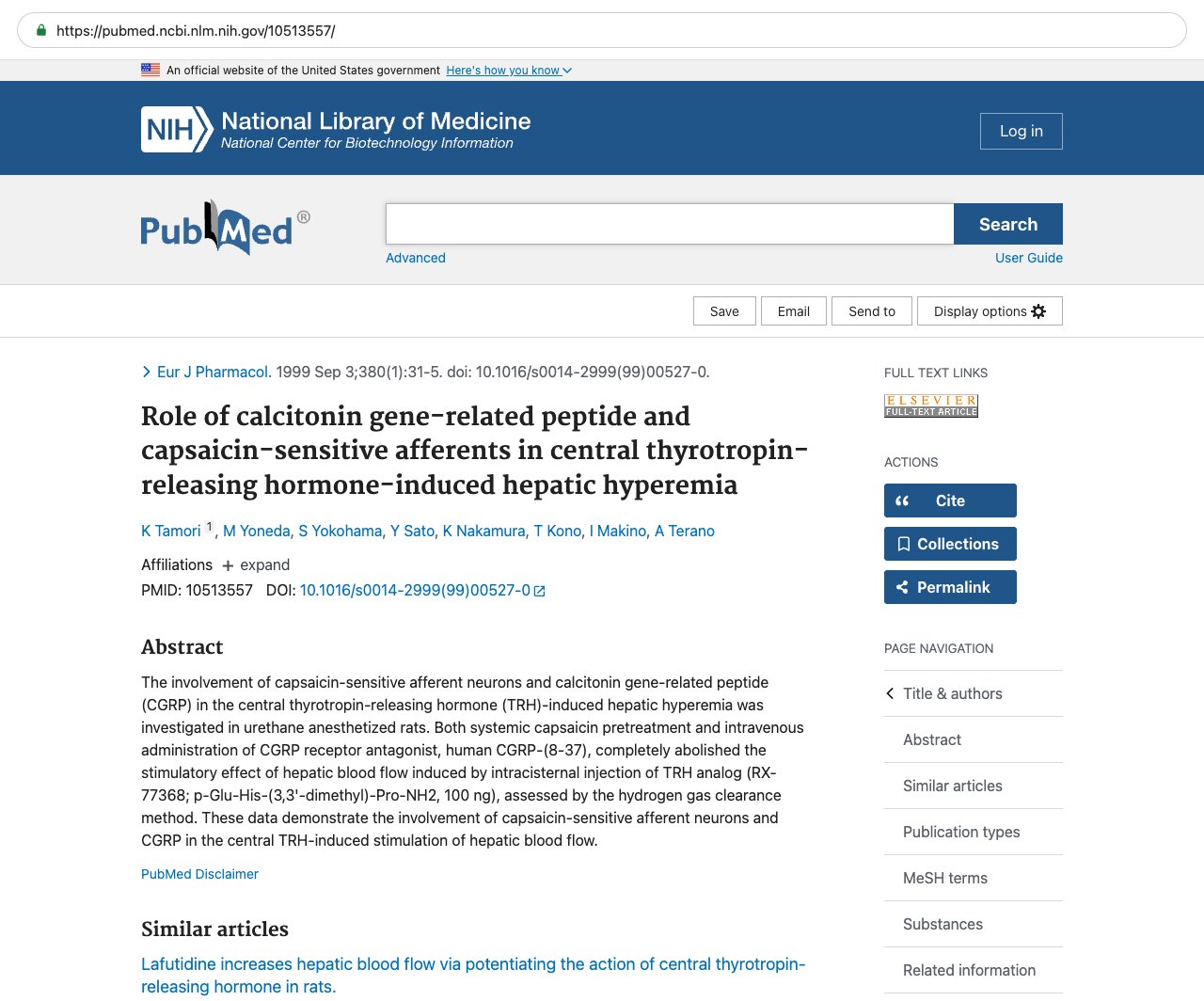
Screenshot of the PubMed page
This page mirrors the published abstract (© the authors / publisher) for reference and citation. The canonical source is the PubMed record linked above. This is not medical advice.