2017 · Watanabe — Protective Effect of Hydrogen Gas Inhalation on Muscular Damage Using a Mouse Hindlimb Ischaemia-Reperfusion Injury Model
Super-Abstract
In a mouse hindlimb ischaemia-reperfusion model, inhalation of hydrogen gas — administered before and during reperfusion — significantly reduced muscle infarct zone, dampened inflammation, and improved walking function recovery. Post-treatment alone had no effect. This is an animal study only; results cannot be directly applied to human surgery or clinical ischaemia-reperfusion scenarios. (Plastic and Reconstructive Surgery, 2017.)
Commentary
Ischaemia-reperfusion (IR) injury occurs when blood flow is restored to tissue after a period of oxygen deprivation — paradoxically causing oxidative damage. This is clinically relevant in free flap surgery, traumatic limb replantation, and orthopaedic surgery with tourniquet use. Watanabe and colleagues first compared how well hydrogen reaches muscle tissue via intraperitoneal H₂-rich saline injection vs. inhalation, finding that inhalation achieves higher and more sustained tissue H₂ concentrations. They then tested H₂ inhalation in the IR model: pre-treatment during ischaemia and continued during reperfusion reduced the infarct zone and cellular infiltration, and improved the footprint test (gait assessment) at one week. Critically, post-reperfusion-only treatment did not work — timing matters. The comparison between delivery routes is an important practical finding for translational research. However, the study is entirely in mice, and human IR physiology in clinical contexts involves very different timescales, body sizes, and surgical realities.
Key quotes
- „Hydrogen concentration of tissue was significantly higher, and the elevated level was maintained longer by hydrogen gas inhalation than by intraperitoneal administration of hydrogen-rich saline.“ — key practical finding: inhalation delivers more H₂ to muscle than injection
- „Infarct zone and area with loss of tissue structure and marked cellular infiltration were significantly decreased in groups treated by hydrogen gas inhalation during ischemia-reperfusion; however, these effects were not observed by posttreatment of hydrogen.“ — pre/during treatment works; post-treatment does not — timing is critical
- „Inhalation of hydrogen gas attenuates muscle damage, inhibits inflammatory response, and enhances functional recovery.“ — summary of the three main therapeutic effects observed in mice
Our assessment
This is a mouse experiment — findings are promising for the mechanism of H₂ in IR injury and the comparison of delivery routes is methodologically valuable. The null effect of post-treatment is an honest negative finding that constrains the therapeutic window. Translating this to human clinical practice (e.g., intraoperative H₂ inhalation during tourniquet surgery or free flap transfers) would require substantial additional preclinical and clinical work. No human data exist.
Study design
- Type: animal study (mouse, in vivo) · Model: hindlimb ischaemia-reperfusion (gastrocnemius muscle) · Groups: H₂ gas inhalation (pre+during) vs. H₂-rich saline (intraperitoneal) vs. post-treatment inhalation vs. control
- H₂ delivery: inhalation (primary) and intraperitoneal H₂-rich saline (comparator) · Endpoints: tissue H₂ concentration, infarct zone morphology, cellular infiltration, footprint gait test at 1 week
- Result: inhalation > injection for tissue H₂; pre/during H₂ inhalation reduced infarct zone and inflammation; improved gait at 1 week; post-treatment had no effect
Abstract
BACKGROUND: Ischemia-reperfusion injury is one of the leading causes of tissue damage and dysfunction, in particular, free tissue transfer, traumatically amputated extremity, and prolonged tourniquet application during extremity surgery. In this study, the authors investigated the therapeutic effects of hydrogen gas on skeletal muscle ischemia-reperfusion injury. METHODS: The authors compared the concentration of hydrogen in a muscle on intraperitoneal administration of hydrogen-rich saline and on inhalation of hydrogen gas. Animals were subjected to ischemia-reperfusion. Mice were treated with inhalation of hydrogen gas, and the hind gastrocnemius muscle was collected. Muscle morphology and inflammatory change were evaluated after ischemia-reperfusion. Moreover, a footprint test was performed to assess the functional effect of hydrogen. RESULTS: Hydrogen concentration of tissue was significantly higher, and the elevated level was maintained longer by hydrogen gas inhalation than by intraperitoneal administration of hydrogen-rich saline. Infarct zone and area with loss of tissue structure and marked cellular infiltration were significantly decreased in groups treated by hydrogen gas inhalation during ischemia-reperfusion; however, these effects were not observed by posttreatment of hydrogen. One week after ischemia-reperfusion, mice that had been pretreated with hydrogen gas recovered faster and achieved smoother walking in appearance compared with mice in the other groups as assessed by the footprint test. CONCLUSIONS: Inhalation of hydrogen gas attenuates muscle damage, inhibits inflammatory response, and enhances functional recovery. These findings suggest that the optimal route for hydrogen delivery is continuous inhalation of hydrogen gas, which could be a novel clinical mode of treatment in ischemia-reperfusion injury.
Source & links
Screenshot of the PubMed page
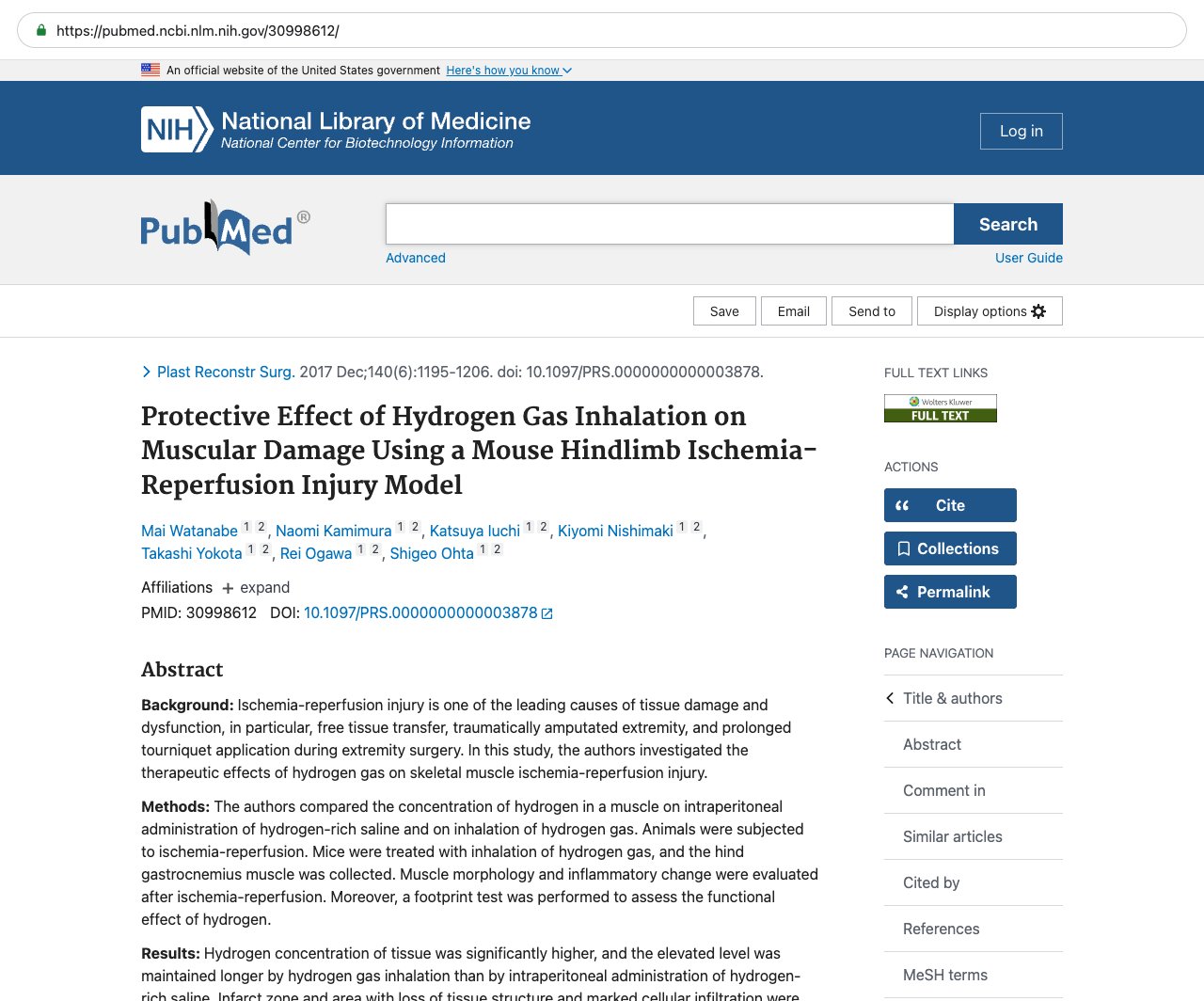
This page mirrors the published abstract (© the authors / publisher) for reference and citation. The canonical source is the PubMed record linked above. This is not medical advice.