2024 · Tamura — Combination of Hydrogen Inhalation and Hypothermic Temperature Control After Out-of-Hospital Cardiac Arrest: A Post hoc Analysis of the Efficacy of Inhaled Hydrogen on Neurologic Outcome Following Brain Ischemia During PostCardiac Arrest Care II Trial
Super-Abstract
Hydrogen inhalation plus deep cooling improves the neurologic outcome after cardiac arrest. In the post-hoc analysis of the HYBRID-II trial, 68% achieved a good neurologic outcome under hydrogen + hypothermia (32–34 °C) vs. 38% under cooling alone (relative risk 1.81). (Critical Care Medicine, 2024 — exploratory secondary analysis, n = 72.)
Commentary
This is about one of the most severe emergency situations there is: brain damage after a cardiac arrest outside the hospital. This work is a post-hoc analysis of the randomized, controlled HYBRID-II trial from 15 Japanese intensive care units — it investigates the combination of hydrogen inhalation and targeted temperature management (TTM). Among the 72 analyzed patients, under deep cooling (32–34 °C): in the hydrogen group, 17 of 25 (68%) achieved a good neurologic outcome after 90 days, in the control group only 9 of 24 (38%) — relative risk 1.81. Adjusted, hydrogen + deep cooling was independently associated with a good neurologic outcome (odds ratio 16.10). Important for the honest assessment: this is an exploratory secondary analysis, not a pre-specified primary analysis. The case number is small (n = 72), the confidence interval of the odds ratio is enormous (1.88–138.17) — i.e. extremely imprecise. And crucially: survival was not improved (hazard ratio 0.22; p = 0.06, not significant). The finding is promising, but hypothesis-generating, not conclusive.
Key quotes
- „Under TTM32-TTM34, 17 (68%) and 9 (38%) patients achieved good neurologic outcomes in the hydrogen and control groups, respectively (relative risk: 1.81 [95% CI, 1.05-3.66], p < 0.05).“ — the core finding: better neurologic outcome under hydrogen + deep cooling
- „Hydrogen + TTM32-TTM34 was independently associated with good neurologic outcomes (adjusted odds ratio 16.10 [95% CI, 1.88-138.17], p = 0.01).“ — adjusted effect — but very wide confidence interval
- „hydrogen + TTM32-TTM34 did not improve survival compared with TTM32-TTM34 alone (adjusted hazard ratio: 0.22 [95% CI, 0.05-1.06], p = 0.06).“ — honest negative finding: no improvement in survival
Our assessment
Relevant for H₂ inhalation applications in the high-risk medical domain, because a hard neurologic endpoint is examined here in a renowned intensive-care journal (Critical Care Medicine) — and the data come from a real randomized trial. Limitation, stated honestly and prominently: it is a post-hoc subgroup analysis, not a pre-specified RCT endpoint. The case number is small (n = 72), the confidence interval of the adjusted odds ratio (1.88–138.17) is so wide that the effect size is practically undetermined, and survival was not improved. Such findings are hypothesis-generating and must be confirmed in a dedicated, adequately powered study.
Study design
- Type: post-hoc analysis of a multicenter RCT (HYBRID II, jRCTs031180352; 15 Japanese ICUs) — exploratory · n: 72 (hydrogen = 39, control = 33) · Duration: outcome at 90 days · H₂ delivery: hydrogen + oxygen inhaled vs. oxygen alone, combined with hypothermic TTM (32–34 °C or 35–36 °C)
- Result metrics: under TTM32–34 good neurologic 90-day outcome 68% (hydrogen) vs. 38% (control), RR 1.81 (95% CI 1.05–3.66; p < 0.05); adjusted OR 16.10 (95% CI 1.88–138.17; p = 0.01); survival NOT improved (adj. HR 0.22; 95% CI 0.05–1.06; p = 0.06)
Abstract
The Efficacy of Inhaled Hydrogen on Neurologic Outcome Following Brain Ischemia During Post-Cardiac Arrest Care (HYBRID) II trial (jRCTs031180352) suggested that hydrogen inhalation may reduce post-cardiac arrest brain injury (PCABI). However, the combination of hypothermic target temperature management (TTM) and hydrogen inhalation on outcomes is unclear. The aim of this study was to investigate the combined effect of hydrogen inhalation and hypothermic TTM on outcomes after out-of-hospital cardiac arrest (OHCA). Post hoc analysis of a multicenter, randomized, controlled trial. Fifteen Japanese ICUs. Cardiogenic OHCA enrolled in the HYBRID II trial. Hydrogen mixed oxygen (hydrogen group) versus oxygen alone (control group). TTM was performed at a target temperature of 32-34°C (TTM32-TTM34) or 35-36°C (TTM35-TTM36) per the institutional protocol. The association between hydrogen + TTM32-TTM34 and 90-day good neurologic outcomes was analyzed using generalized estimating equations. The 90-day survival was compared between the hydrogen and control groups under TTM32-TTM34 and TTM35-TTM36, respectively. The analysis included 72 patients (hydrogen [ n = 39] and control [ n = 33] groups) with outcome data. TTM32-TTM34 was implemented in 25 (64%) and 24 (73%) patients in the hydrogen and control groups, respectively ( p = 0.46). Under TTM32-TTM34, 17 (68%) and 9 (38%) patients achieved good neurologic outcomes in the hydrogen and control groups, respectively (relative risk: 1.81 [95% CI, 1.05-3.66], p < 0.05). Hydrogen + TTM32-TTM34 was independently associated with good neurologic outcomes (adjusted odds ratio 16.10 [95% CI, 1.88-138.17], p = 0.01). However, hydrogen + TTM32-TTM34 did not improve survival compared with TTM32-TTM34 alone (adjusted hazard ratio: 0.22 [95% CI, 0.05-1.06], p = 0.06). Hydrogen + TTM32-TTM34 was associated with improved neurologic outcomes after cardiogenic OHCA compared with TTM32-TTM34 monotherapy. Hydrogen inhalation is a promising treatment option for reducing PCABI when combined with TTM32-TTM34.
Source & links
Screenshot of the PubMed page
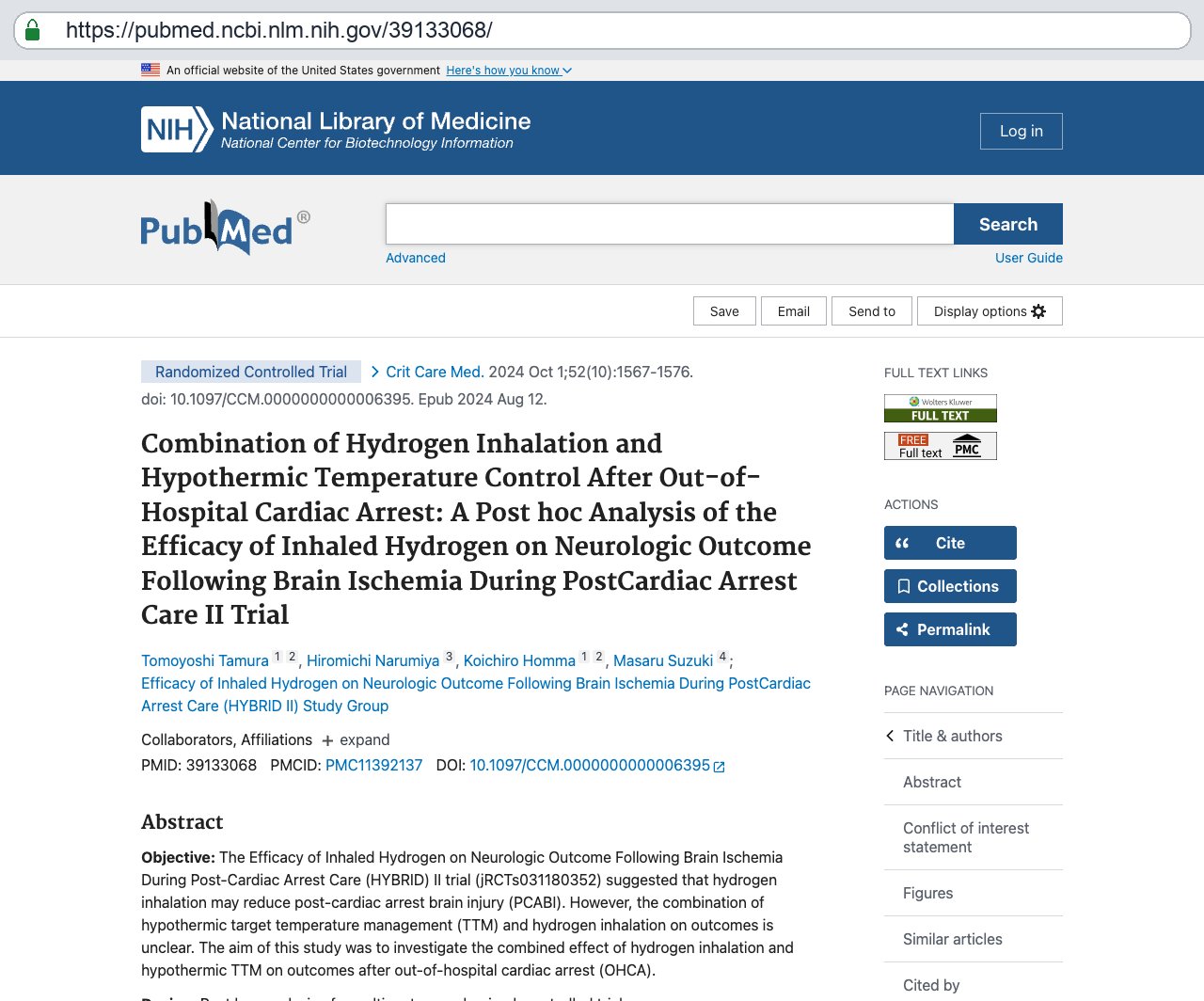
This page mirrors the published abstract (© the authors / publisher) for reference and citation. The canonical source is the PubMed record linked above. This is not medical advice.