2019 · Tao et al. — Molecular hydrogen: current knowledge on mechanism in alleviating free radical damage and diseases.
Super-Abstract
Since molecular hydrogen was identified as a hydroxyl radical scavenger in 2007, beneficial effects have been documented in over 170 disease models and human conditions. This 2019 review by Tao and colleagues systematically maps the current mechanistic understanding of how H₂ exerts its antioxidative, anti-inflammatory, and anti-apoptotic effects — including its protection of mitochondria, the endoplasmic reticulum, and its regulation of intracellular signalling and immune cell balance.
Commentary
Rather than surveying clinical outcomes, this review focuses on the molecular machinery behind H₂'s observed effects. The authors cover selective ROS scavenging (hydroxyl radical, peroxynitrite), modulation of inflammatory cytokines and immune cell subtypes, Nrf2 pathway activation, mitochondrial protection, and endoplasmic reticulum stress responses. The scope is impressively broad — covering ischemia-reperfusion, metabolic syndrome, inflammation, and cancer. Importantly, the paper acknowledges that „it is difficult to construe the molecular mechanism of hydrogen's biomedical effect,“ reflecting genuine scientific humility about what remains unknown. It is purely a review — no new experimental data.
Key quotes
- „the beneficial effect of hydrogen was documented in more than 170 disease models and human diseases including ischemia/reperfusion injury, metabolic syndrome, inflammation, and cancer.“ — the breadth of the H₂ literature as of 2019
- „it is difficult to construe the molecular mechanism of hydrogen's biomedical effect, an increasing number of studies have been helping us draw the picture clearer with days passing by.“ — honest acknowledgement of mechanistic uncertainty alongside cautious optimism
- „We discussed the antioxidative, anti-inflammatory, and anti-apoptosis effects of hydrogen, as well as its protection on mitochondria and the endoplasmic reticulum, regulation of intracellular signaling pathways, and balancing of the immune cell subtypes.“ — the scope of the mechanistic review
Our assessment
This is a comprehensive mechanistic review that provides a well-organised map of the current H₂ research landscape as of 2019. Its honest acknowledgement of mechanistic uncertainty is commendable. Limitations: it is a narrative review and cannot establish clinical efficacy; the enormous breadth (170+ disease models) risks superficiality on any single topic; much of the cited mechanistic data comes from cell and animal studies. The review is a useful orientation document for researchers but cannot be cited as clinical proof of H₂'s benefits in specific human diseases.
Study design
- Type: comprehensive mechanistic narrative review · n: n/a (170+ disease models and human studies synthesised) · H₂ delivery: unspecified (multiple delivery routes across cited studies)
- Mechanisms covered: selective ROS scavenging, anti-inflammatory cytokine modulation, anti-apoptosis, mitochondrial protection, endoplasmic reticulum stress, Nrf2/ARE signalling, immune cell subtype regulation
Abstract
Ever since molecular hydrogen was first reported as a hydroxyl radical scavenger in 2007, the beneficial effect of hydrogen was documented in more than 170 disease models and human diseases including ischemia/reperfusion injury, metabolic syndrome, inflammation, and cancer. All these pathological damages are concomitant with overproduction of reactive oxygen species (ROS) where molecular hydrogen has been widely demonstrated as a selective antioxidant. Although it is difficult to construe the molecular mechanism of hydrogen's biomedical effect, an increasing number of studies have been helping us draw the picture clearer with days passing by. In this review, we summarized the current knowledge on systemic and cellular modulation by hydrogen treatment. We discussed the antioxidative, anti-inflammatory, and anti-apoptosis effects of hydrogen, as well as its protection on mitochondria and the endoplasmic reticulum, regulation of intracellular signaling pathways, and balancing of the immune cell subtypes. We hope that this review will provide organized information that prompts further investigation for in-depth studies of hydrogen effect.
Source & links
Screenshot of the PubMed page
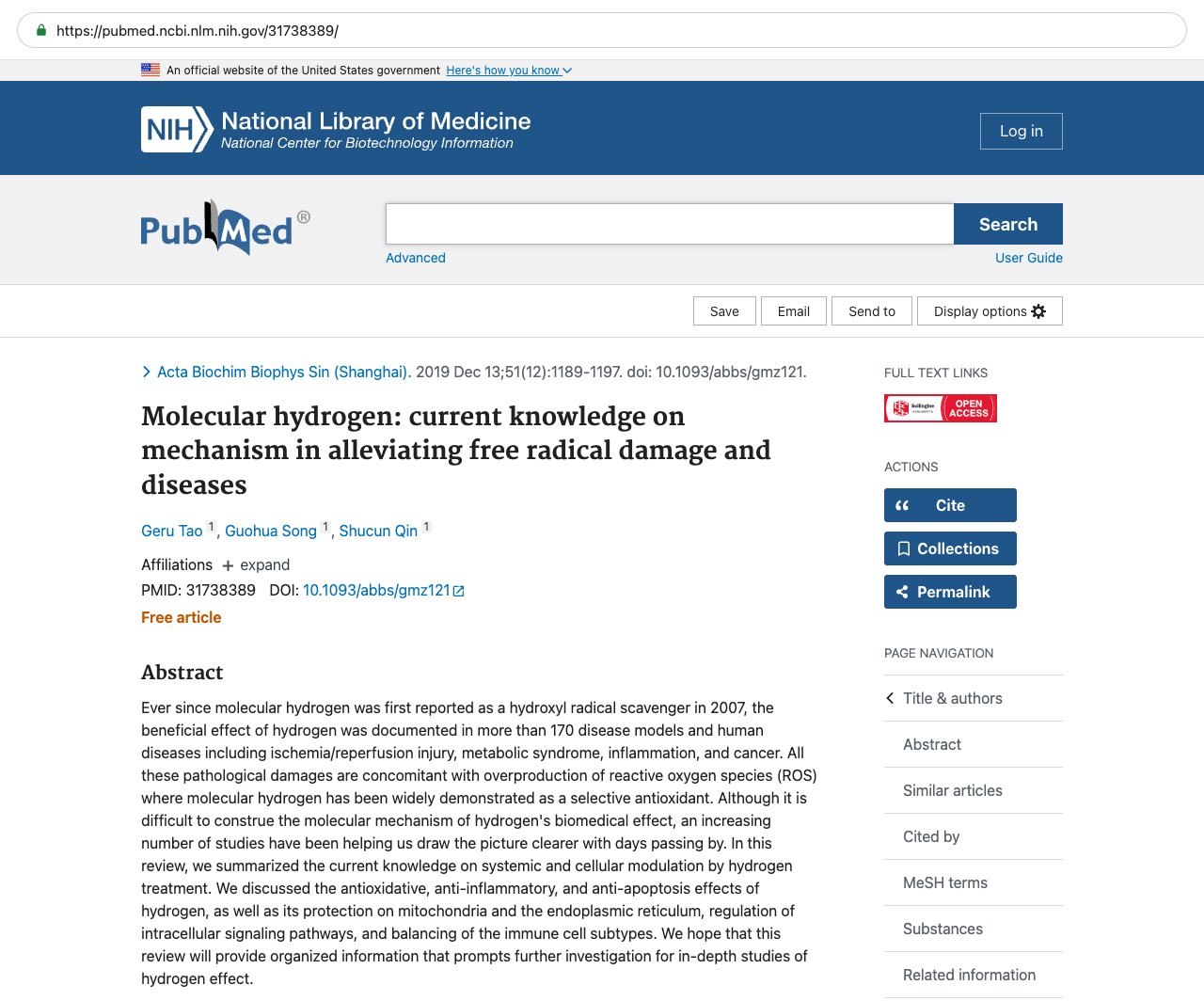
This page mirrors the published abstract (© the authors / publisher) for reference and citation. The canonical source is the PubMed record linked above. This is not medical advice.