2013 Medical gas research Pilot / Observational Human H₂ therapy Saline / IV Kidney / DialysisOxidative stress
2013 · Terawaki et al. — Transperitoneal Administration of Dissolved Hydrogen for Peritoneal Dialysis Patients: A Novel Approach to Suppress Oxidative Stress in the Peritoneal Cavity
Super-Abstract
In six peritoneal dialysis patients, a single test dwell with hydrogen-enriched dialysate left a higher share of reduced albumin, a marker of lower oxidative stress, in the drained fluid than standard dialysate (62.31% compared with 54.70%). Reduced albumin in serum was also higher after the hydrogen dwell (65.75% compared with 62.44%). Per full text, the two tests ran in a fixed order without randomisation, and the abstract gives no p-values. (Medical Gas Research, 2013.)
Commentary
Oxidative stress linked to glucose degradation products is thought to contribute to damage of the peritoneum in peritoneal dialysis, and general antioxidants are limited by harmful effects. Six patients on regular peritoneal dialysis (per full text, all men, mean age 55 years) each underwent a peritoneal equilibration test with standard dialysate and one with hydrogen-enriched dialysate. Per full text, the hydrogen test followed the standard test 2 weeks later, each test used 2 L of 2.5% dextrose dialysate left in the abdomen for 240 minutes, and hydrogen was added by immersing commercial dialysate bags in hydrogen-enriched water for more than 2 hours. The abstract does not give the H₂ concentration of the dialysate. The redox state of albumin in the drained fluid and in blood was measured by high-performance liquid chromatography as the marker of oxidative stress. The abstract does not name a primary endpoint or mention blinding.
Key quotes
- „Mean proportion of reduced albumin (ƒ(HMA)) in effluent was significantly higher in H2-enriched dialysate (62.31 ± 11.10%) than in standard dialysate (54.70 ± 13.08%).“ — the main result in the drained dialysis fluid
- „Likewise, serum ƒ(HMA) after administration of hydrogen-enriched dialysate (65.75 ± 7.52%) was significantly higher than that after standard dialysate (62.44 ± 7.66%).“ — a smaller difference in blood, which the authors read as a systemic effect
- „Trans-peritoneal administration of H2 reduces peritoneal and systemic OS.“ — the authors' conclusion, drawn from one test dwell in six patients
Our assessment
The study shows that hydrogen can be delivered with peritoneal dialysate and that, after one test dwell, the albumin redox marker pointed toward less oxidation in fluid and blood. Limitations: six patients, one dwell per solution, and per full text a fixed order without randomisation and without stated blinding. The abstract gives means and standard deviations but no p-values, and the standard deviations are large compared with the differences. Albumin redox state is a laboratory marker; peritoneal function over time and clinical outcomes were not studied. The abstract does not report adverse events; per full text, blood pressure and heart rate did not differ between the two tests. The conclusion that hydrogen reduces oxidative stress is stated more firmly than a single-dose pilot in six patients can support.
Study design
- Type: pilot study with two tests in the same patients, per full text in fixed order and not randomised · n: 6 · H₂ delivery: hydrogen-enriched peritoneal dialysate, one dwell of 240 minutes (per full text), concentration not given in the abstract
- Comparator: standard dialysate in the same patients, per full text 2 weeks earlier
- Result: reduced albumin in drained fluid 62.31 ± 11.10% vs. 54.70 ± 13.08%, in serum after the test 65.75 ± 7.52% vs. 62.44 ± 7.66%, both reported as significant, no p-values in the abstract
Abstract
BACKGROUND: Oxidative stress (OS) related to glucose degradation products such as methylglyoxal is reportedly associated with peritoneal deterioration in patients treated with peritoneal dialysis (PD). However, the use of general antioxidant agents is limited due to their harmful effects. This study aimed to clarify the influence of the novel antioxidant molecular hydrogen (H2) on peritoneal OS using albumin redox state as a marker. METHODS: Effluent and blood samples of 6 regular PD patients were obtained during the peritoneal equilibrium test using standard dialysate and hydrogen-enriched dialysate. The redox state of albumin in effluent and blood was determined using high-performance liquid chromatography. RESULTS: Mean proportion of reduced albumin (ƒ(HMA)) in effluent was significantly higher in H2-enriched dialysate (62.31 ± 11.10%) than in standard dialysate (54.70 ± 13.08%). Likewise, serum ƒ(HMA) after administration of hydrogen-enriched dialysate (65.75 ± 7.52%) was significantly higher than that after standard dialysate (62.44 ± 7.66%). CONCLUSIONS: Trans-peritoneal administration of H2 reduces peritoneal and systemic OS.
Source & links
Screenshot of the PubMed page
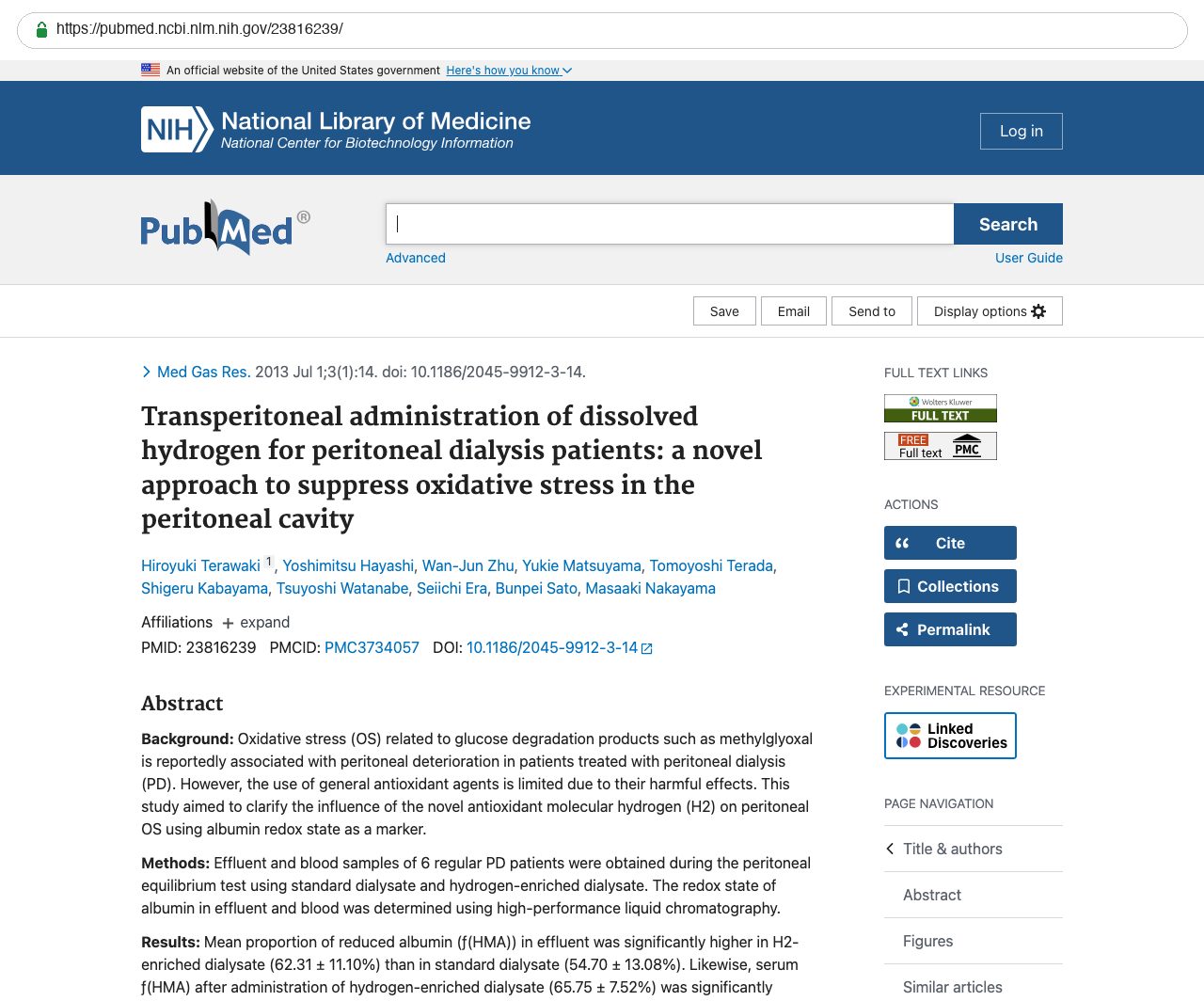
This page mirrors the published abstract (© the authors / publisher) for reference and citation. The canonical source is the PubMed record linked above. This is not medical advice.