2014 Hemodialysis international. International Symposium on Home Hemodialysis Pilot / Observational Human H₂ therapy Saline / IV Kidney / DialysisOxidative stress
2014 · Terawaki et al. — Effect of a Hydrogen (H2)-Enriched Solution on the Albumin Redox of Hemodialysis Patients
Super-Abstract
In eight hemodialysis patients who each had one session with standard and one with hydrogen-enriched dialysis solution, the share of reversibly oxidized albumin fell significantly between dialyzer inlet and outlet only in the hydrogen session. In both sessions, glutathione decreased and hydrogen peroxide increased significantly across the dialyzer. The abstract compares inlet with outlet blood within each session and gives no numbers or p-values for a direct comparison between the two solutions. (Hemodialysis International, 2014.)
Commentary
Oxidative stress is linked to severe cardiovascular disease and premature death in people on hemodialysis, and contact between blood and the dialysis membrane increases it during each session. Eight patients on regular hemodialysis took part in a crossover trial with two dialysis sessions: one with standard solution and one with hydrogen-enriched solution containing a mean of 50 ppb H₂. The abstract does not say whether the order was randomised, whether anyone was blinded or how far apart the sessions were. Blood was drawn from the inlet and outlet of the dialyzer during each session to measure plasma glutathione, hydrogen peroxide and the redox state of albumin, used as the marker of oxidative stress. The abstract does not name a primary endpoint and does not report adverse events. No full text was available for this page.
Key quotes
- „However, the mean proportion of reversibly oxidized albumin in outlet serum was significantly lower than that in inlet serum following the H2-HD session, whereas no significant changes were found in the standard solution session, suggesting that "intra-dialyzer" OS is reduced by H2 -HD.“ — the main finding, based on inlet and outlet blood within each session
- „Comparison of inlet and outlet blood revealed significant decreases in total glutathione and reduced glutathione, as well as significant increases in hydrogen peroxide in both HD treatments.“ — the other oxidative stress markers changed the same way with both solutions
- „In conclusion, the application of H2-enriched solutions could ameliorate OS during HD.“ — the authors' conclusion, phrased as a possibility
Our assessment
The study asks a narrow question: whether hydrogen in the dialysis solution changes albumin oxidation while blood passes through the dialyzer. Albumin oxidation fell across the dialyzer only in the hydrogen session, while glutathione and hydrogen peroxide changed the same way with both solutions. Limitations: eight patients and a single session per solution. PubMed indexes the study as a randomised controlled trial, but the abstract mentions neither randomisation nor blinding. It reports no effect sizes or p-values, and the main result is a within-session comparison of inlet and outlet blood, not a direct test between the two solutions. Albumin redox state is a laboratory marker, and no clinical outcomes were measured. Whether the change persists over repeated sessions is not addressed.
Study design
- Type: crossover trial with two dialysis sessions per patient, randomisation not stated in the abstract · n: 8 · H₂ delivery: hydrogen-enriched dialysis solution, mean 50 ppb H₂, one session
- Comparator: one session with standard dialysis solution in the same patients
- Result: reversibly oxidized albumin significantly lower in outlet than in inlet serum in the hydrogen session, no significant change with standard solution. Total and reduced glutathione decreased and hydrogen peroxide increased significantly in both sessions. No numbers or p-values in the abstract
Abstract
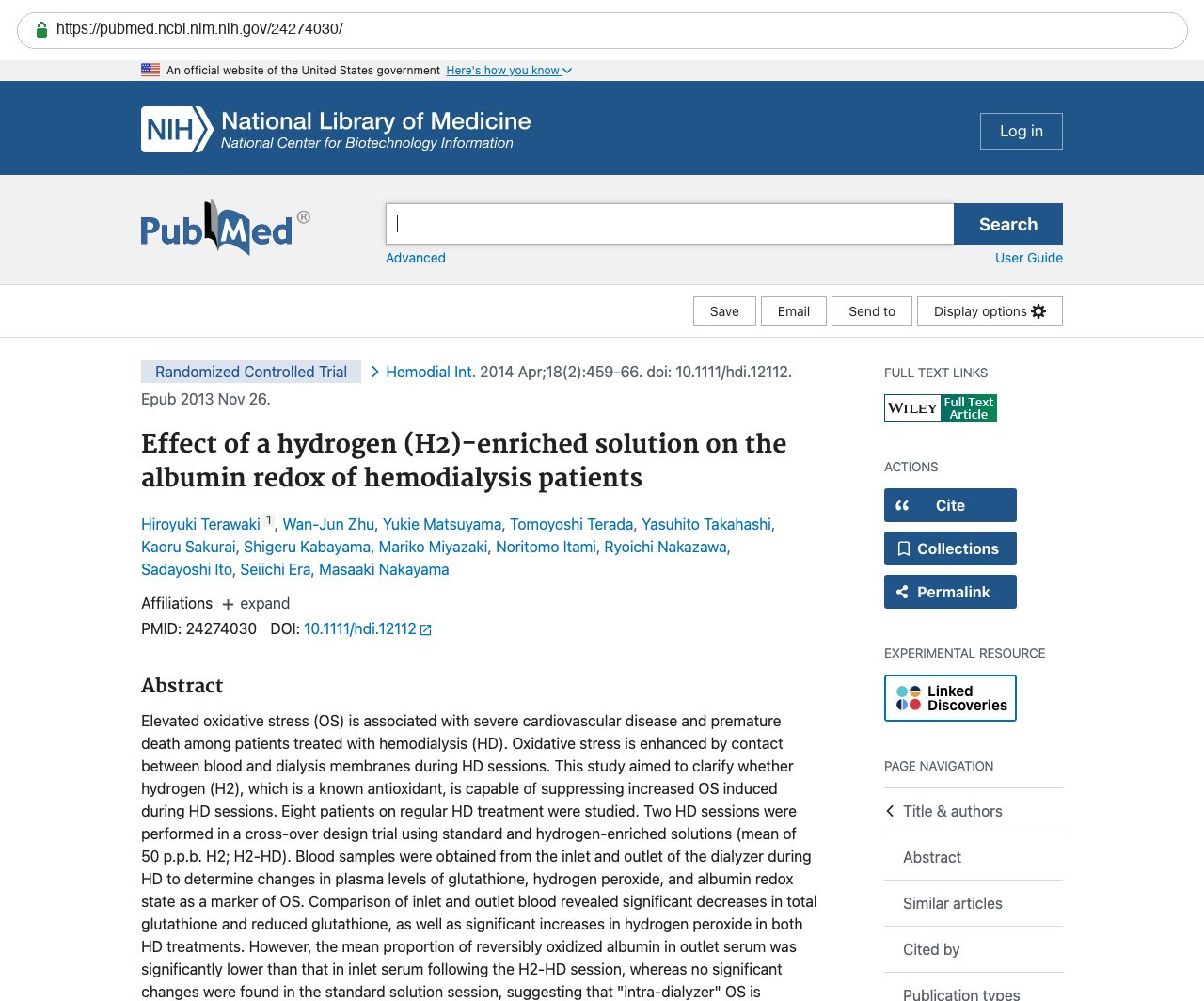
Elevated oxidative stress (OS) is associated with severe cardiovascular disease and premature death among patients treated with hemodialysis (HD). Oxidative stress is enhanced by contact between blood and dialysis membranes during HD sessions. This study aimed to clarify whether hydrogen (H2), which is a known antioxidant, is capable of suppressing increased OS induced during HD sessions. Eight patients on regular HD treatment were studied. Two HD sessions were performed in a cross-over design trial using standard and hydrogen-enriched solutions (mean of 50 p.p.b. H2; H2-HD). Blood samples were obtained from the inlet and outlet of the dialyzer during HD to determine changes in plasma levels of glutathione, hydrogen peroxide, and albumin redox state as a marker of OS. Comparison of inlet and outlet blood revealed significant decreases in total glutathione and reduced glutathione, as well as significant increases in hydrogen peroxide in both HD treatments. However, the mean proportion of reversibly oxidized albumin in outlet serum was significantly lower than that in inlet serum following the H2-HD session, whereas no significant changes were found in the standard solution session, suggesting that "intra-dialyzer" OS is reduced by H2 -HD. In conclusion, the application of H2-enriched solutions could ameliorate OS during HD.
Source & links
Screenshot of the PubMed page
This page mirrors the published abstract (© the authors / publisher) for reference and citation. The canonical source is the PubMed record linked above. This is not medical advice.