2007 · Tovar et al. — A mitosome purification protocol based on percoll density gradients and its use in validating the mitosomal nature of Entamoeba histolytica mitochondrial Hsp70
Super-Abstract
This cell biology study describes a method to isolate „mitosomes“ — highly reduced, hydrogen-independent remnants of mitochondria — from the intestinal parasite Entamoeba histolytica. The paper confirms that a key chaperone protein (Hsp70) resides in these organelles. Molecular hydrogen (H₂) is mentioned only in passing as a criterion that distinguishes mitosomes from hydrogenosomes; there is no therapeutic or health context.
Commentary
Mitochondria-related organelles in anaerobic microorganisms come in two flavours: hydrogenosomes (which produce H₂) and mitosomes (which do not). This distinction is the only point at which molecular hydrogen is relevant in this paper. The study is a methodological contribution to cell biology — it establishes a density-gradient centrifugation protocol to purify E. histolytica mitosomes and then uses immunofluorescence and immunogold electron microscopy to confirm Hsp70 localisation. The parasite's mitosomes are of interest because their function in cellular metabolism remains largely unknown, with only three resident proteins characterised prior to this work. The study adds Hsp70 as a fourth. Nothing in this paper has implications for H₂ supplementation, antioxidant activity, or human health.
Key quotes
- „Their modified mitochondria are known as hydrogenosomes or mitosomes depending on whether or not they produce molecular hydrogen.“ — the only mention of H₂: it distinguishes two types of mitochondria-derived organelles
- „Only three proteins have been shown thus far to reside in these organelles: the molecular chaperones Hsp10 and Hsp60 and an unusual ADP/ATP carrier.“ — prior state of knowledge before this study
- „the mitochondrial-type chaperone Hsp70 is also housed in Entamoeba mitosomes.“ — the paper's key finding
Our assessment
This is a cell biology / parasitology methods paper with no relevance to H₂ as a health intervention. The sole mention of molecular hydrogen is definitional — to distinguish mitosome from hydrogenosome. The study is methodologically rigorous within its domain. It does not provide any evidence regarding H₂ supplementation or biological H₂ effects in humans or mammals.
Study design
- Type: in-vitro / cell biology study · Model: Entamoeba histolytica (intestinal parasite) cell fractionation · H₂ relevance: definitional only (mitosomes do not produce H₂, unlike hydrogenosomes)
- Result: successful mitosome purification via Percoll density gradient; Hsp70 confirmed as a fourth mitosomal resident protein by immunofluorescence and immunogold EM
Abstract
Mitochondria are indispensable for aerobic respiration, but many microbial eukaryotes have lost this function through reductive evolution. Their modified mitochondria are known as hydrogenosomes or mitosomes depending on whether or not they produce molecular hydrogen. The intestinal parasite Entamoeba histolytica contains mitosomes whose role in cellular metabolism is unclear. Only three proteins have been shown thus far to reside in these organelles: the molecular chaperones Hsp10 and Hsp60 and an unusual ADP/ATP carrier. Here we describe the isolation of E. histolytica mitosomes by cellular fractionation and density gradient centrifugation and show that the mitochondrial-type chaperone Hsp70 is also housed in Entamoeba mitosomes.
Source & links
Screenshot of the PubMed page
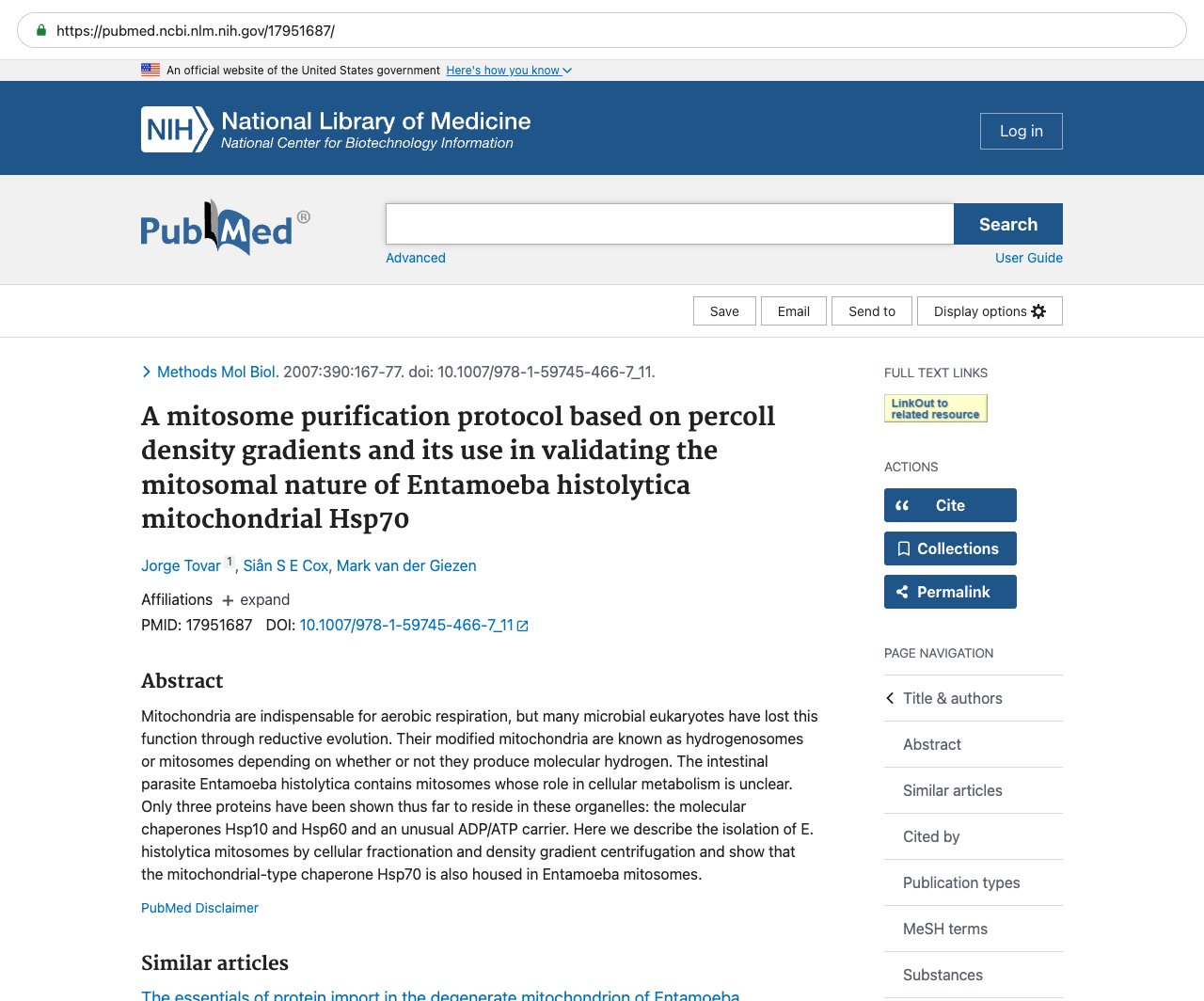
This page mirrors the published abstract (© the authors / publisher) for reference and citation. The canonical source is the PubMed record linked above. This is not medical advice.