2009 · Tsai — Enhanced induction of mitochondrial damage and apoptosis in human leukemia HL-60 cells due to electrolyzed-reduced water and glutathione.
Super-Abstract
This in-vitro study found that electrolyzed-reduced water (ERW) combined with glutathione (GSH) enhanced apoptosis in human leukemia (HL-60) cells, while showing no cytotoxic effect in normal blood cells. The combination upregulated pro-apoptotic Bax and downregulated anti-apoptotic Bcl-2, suggesting a mitochondria-dependent cell death pathway. (Bioscience, Biotechnology, and Biochemistry, 2009.)
Commentary
Electrolyzed-reduced water (ERW) is alkaline water produced by electrolysis that contains dissolved molecular hydrogen. This cell study explores whether ERW has selective toxicity toward cancer cells while sparing normal cells — a property that, if confirmed in vivo, would be highly desirable. The results are intriguing: ERW alone had modest effects, but combined with GSH it substantially enhanced leukemia cell death via apoptosis, without harming peripheral blood mononuclear cells (normal immune cells). The proposed mechanism — modulation of Bax/Bcl-2 via the mitochondrial apoptosis pathway — is consistent with oxidative stress modulation. However, this is a cell culture study only. Cell lines like HL-60 (a lab-adapted leukemia line) do not replicate the complex biology of in vivo tumors, immune systems, or pharmacokinetics. Extrapolation to cancer treatment in living beings would require extensive preclinical and clinical investigation.
Key quotes
- „An enhanced inhibitory effect on the viability of the HL-60 cells was observed after treatment with a combination of ERW with various concentrations of GSH, whereas no cytotoxic effect in normal peripheral blood mononuclear cells was observed.“ — the key selectivity finding: cancer cell death without normal cell toxicity in vitro
- „the induction of HL-60 cell death was caused by the induction of apoptosis through upregulation of Bax and downregulation of Bcl-2.“ — proposed molecular mechanism via the mitochondrial apoptosis pathway
- „ERW, in combination with GSH, has an enhanced apoptosis-inducing effect on HL-60 cells, which might be mediated through the mitochondria-dependent pathway.“ — conclusion — conditional language reflects the in-vitro limitation
Our assessment
This is an in-vitro (cell culture) study — its findings cannot be extrapolated to humans or to cancer treatment. The observed selective toxicity of ERW+GSH toward leukemia cells in a dish is biologically interesting, but the HL-60 cell line is an immortalized lab model far removed from actual human leukemia. No animal experiments or clinical data support these findings. The study is a hypothesis-generating preclinical observation, not evidence for cancer therapy.
Study design
- Type: in-vitro study (cell culture) · Model: human leukemia HL-60 cells; normal peripheral blood mononuclear cells as control · H₂ source: electrolyzed-reduced water (ERW), higher pH / lower ORP
- Result: ERW + GSH combination enhanced apoptosis in HL-60 cells (Bax↑, Bcl-2↓) via mitochondrial pathway; no cytotoxicity in normal blood cells; ERW alone showed antioxidant properties
Abstract
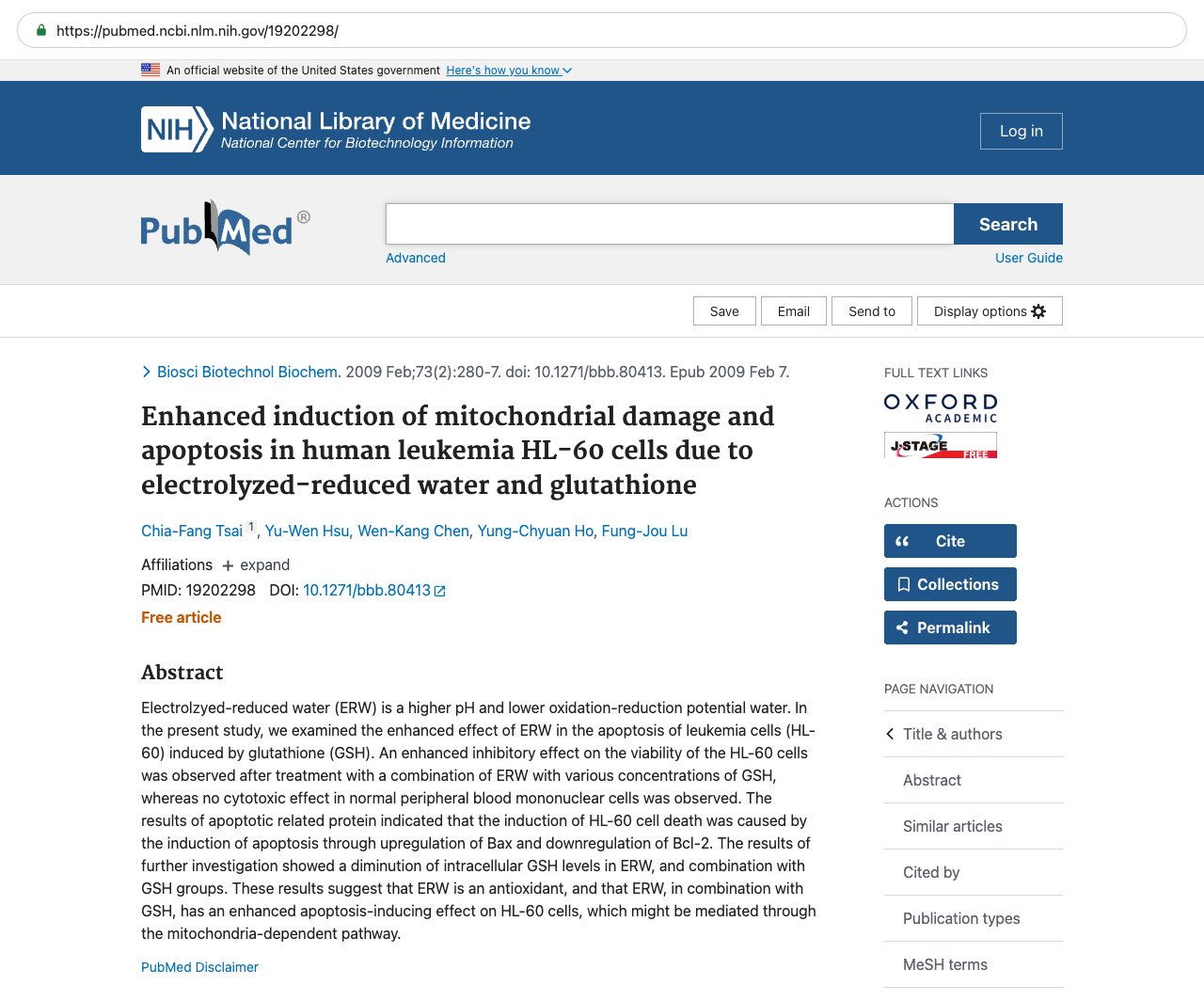
Electrolzyed-reduced water (ERW) is a higher pH and lower oxidation-reduction potential water. In the present study, we examined the enhanced effect of ERW in the apoptosis of leukemia cells (HL-60) induced by glutathione (GSH). An enhanced inhibitory effect on the viability of the HL-60 cells was observed after treatment with a combination of ERW with various concentrations of GSH, whereas no cytotoxic effect in normal peripheral blood mononuclear cells was observed. The results of apoptotic related protein indicated that the induction of HL-60 cell death was caused by the induction of apoptosis through upregulation of Bax and downregulation of Bcl-2. The results of further investigation showed a diminution of intracellular GSH levels in ERW, and combination with GSH groups. These results suggest that ERW is an antioxidant, and that ERW, in combination with GSH, has an enhanced apoptosis-inducing effect on HL-60 cells, which might be mediated through the mitochondria-dependent pathway.
Source & links
Screenshot of the PubMed page
This page mirrors the published abstract (© the authors / publisher) for reference and citation. The canonical source is the PubMed record linked above. This is not medical advice.