2002 · van der Giezen — Conserved properties of hydrogenosomal and mitochondrial ADP/ATP carriers: a common origin for both organelles.
Super-Abstract
Hydrogenosomes — the hydrogen-producing organelles found in certain anaerobic eukaryotes — and mitochondria share the same fundamental ADP/ATP transport machinery, providing strong evidence that both organelles descend from a common ancestor. This in-vitro study demonstrates that the hydrogenosomal ADP/ATP carrier from the anaerobic fungus Neocallimastix can functionally substitute for its mitochondrial counterpart in yeast. (The EMBO Journal, 2002.)
Commentary
This work by van der Giezen and colleagues addresses a long-standing evolutionary question: are hydrogenosomes — organelles that produce molecular hydrogen instead of consuming oxygen — related to mitochondria? The answer from this elegantly designed cross-complementation experiment is clearly yes. The hydrogenosomal ADP/ATP carrier from the fungus Neocallimastix was correctly targeted to yeast mitochondria and restored their function. This is a landmark result in evolutionary cell biology. The connection to H₂ medicine is purely structural: these organelles produce molecular hydrogen as a metabolic byproduct, but this study provides no data relevant to therapeutic hydrogen use in animals or humans.
Key quotes
- „our data demonstrate that fungal hydrogenosomes and yeast mitochondria use the same pathway for ADP/ATP exchange.“ — key finding: identical ADP/ATP transport in both organelles
- „These experiments provide some of the strongest evidence yet that yeast mitochondria and Neocallimastix hydrogenosomes are but two manifestations of the same fundamental organelle.“ — evolutionary conclusion: hydrogenosomes are modified mitochondria
- „the hydrogenosomal protein was correctly targeted to the yeast mitochondria inner membrane and yielded mitochondria able to perform ADP/ATP exchange.“ — functional proof of common ancestry via cross-complementation
Our assessment
This is a basic science paper in evolutionary cell biology — it is not a therapeutic study and provides no evidence for health effects of hydrogen in humans. Its relevance to H₂ medicine is limited to the biological context: it explains the cellular machinery by which some organisms produce molecular hydrogen naturally. The work is methodologically rigorous and was influential in establishing the mitochondrial origin of hydrogenosomes. Readers interested in H₂ therapy will find no clinically applicable findings here.
Study design
- Type: in-vitro molecular biology · Model: Neocallimastix (anaerobic fungus) ADP/ATP carrier expressed in Saccharomyces cerevisiae mitochondria · H₂ relevance: characterisation of organelles that produce molecular H₂
- Result: hydrogenosomal AAC correctly localised to yeast inner mitochondrial membrane; restored ADP/ATP exchange in AAC-deficient yeast; blocked by canonical mitochondrial AAC inhibitors — confirming shared evolutionary origin
Abstract
Mitochondria are one of the hallmarks of eukaryotic cells, exporting ATP in exchange for cytosolic ADP using ADP/ATP carriers (AAC) located in the inner mitochondrial membrane. In contrast, several evolutionarily important anaerobic eukaryotes lack mitochondria but contain hydrogenosomes, peculiar organelles of controversial ancestry that also supply ATP but, like some fermentative bacteria, make molecular hydrogen in the process. We have now identified genes from two species of the hydrogenosome-containing fungus Neocallimastix that have three-fold sequence repeats and signature motifs that, along with phylogenetic analysis, identify them as AACs. When expressed in a mitochondrial AAC- deficient yeast strain, the hydrogenosomal protein was correctly targeted to the yeast mitochondria inner membrane and yielded mitochondria able to perform ADP/ATP exchange. Characteristic inhibitors of mitochondrial AACs blocked adenine nucleotide exchange by the Neocallimastix protein. Thus, our data demonstrate that fungal hydrogenosomes and yeast mitochondria use the same pathway for ADP/ATP exchange. These experiments provide some of the strongest evidence yet that yeast mitochondria and Neocallimastix hydrogenosomes are but two manifestations of the same fundamental organelle.
Source & links
Screenshot of the PubMed page
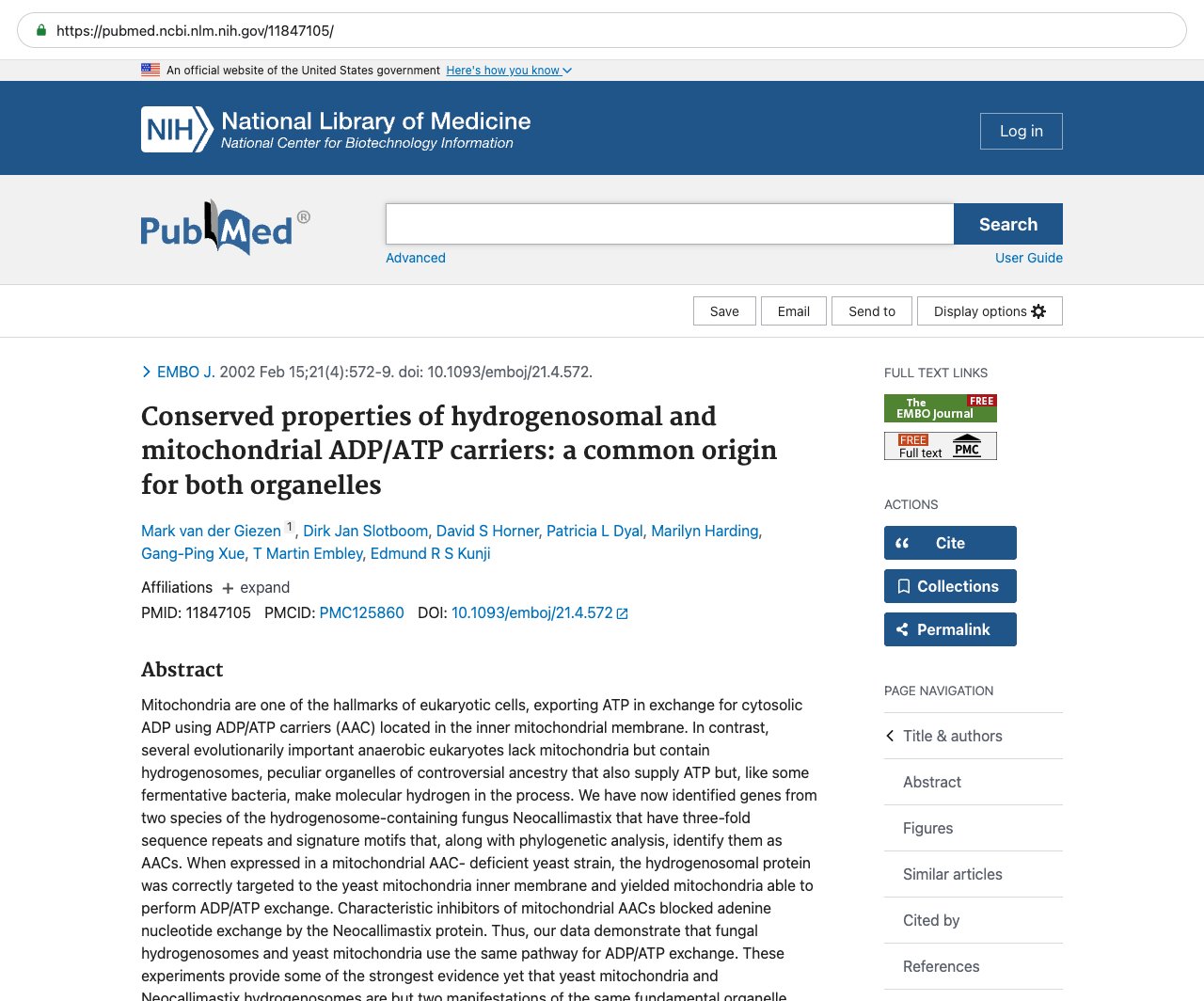
This page mirrors the published abstract (© the authors / publisher) for reference and citation. The canonical source is the PubMed record linked above. This is not medical advice.