2016 · Verghese — Complementary therapies for bladder pain syndrome: a systematic review
Super-Abstract
A systematic review of complementary treatments for bladder pain syndrome identified dietary management, acupuncture, and physical therapy as approaches with the most potential benefit — while hydrogen-rich therapy was among the interventions surveyed. The authors stress that all findings come from small studies, and that large, robust randomised trials are still lacking. (International Urogynecology Journal, 2016.)
Commentary
This systematic review — conducted according to PRISMA guidelines — screened 1,454 citations and identified 11 studies meeting inclusion criteria (4 RCTs, 7 prospective studies). The interventions reviewed included acupuncture, relaxation therapy, physical therapy, hydrogen-rich therapy, dietary management, and nitric oxide synthetase modulation. The review is notable in that it is one of the few systematic evidence summaries to list hydrogen-rich therapy as a studied intervention in this condition. However, the overall quality of evidence was rated low, the included studies were small, and the authors explicitly call for robustly designed multicentre RCTs before any of these approaches can be recommended with confidence. The review does not provide effect sizes or meta-analytic pooling, limiting its informational value beyond a narrative overview.
Key quotes
- „The key interventions studied were acupuncture, relaxation therapy, physical therapy, hydrogen-rich therapy, diet and nitric oxide synthetase.“ — hydrogen-rich therapy appears explicitly in the list of studied interventions
- „Therapies with the potential for benefit in patients with bladder pain syndrome are dietary management, acupuncture and physical therapy.“ — the authors' main conclusion on which approaches showed most promise
- „These findings were obtained from small studies and hence caution is advised. Robustly designed multicentre RCTs on these complementary therapies are needed to guide patients and clinicians.“ — explicit caution: the evidence base remains insufficient for firm recommendations
Our assessment
This is a literature review, not an experiment — it aggregates and narratively describes existing small studies. Hydrogen-rich therapy is mentioned as one of several interventions surveyed, but the review provides no detailed analysis of the hydrogen-specific studies and draws no separate conclusions about it. The overall evidence level for all examined complementary therapies is low. No clinical recommendation for hydrogen therapy in bladder pain syndrome can be derived from this paper. Its value lies in signalling that the topic has entered systematic review literature, and in clearly identifying the need for larger, better-designed trials.
Study design
- Type: systematic review (PRISMA) · n: 11 studies included (4 RCTs, 7 prospective studies) out of 1,454 screened citations · H₂ delivery: hydrogen-rich therapy (details of individual studies not broken out in the review)
- Result: narrative synthesis only; dietary management, acupuncture, and physical therapy identified as having potential benefit; hydrogen-rich therapy listed among surveyed interventions; all findings from small studies; authors call for multicentre RCTs
Abstract
INTRODUCTION AND HYPOTHESIS: Bladder pain syndrome is a difficult condition to treat. The purpose of this systematic review is to assess the effectiveness of various complementary therapies available for treatment. METHODS: This review was conducted in adherence with Preferred Reporting Items for Systematic Reviews. Citations were retrieved using a comprehensive database search (from inception to July 2014: CINAHL, Cochrane, EMBASE, Medline and SIGEL and grey literature). Studies that fulfilled the inclusion criteria were selected. Eligibility consisted of women with bladder pain syndrome, an intervention of alternative/complementary therapies and an outcome of improvement of symptoms. Information regarding study characteristics and primary outcomes was collated. The Cochrane risk of bias scale was used to evaluate the quality of the studies included. RESULTS: A total of 1,454 citations were identified, 11 studies fulfilled the inclusion criteria (4 randomised control trials [RCTs] and 7 prospective studies). The key interventions studied were acupuncture, relaxation therapy, physical therapy, hydrogen-rich therapy, diet and nitric oxide synthetase. CONCLUSION: Therapies with the potential for benefit in patients with bladder pain syndrome are dietary management, acupuncture and physical therapy. These findings were obtained from small studies and hence caution is advised. Robustly designed multicentre RCTs on these complementary therapies are needed to guide patients and clinicians.
Source & links
Screenshot of the PubMed page
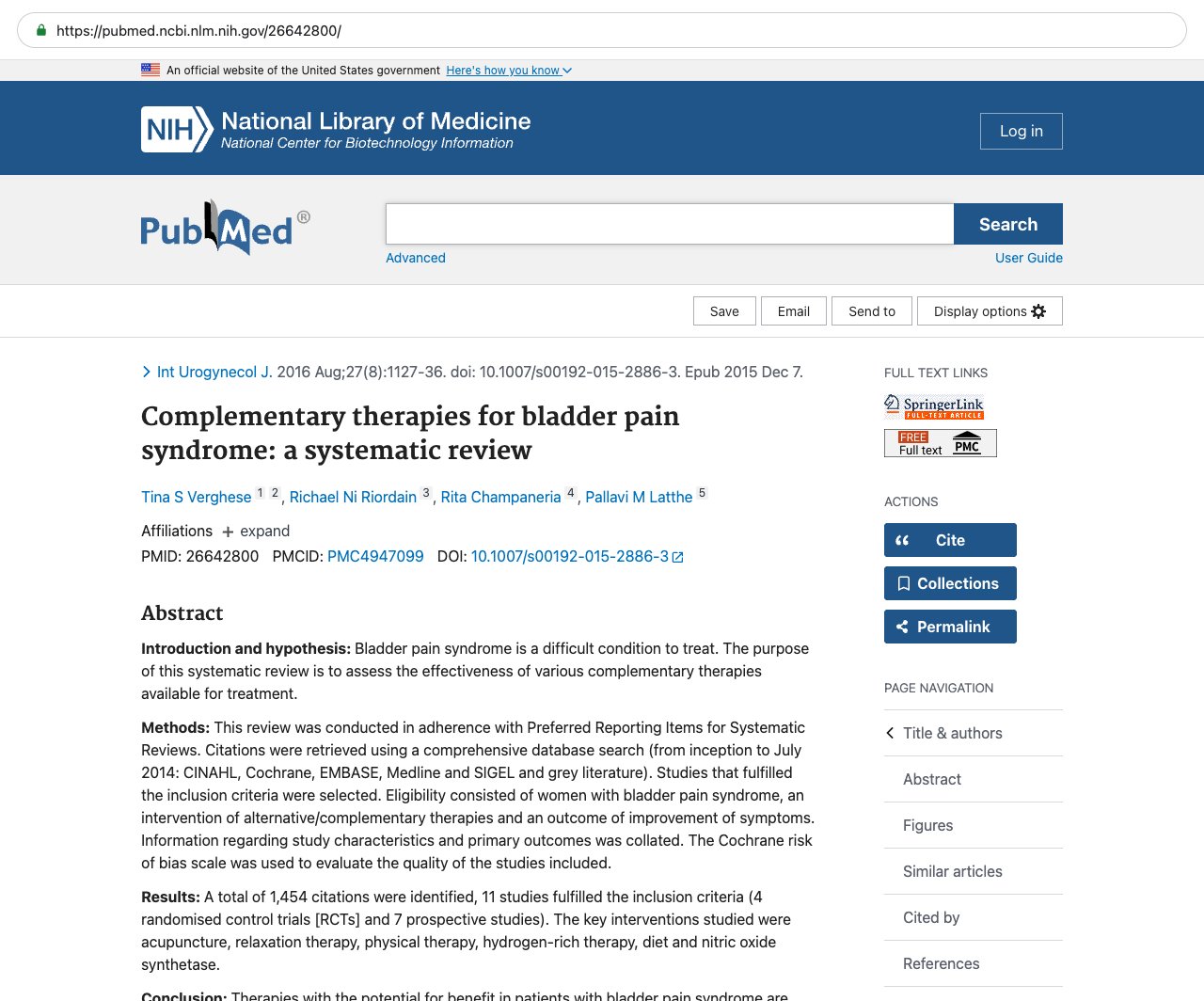
This page mirrors the published abstract (© the authors / publisher) for reference and citation. The canonical source is the PubMed record linked above. This is not medical advice.