2023 · Videhult Pierre — Hydrogen Gas Inhalation Attenuates Acute Impulse Noise Trauma: A Preclinical In Vivo Study
Super-Abstract
In guinea pigs subjected to extremely loud impulse noise (156 dB), inhaling 2% H₂ immediately afterwards significantly reduced hearing threshold shifts and inner ear hair cell loss compared to noise-only controls. This animal study suggests H₂ inhalation may protect against acute acoustic trauma by reducing oxidative stress in the cochlea — but results cannot be directly applied to humans.
Commentary
Acoustic trauma from impulse noise — such as explosions, gunfire, or industrial accidents — causes hearing loss through oxidative damage to cochlear hair cells, and effective post-exposure treatments are limited. This well-designed preclinical study uses a standardized guinea pig model with controlled impulse noise (400 shots at 156 dB SPL) and measures both electrophysiological outcomes (ABR threshold shifts at multiple frequencies) and histological hair cell counts. The 1-hour H₂ inhalation (2 mol%, 500 ml/min) immediately post-noise exposure represents a clinically translatable timeframe and delivery method. The results are consistently positive across frequency bands and hair cell populations, with statistically significant reductions in both threshold elevation and outer/inner hair cell loss in the Noise + H₂ group. The cochlea is a well-established site of H₂-amenable oxidative stress. Limitations include small group sizes (n=10–11 per group), animal-to-human extrapolation challenges, and the short follow-up (4 days), which may not capture long-term recovery or delayed damage.
Key quotes
- „Noise exposure caused ABR threshold elevations at all frequencies (median 35, 35, 30, 35, and 35 dB SPL, the Noise group; 20, 25, 10, 13, and 20 dB SPL, the Noise + H2 group; P < .05) but significantly less so in the Noise + H2 group (P < .05).“ — the main audiological result: H₂ inhalation halved or more the hearing threshold elevation
- „Outer hair cell (OHC) loss was in the apical, mid, and basal regions 8.8%, 53%, and 14% in the Noise group and 3.5%, 22%, and 1.2% in the Noise + H2 group.“ — hair cell loss data: H₂ group showed substantially less cochlear cell death
- „Acute acoustic trauma can be reduced by H2 when inhaled immediately after impulse noise exposure.“ — the authors' conclusion — limited to animal model findings
Our assessment
This is a preclinical animal study (guinea pigs). The results are consistently positive and the study design is rigorous for an animal model, with appropriate controls and multi-frequency ABR measurements. These findings cannot be directly applied to human acoustic trauma prevention or treatment. The guinea pig cochlea responds similarly to humans in some respects but not all. Human studies with H₂ inhalation for noise-induced hearing loss are currently absent. The 4-day follow-up is short for assessing long-term hearing recovery. This study provides a solid preclinical rationale for further investigation, including human trials.
Study design
- Type: preclinical in-vivo animal study · Model: guinea pigs (n=26); Noise group n=11, Noise+H₂ n=10, H₂-only n=5 · H₂ delivery: gas inhalation (2 mol% H₂, 500 ml/min, 1 hour, immediately post-noise exposure)
- Noise stimulus: 400 impulses at 156 dB SPL, 0.33/s
- Result: ABR threshold elevations significantly lower in Noise+H₂ group at all frequencies (p<0.05); OHC loss reduced from 8.8/53/14% to 3.5/22/1.2% (apical/mid/basal); IHC loss reduced from 0.1/14/3.5% to 0/2.8/0%
Abstract
OBJECTIVE: Molecular hydrogen (H2) has shown therapeutic potential in several oxidative stress-related conditions in humans, is well-tolerated, and is easily administered via inhalation.The aim of this preclinical in vivo study was to investigate whether impulse noise trauma can be prevented by H2 when inhaled immediately after impulse noise exposure. METHODS: Guinea pigs (n = 26) were subjected to impulse noise (n = 400; 156 dB SPL; 0.33/s; n = 11; the Noise group), to impulse noise immediately followed by H2 inhalation (2 mol%; 500 ml/min; 1 hour; n = 10; the Noise + H2 group), or to H2 inhalation (n = 5; the H2 group). The acoustically evoked ABR threshold at 3.15, 6.30, 12.5, 20.0, and 30.0 kHz was assessed before and 4 days after impulse noise and/or H2 exposure. The cochleae were harvested after the final ABR assessment for quantification of hair cells. RESULTS: Noise exposure caused ABR threshold elevations at all frequencies (median 35, 35, 30, 35, and 35 dB SPL, the Noise group; 20, 25, 10, 13, and 20 dB SPL, the Noise + H2 group; P < .05) but significantly less so in the Noise + H2 group (P < .05). Outer hair cell (OHC) loss was in the apical, mid, and basal regions 8.8%, 53%, and 14% in the Noise group and 3.5%, 22%, and 1.2% in the Noise + H2 group. The corresponding inner hair cell (IHC) loss was 0.1%, 14%, and 3.5% in the Noise group and 0%, 2.8%, and 0% in the Noise + H2 group. The difference between the groups was significant in the basal region for OHCs (P = .003) and apical (P = .033) and basal (P = .048) regions for IHCs. CONCLUSIONS: Acute acoustic trauma can be reduced by H2 when inhaled immediately after impulse noise exposure.
Source & links
Screenshot of the PubMed page
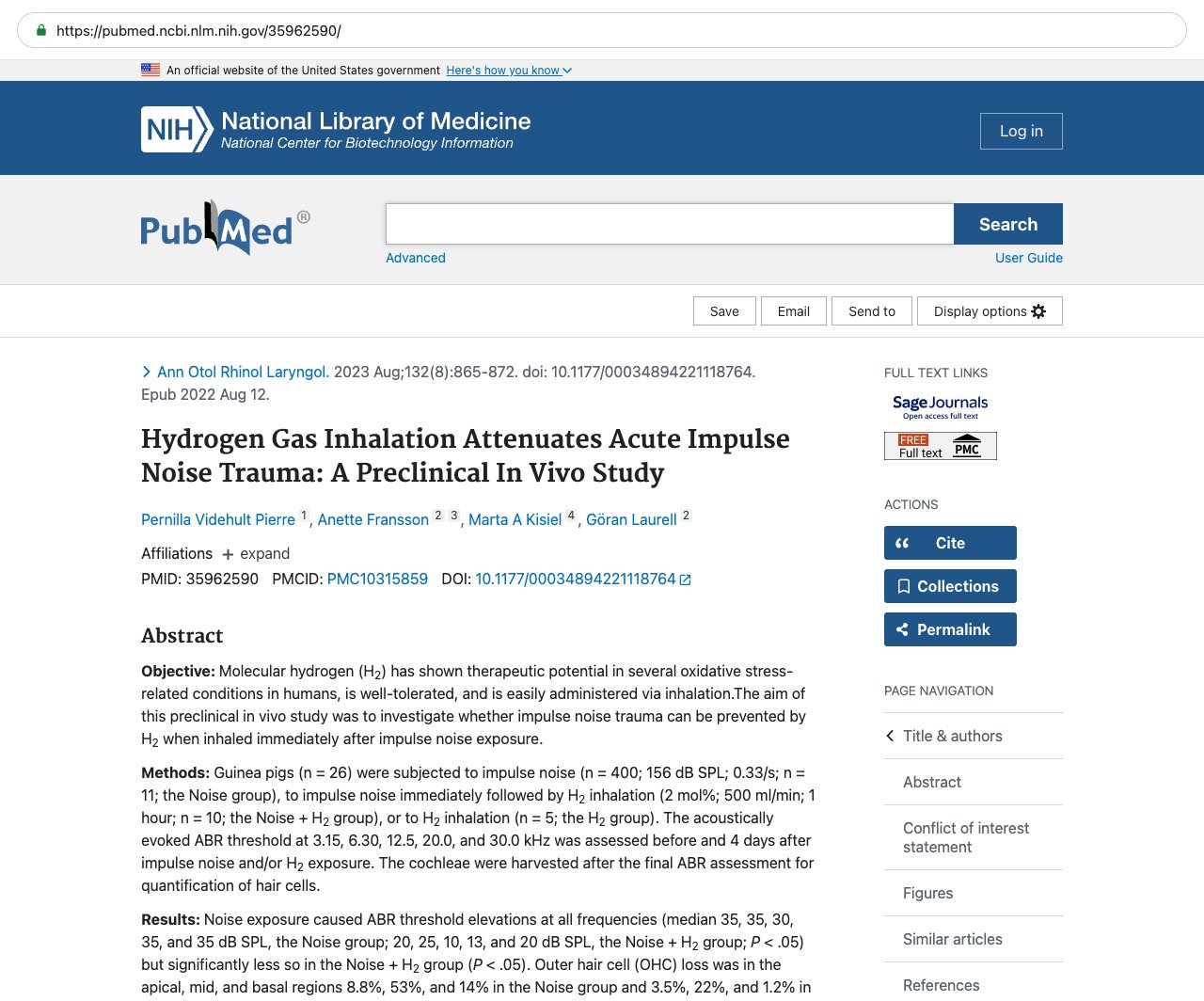
This page mirrors the published abstract (© the authors / publisher) for reference and citation. The canonical source is the PubMed record linked above. This is not medical advice.