2024 The World Allergy Organization journal Pilot / Observational Human H₂ therapy Inhalation AllergyRespiratory / COVID
2024 · Wang et al. — Hydrogen Inhalation: A Novel Approach to Alleviating Allergic Rhinitis Symptoms by Modulating Nasal Flora
Super-Abstract
In patients with allergic rhinitis, symptom scores (VAS and TNSS), blood eosinophil count and IgE improved significantly after a course of hydrogen inhalation, in a before-and-after comparison without an untreated or placebo group. No adverse reactions occurred during or after inhalation. Per full text, 30 patients inhaled a gas with 66.6% hydrogen for 3 hours a day over 4 weeks, and the quality of life questionnaire (RQLQ) did not change significantly (P = 0.692), a result the abstract leaves out. Nasal bacteria shifted after inhalation, but without a control group neither these changes nor the symptom changes can be attributed to hydrogen. (World Allergy Organization Journal, 2024.)
Commentary
Allergic rhinitis is driven by a Th2 immune response in the nasal mucosa, and the authors asked whether hydrogen acts on it by changing the nasal bacteria. The study, registered in the Chinese clinical trial registry, measured patients before and after hydrogen inhalation. Per full text, 30 adults with persistent allergic rhinitis (6 men, 24 women, aged 18 to 47) were treated at a rhinology outpatient clinic between April 2022 and July 2023, and 30 healthy people served only as a reference for nasal bacteria and did not inhale hydrogen. Per full text, patients inhaled a gas with 66.6% hydrogen from a hydrogen-oxygen device for 3 hours a day for 4 consecutive weeks. Outcomes were symptom scores (VAS and TNSS), the RQLQ, blood eosinophil count and IgE, and nasal bacteria analysed by 16S rRNA gene sequencing. Allergen sensitisation was tested by skin prick test. The abstract does not name a primary endpoint.
Key quotes
- „There were no adverse reactions during and after hydrogen inhalation in AR patients, with a favorable safety profile and significant improvements in VAS, TNSS, EOS, and IgE (P < 0.05).“ — the main clinical result, from a before-and-after comparison in the same patients
- „Cavity flora 16S rRNA gene sequencing showed higher abundance of Ruminococcus and Erysipelotrichaceae flora in the nasal cavity of AR patients than in normal subjects, and their abundance could be down-regulated after H2 inhalation.“ — the nasal bacteria findings, compared with healthy people and with baseline
- „H2 may improve symptoms in AR patients by modulating the distribution of nasal flora. Trials with larger sample sizes are required to further test this hypothesis.“ — the authors call the bacteria mechanism a hypothesis that needs larger trials
Our assessment
This single-group study compared patients with their own values before treatment. Symptom scores (VAS and TNSS), eosinophil count and IgE were lower after the inhalation course than before it. Without patients who received no hydrogen or a placebo gas, the study cannot show that hydrogen caused these changes. Symptoms can change over time for other reasons, and patients who know they are being treated may report fewer symptoms. The healthy people serve only as a reference for nasal bacteria and did not inhale hydrogen. Per full text, the quality of life score (RQLQ) did not change significantly (P = 0.692). Limitations: one clinic, 30 patients, no randomisation, no placebo, no blinding reported, no primary endpoint named, and no effect sizes in the abstract. Many bacterial groups were compared, which raises the risk of false-positive findings. The link between nasal bacteria and symptoms is a correlation and does not establish a mechanism.
Study design
- Type: single-group before-and-after study at one outpatient clinic, not randomised, no placebo, blinding not reported; healthy reference group for nasal bacteria only · n: 30 patients with allergic rhinitis and 30 healthy people (per full text) · H₂ delivery: inhaled gas with 66.6% hydrogen, 3 hours a day for 4 weeks (per full text)
- Comparator: the same patients before inhalation; healthy people without inhalation as a reference for nasal bacteria
- Result: VAS, TNSS, eosinophil count and IgE improved (P < 0.05; per full text P = 0.005, 0.003, 0.002 and 0.013). RQLQ not significantly changed per full text (P = 0.692). No adverse reactions. Ruminococcus and Erysipelotrichaceae lower and Blautia_faecis higher after inhalation
Abstract
BACKGROUND: Allergic rhinitis (AR) is an allergic reaction dominated by the Th2 immune response in the nasal mucosa. The bacterial infection process affects the balance between Th1 and Th2 immune responses, and the level of exposure to environmental flora is closely related to the development of AR. Hydrogen (H2) is a medical molecule with anti-inflammatory and antioxidant properties. This study aimed to explore the possible mechanism of action of H2 on AR through its ability to regulate the balance of nasal flora. METHODS: Serum eosinophil count (EOS), immunoglobulin E (IgE) concentration, visual analog scale (VAS), total nasal symptom score (TNSS), and rhinoconjunctivitis quality of life questionnaire (RQLQ) were observed before and after hydrogen inhalation in AR patients. Skin prick test (SPT) was used to determine allergen sensitisation. Community composition and relative abundance of nasal flora were examined before and after hydrogen inhalation and in normal subjects using 16S rRNA gene sequencing. RESULTS: There were no adverse reactions during and after hydrogen inhalation in AR patients, with a favorable safety profile and significant improvements in VAS, TNSS, EOS, and IgE (P < 0.05). Cavity flora 16S rRNA gene sequencing showed higher abundance of Ruminococcus and Erysipelotrichaceae flora in the nasal cavity of AR patients than in normal subjects, and their abundance could be down-regulated after H2 inhalation. H2 significantly increased the abundance of Blautia_faecis and negatively correlated with VAS, TNSS, EOS, and IgE. CONCLUSIONS: H2 may improve symptoms in AR patients by modulating the distribution of nasal flora. Trials with larger sample sizes are required to further test this hypothesis. TRIAL REGISTRATION: This trial was registered in the China Clinical Trial Registry (Registration No. ChiCTR2200062253).
Source & links
Screenshot of the PubMed page
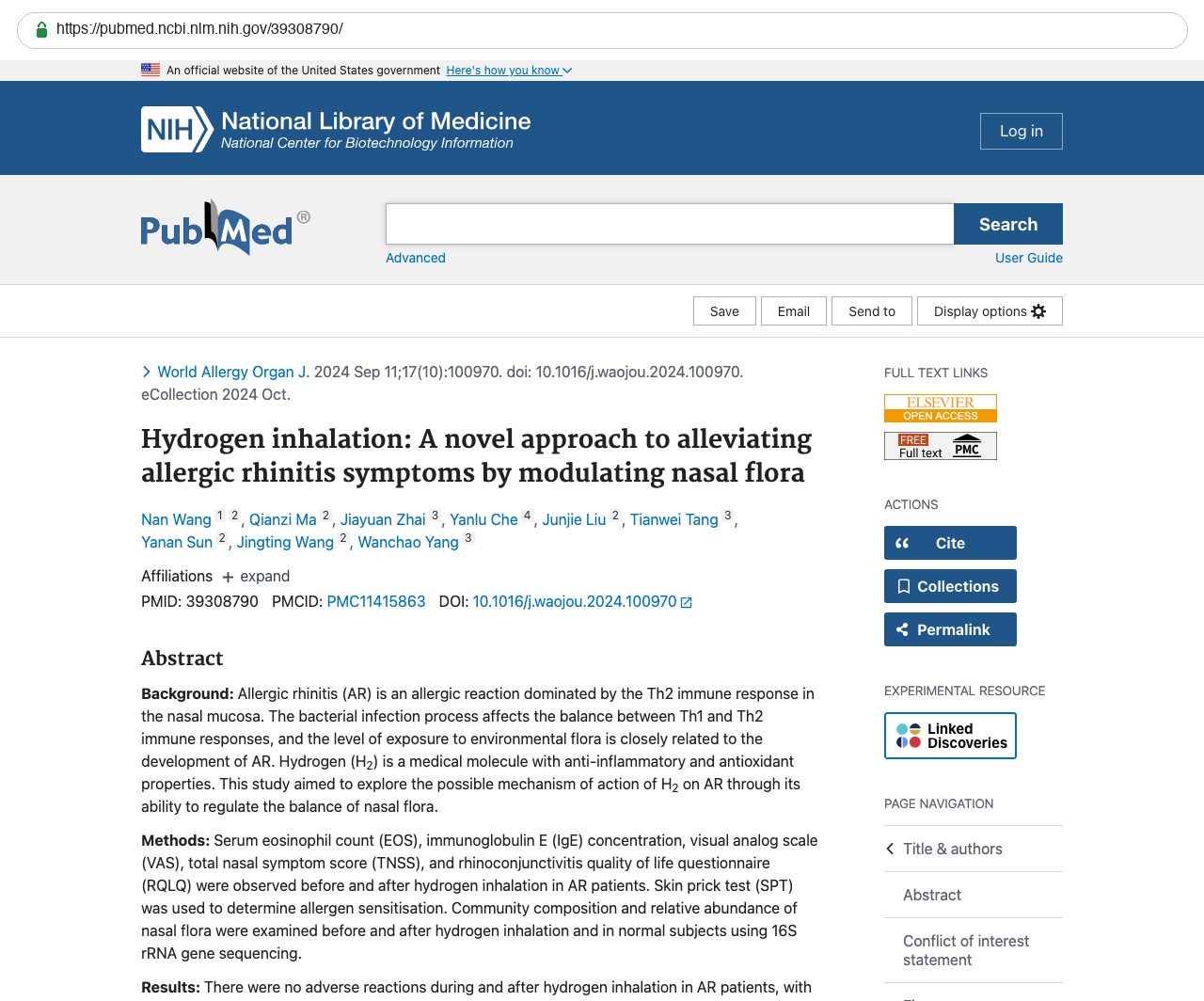
This page mirrors the published abstract (© the authors / publisher) for reference and citation. The canonical source is the PubMed record linked above. This is not medical advice.