2021 · Zheng et al. — Hydrogen/Oxygen Therapy for the Treatment of an Acute Exacerbation of Chronic Obstructive Pulmonary Disease: Results of a Multicenter, Randomized, Double-Blind, Parallel-Group Controlled Trial
Super-Abstract
In a randomised, double-blind trial at 10 centres, patients with an acute exacerbation of COPD who inhaled a hydrogen/oxygen mixture had a larger drop in symptom score (BCSS) at day 7 than those given oxygen alone (−5.3 compared with −2.4 points). The difference of −2.75 points met the trial's criterion for superiority, and the Cough Assessment Test score also fell more with hydrogen/oxygen. Lung function, arterial blood gases and oxygen saturation did not differ significantly between groups. Adverse events were reported in 63.0% of the hydrogen/oxygen group and 77.8% of the oxygen group. (Respiratory Research, 2021.)
Commentary
The trial asked whether a hydrogen/oxygen mixture relieves symptoms better than oxygen in acute exacerbation of chronic obstructive pulmonary disease (AECOPD). Ten centres enrolled patients with AECOPD and a score of at least 6 points on the Breathlessness, Cough and Sputum Scale (BCSS). Patients were randomly assigned 1:1 to the hydrogen/oxygen mixture or to oxygen therapy, and the trial was double-blind. The primary endpoint was the change in BCSS score from baseline to day 7. Other measures reported in the abstract are the Cough Assessment Test score, pulmonary function, arterial blood gas and noninvasive oxygen saturation. Adverse events were recorded for safety. The abstract does not give the number of patients, the hydrogen-to-oxygen ratio, the flow rate or the daily duration of inhalation. According to the full text (PMC8120708), 108 patients were randomised (54 per group) and 107 were analysed. The trial was registered retrospectively (NCT04000451).
Key quotes
- „Change of BCSS score in Hydrogen/oxygen group was larger than that in Oxygen group (- 5.3 vs. - 2.4 point; difference: - 2.75 [95% CI - 3.27 to - 2.22], meeting criteria for superiority).“ — the primary endpoint: a larger symptom improvement with hydrogen/oxygen at day 7
- „Changes in pulmonary function, arterial blood gas and noninvasive oxygen saturation did not differ significantly between groups as well as other endpoints.“ — the objective measures showed no significant difference between the groups
- „The trial demonstrated that hydrogen/oxygen therapy is superior to oxygen therapy in patient with AECOPD with acceptable safety and tolerability profile.“ — the authors' conclusion, based on the symptom score at day 7
Our assessment
This is a multicentre, randomised, double-blind trial with a predefined primary endpoint. The primary endpoint favoured hydrogen/oxygen over oxygen by 2.75 points on the BCSS at day 7, with a confidence interval that did not cross zero. The benefit appears in symptom scores only: lung function, blood gases and oxygen saturation did not differ between the groups. Limitations: the abstract does not state the gas composition or the length of treatment (the full text gives 108 randomised patients). Both symptom scores rely on patients' reports, so the result depends on blinding working, and the abstract does not describe how blinding was achieved. Follow-up in the abstract covers the first week, so longer-term effects are not addressed. Adverse events were less frequent with hydrogen/oxygen (63.0% vs. 77.8%), but the abstract gives no statistical test for this difference. The trial was registered only retrospectively.
Study design
- Type: prospective, multicentre (10 centres), randomised, double-blind, parallel-group controlled trial · n: 108 randomised, 107 analysed (per full text) · H₂ delivery: inhaled hydrogen/oxygen mixture (ratio, flow and duration not stated)
- Comparator: oxygen therapy
- Result: change in BCSS at day 7 (primary) −5.3 vs. −2.4 points, difference −2.75 (95% CI −3.27 to −2.22), superiority criterion met. Similar results from day 2 to day 6. Cough Assessment Test −11.00 vs. −6.00 (p below 0.001). Pulmonary function, arterial blood gas and oxygen saturation: no significant difference. Adverse events 34 (63.0%) vs. 42 (77.8%), no deaths and no equipment defects
Abstract
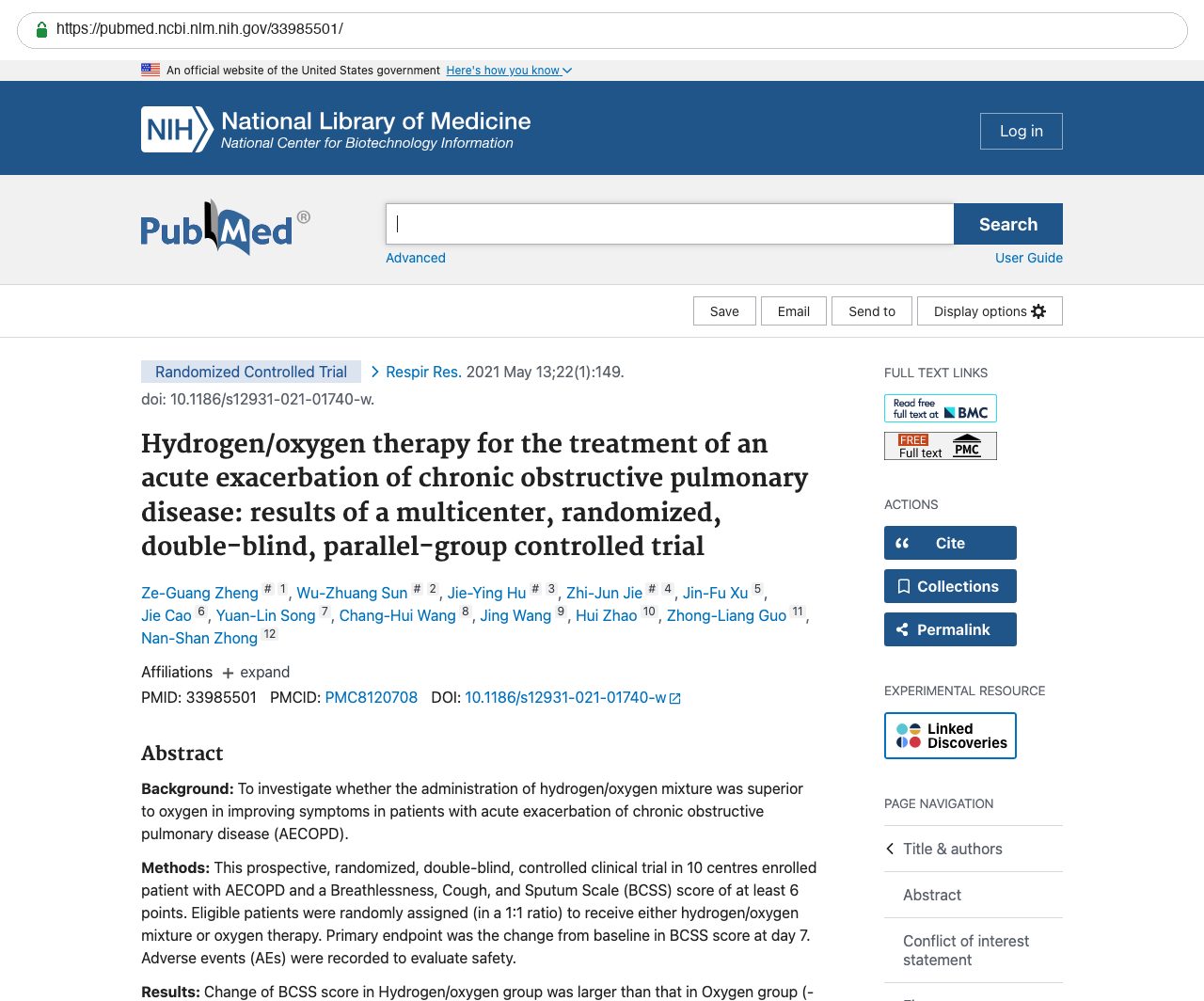
BACKGROUND: To investigate whether the administration of hydrogen/oxygen mixture was superior to oxygen in improving symptoms in patients with acute exacerbation of chronic obstructive pulmonary disease (AECOPD). METHODS: This prospective, randomized, double-blind, controlled clinical trial in 10 centres enrolled patient with AECOPD and a Breathlessness, Cough, and Sputum Scale (BCSS) score of at least 6 points. Eligible patients were randomly assigned (in a 1:1 ratio) to receive either hydrogen/oxygen mixture or oxygen therapy. Primary endpoint was the change from baseline in BCSS score at day 7. Adverse events (AEs) were recorded to evaluate safety. RESULTS: Change of BCSS score in Hydrogen/oxygen group was larger than that in Oxygen group (- 5.3 vs. - 2.4 point; difference: - 2.75 [95% CI - 3.27 to - 2.22], meeting criteria for superiority). Similar results were observed in other time points from day 2 through day 6. There was a significant reduction of Cough Assessment Test score in Hydrogen/oxygen group compared to control (- 11.00 vs. - 6.00, p < 0.001). Changes in pulmonary function, arterial blood gas and noninvasive oxygen saturation did not differ significantly between groups as well as other endpoints. AEs were reported in 34 (63.0%) patients in Hydrogen/oxygen group and 42 (77.8%) in Oxygen group. No death and equipment defects were reported during study period. CONCLUSIONS: The trial demonstrated that hydrogen/oxygen therapy is superior to oxygen therapy in patient with AECOPD with acceptable safety and tolerability profile. TRIAL REGISTRATION: Name of the registry: U.S National Library of Medicine Clinical Trials; Trial registration number: NCT04000451; Date of registration: June 27, 2019-Retrospectively registered; URL of trial registry record: https://www.clinicaltrials.gov/ct2/show/study/NCT04000451?term=04000451&draw=2&rank=1 .
Source & links
Screenshot of the PubMed page
This page mirrors the published abstract (© the authors / publisher) for reference and citation. The canonical source is the PubMed record linked above. This is not medical advice.