2023 · Wu — Ultrasound-Driven Piezoelectrocatalytic Immunoactivation of Deep Tumor
Super-Abstract
A novel nanotechnology platform uses ultrasound to drive piezoelectric tin disulfide nanosheets (SSN) to generate H₂ locally inside tumors and simultaneously deplete lactic acid — a dual strategy designed to reactivate immune cells against deep liver tumors in mice. In an orthotopic liver cancer mouse model, this approach achieved complete tumor eradication and 100 % survival. This is an experimental proof-of-concept study in animals; it is not clinical evidence.
Commentary
One fundamental challenge in cancer immunotherapy is the immunosuppressive tumor microenvironment: PD-L1 overexpression keeps cytotoxic CD8⁺ T cells inactive, while excess lactic acid (produced by the Warburg effect) sustains regulatory T cells that further suppress immunity. This study proposes an elegant materials-science solution: piezoelectric SnS nanosheets that, when activated by low-intensity ultrasound, catalyze local H₂ production and simultaneously oxidize lactic acid. The H₂ is hypothesized to downregulate PD-L1, freeing CD8⁺ T cells; lactic acid depletion independently activates those T cells by inhibiting regulatory T cells. The proof-of-concept in an orthotopic mouse liver cancer model is striking (100 % survival, complete eradication), but this is a highly engineered nanomaterial that has not been tested in larger animals or humans. Translation to the clinic would require extensive safety, biodistribution, and efficacy studies.
Key quotes
- „Intratumoral SSN-medicated piezoelectrocatalytically generated H2 liberates effector CD8+ T cells from the immunosuppression of tumor cells through down-regulating PD-L1 over-expression.“ — proposed mechanism: H₂ releases immune cells by reducing PD-L1
- „Simultaneous LA deprivation activates CD8+ T cells by inhibiting regulatory T cells, efficiently co-activating tumor immunity and achieving a high outcome of liver tumor therapy with complete tumor eradication and 100% mice survival.“ — dual mechanism leads to full tumor clearance in mice
- „The proposed strategy of US-driven piezoelectrocatalytic tumor immunoactivation opens a safe and efficient pathway for deep tumor therapy.“ — authors' forward-looking conclusion — animal/proof-of-concept only
Our assessment
This is an experimental proof-of-concept study in mice using a custom-engineered nanomaterial. The results are scientifically exciting but are far from clinical application. H₂ here is generated in situ by a nanomaterial device, not consumed as hydrogen-rich water — this is a fundamentally different delivery modality. The 100 % survival figure must be read in the context of a small, controlled orthotopic mouse model, not human liver cancer. Major translational hurdles remain: safety of SnS nanomaterials, delivery to human tumors, immune effects in immunocompetent humans, etc.
Study design
- Type: animal proof-of-concept study (orthotopic mouse liver cancer model) · n: not specified in abstract · H₂ delivery: in-situ piezoelectrocatalytic generation by SnS nanosheets activated by ultrasound
- Result: complete tumor eradication and 100 % mice survival in orthotopic liver cancer model; mechanistic evidence for PD-L1 downregulation and CD8⁺ T cell activation; lactic acid depletion co-activates anti-tumor immunity
Abstract
Tumor heterogeneity makes routine drugs difficult to penetrate solid tumors, limiting their therapy efficacies. Based on high tissue penetrability of hydrogen molecules (H2 ) and ultrasound (US) and the immunomodulation effects of H2 and lactic acid (LA), this work proposes a novel strategy of US-driven piezoelectrocatalytic tumor immunoactivation for high-efficacy therapy of deep tumors by piezoelectrocatalytic hydrogen generation and LA deprivation. A kind of US-responsive piezoelectric SnS nanosheets (SSN) is developed to realize US-triggered local hydrogen production and simultaneous LA deprivation in deep tumors. The proof-of-concept experiments which are executed on an orthotopic liver cancer model have verified that intratumoral SSN-medicated piezoelectrocatalytically generated H2 liberates effector CD8+ T cells from the immunosuppression of tumor cells through down-regulating PD-L1 over-expression, and simultaneous LA deprivation activates CD8+ T cells by inhibiting regulatory T cells, efficiently co-activating tumor immunity and achieving a high outcome of liver tumor therapy with complete tumor eradication and 100% mice survival. The proposed strategy of US-driven piezoelectrocatalytic tumor immunoactivation opens a safe and efficient pathway for deep tumor therapy.
Source & links
Screenshot of the PubMed page
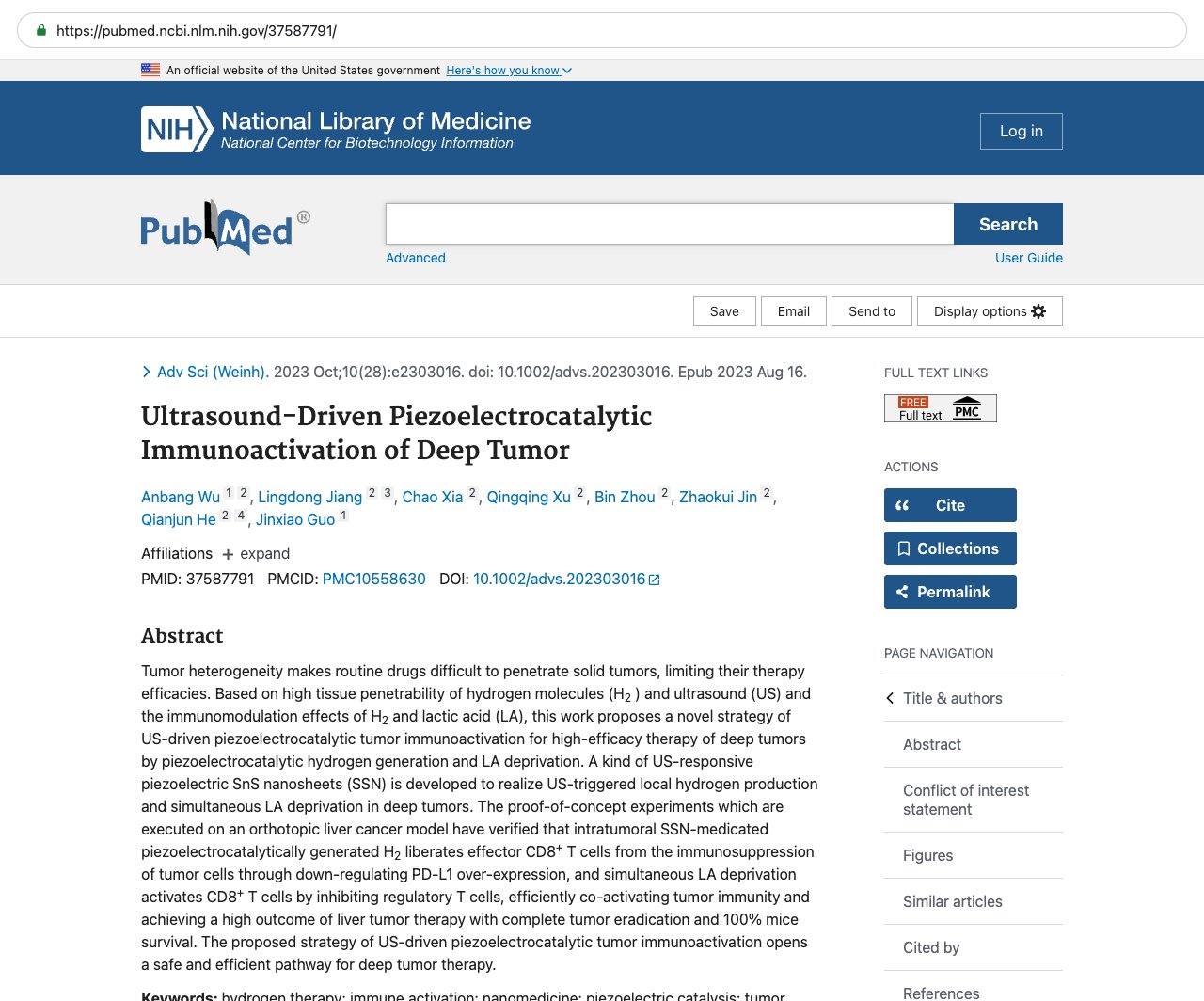
This page mirrors the published abstract (© the authors / publisher) for reference and citation. The canonical source is the PubMed record linked above. This is not medical advice.