2024 · Wu et al. — Effects of Hydrogen-Rich Water on Blood Uric Acid in Patients with Hyperuricemia: A Randomized Placebo-Controlled Trial
Super-Abstract
In a trial with 100 completers with hyperuricemia, blood uric acid fell significantly from 488.2 to 446.8 μmol/L after 8 weeks in the group drinking three bottles of hydrogen-rich water a day, but the abstract reports this change only against baseline, not against placebo. The authors state that the high dose controlled uric acid better than the low dose, without giving numbers for the low-dose or placebo groups. The abstract contains no adverse-event data, although the authors describe hydrogen-rich water as a rather safe agent. (Heliyon, 2024.)
Commentary
Hydrogen-rich water has been reported to have anti-inflammatory and metabolic-modulatory benefits, and this trial asked whether it lowers blood uric acid in people with hyperuricemia. Participants were randomised to three groups. The placebo group drank three 330 mL bottles of ordinary drinking water a day. The low-dose group drank two bottles of hydrogen-rich water (H₂ at least 4.66 mg/L) and one bottle of ordinary water. The high-dose group drank three bottles of hydrogen-rich water a day. Drinking lasted 8 weeks. The primary outcome was blood uric acid at 4 and 8 weeks compared with baseline. A total of 100 participants completed the trial: 32 in the placebo group, 35 in the low-dose group and 33 in the high-dose group. The abstract does not state how many people were randomised, whether participants or staff were blinded, or which other outcomes were measured. The trial was registered in the Chinese Clinical Trial Registry.
Key quotes
- „Following an 8-week period, the High-HRW group exhibited a significant reduction in blood uric acid levels compared to the baseline (488.2 ± 54.1 μmol/L to 446.8 ± 57.1 μmol/L, P < 0.05).“ — the main result, a change within one group from baseline rather than a comparison with placebo
- „The high-dose of HRW was more effective than low-dose HRW in controlling blood uric acid.“ — a dose comparison given without numbers or a p-value in the abstract
- „As a rather safe agent, the prolonged consumption of HRW may be feasible in the management of hyperuricemia.“ — the authors' conclusion, although the abstract reports no adverse-event data
Our assessment
The trial was randomised and placebo-controlled and tested two doses. The reported effect is a change within the high-dose group compared with its own baseline, not a difference from placebo. Without the placebo group's values or a test between groups, the abstract cannot show how much of the fall is due to the water. Limitations: only completers are reported, so the number of dropouts is unknown. Blinding is not mentioned. The trial lasted 8 weeks, and blood uric acid is a laboratory value, not a clinical outcome. The dose comparison is described without numbers. The abstract gives no adverse-event data, so the authors' description of hydrogen-rich water as rather safe is not backed by figures in the abstract.
Study design
- Type: randomised, placebo-controlled trial with three arms, 8 weeks, blinding not stated · n: 100 completers (32 placebo, 35 low dose, 33 high dose), number randomised not reported · H₂ delivery: drinking hydrogen-rich water (H₂ at least 4.66 mg/L), two or three 330 mL bottles a day
- Comparator: three 330 mL bottles of ordinary drinking water a day
- Result: primary outcome (blood uric acid compared with baseline): high-dose group 488.2 ± 54.1 to 446.8 ± 57.1 μmol/L after 8 weeks, P < 0.05. High dose described as more effective than low dose. No comparison with placebo reported
Abstract
BACKGROUND: Consumption of hydrogen-rich water (HRW) has been shown to have anti-inflammatory and metabolic-modulatory benefits. OBJECTIVE: A randomized, placebo-controlled trial was conducted to assess the potential blood uric acid-lowering effects of HRW consumption with different doses (low and high doses) and duration (4 and 8 weeks) in patients with hyperuricemia. METHODS: The Placebo group consumed three bottles of ordinary drinking water (330 mL per bottle), the Low-HRW group consumed two bottles of HRW (330 mL per bottle, H2 ≥ 4.66 mg/L) and a bottle of ordinary water, and the High-HRW group consumed three bottles of HRW daily for 8 weeks. The primary outcome was the blood uric acid levels following different time points (4 and 8 weeks) compared to baseline. RESULTS: A total of 100 participants completed the entire trial (32 in Placebo, 35 in Low-HRW, and 33 in High-HRW groups). The high-dose of HRW was more effective than low-dose HRW in controlling blood uric acid. Following an 8-week period, the High-HRW group exhibited a significant reduction in blood uric acid levels compared to the baseline (488.2 ± 54.1 μmol/L to 446.8 ± 57.1 μmol/L, P < 0.05). CONCLUSION: As a rather safe agent, the prolonged consumption of HRW may be feasible in the management of hyperuricemia. CLINICAL TRIAL REGISTRATION: chictr.org.cn, identifier ChiCTR2200066369.
Source & links
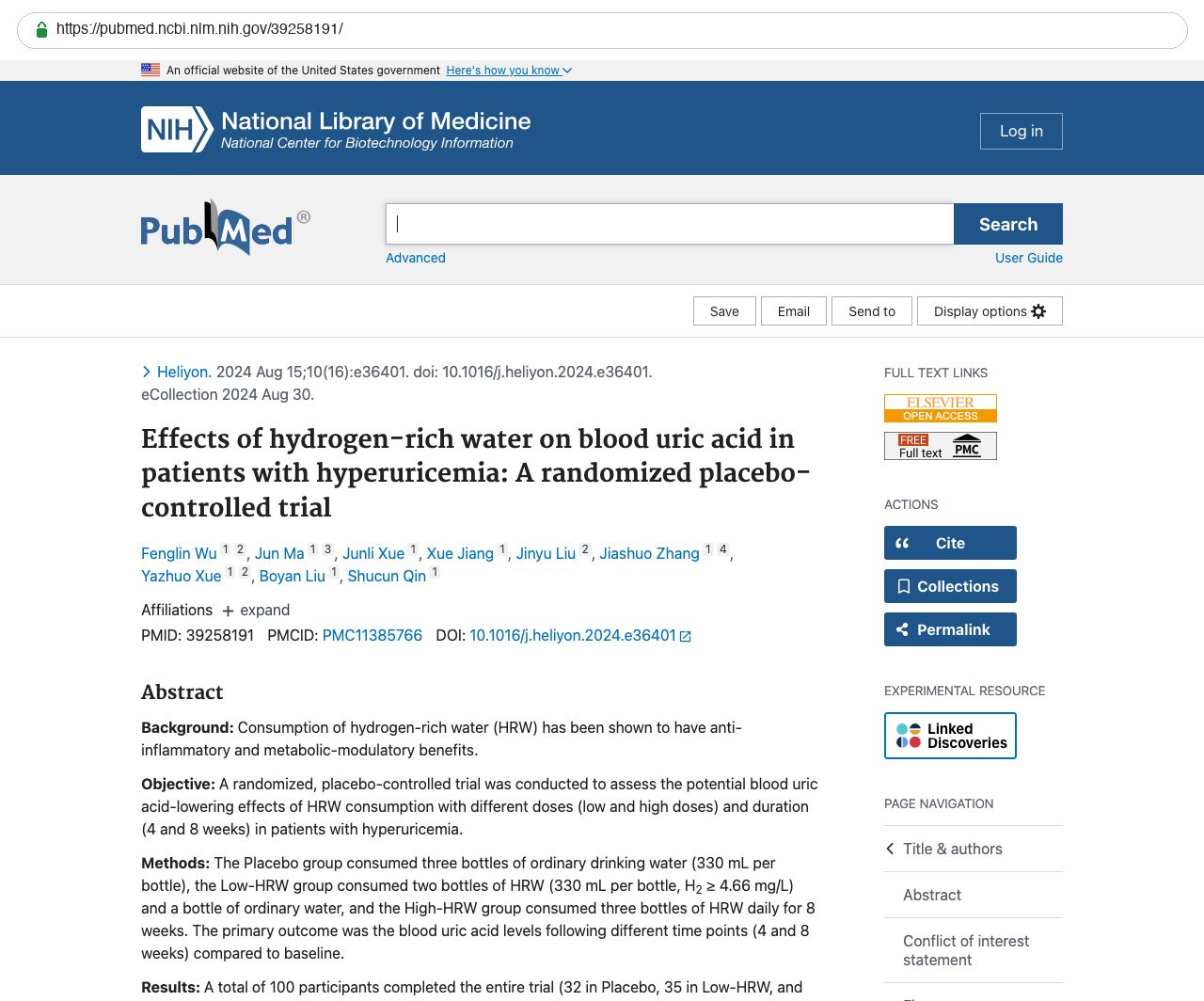
Screenshot of the PubMed page
This page mirrors the published abstract (© the authors / publisher) for reference and citation. The canonical source is the PubMed record linked above. This is not medical advice.