2022 · Kura et al. — Biological Effects of Hydrogen Water on Subjects with NAFLD: A Randomized, Placebo-Controlled Trial
Super-Abstract
In 30 people with non-alcoholic fatty liver disease, eight weeks of hydrogen-rich water produced no statistically significant effects: weight (about 1 kg lower), body mass index, blood lipids and lactate dehydrogenase showed only non-significant trends. Liver enzymes did not change significantly, and the water was well tolerated. Two oxidative damage markers, 8-hydroxy-2'-deoxyguanosine and malondialdehyde, tended to rise slightly in the hydrogen group, also without statistical significance. (Antioxidants, 2022.)
Commentary
According to the abstract, non-alcoholic fatty liver disease (NAFLD) affects around 25% of people worldwide, and oxidative stress and inflammation can contribute to it. In this randomized, double-blind, placebo-controlled trial, 30 subjects with NAFLD drank hydrogen-rich water or a placebo for eight weeks. The abstract does not give the hydrogen concentration, the daily amount, the number of participants per group or a primary endpoint. Measured outcomes included body weight and body mass index, liver enzymes, lipid profile and lactate dehydrogenase, the inflammation- and stress-related proteins nuclear factor kappa B, heat shock protein 70 and matrix metalloproteinase-9, and the oxidative damage markers 8-hydroxy-2'-deoxyguanosine and malondialdehyde. Tolerability was also assessed.
Key quotes
- „Phenotypically, we observed beneficial trends (p > 0.05) in decreased weight (≈1 kg) and body mass index in the HRW group.“ — the main clinical finding: trends without statistical significance
- „HRW was well-tolerated, with no significant changes in liver enzymes and a trend of improved lipid profile and reduced lactate dehydrogenase levels.“ — tolerability and liver enzymes, again without significant changes
- „The favorable trends in this study in conjunction with previous animal and clinical findings suggest that HRW may serve as an important adjuvant therapy for promoting and maintaining optimal health and wellness.“ — the authors' conclusion, which rests on trends and earlier studies rather than on significant results here
Our assessment
This small, randomized, double-blind trial has a null result. None of the reported changes reached statistical significance. Weight, body mass index, lipids, lactate dehydrogenase and the inflammation-related proteins moved in the direction the authors expected, but the trial cannot separate these trends from chance. The authors read the slight rise in 8-hydroxy-2'-deoxyguanosine and malondialdehyde as a possible hormetic effect of hydrogen. The data in the abstract do not test this interpretation. Their conclusion relies on earlier studies more than on this trial. Limitations: 30 participants with no group sizes reported, eight-week duration, hydrogen dose not reported, no primary endpoint named, many outcomes tested, mostly laboratory surrogate markers, and no measure of liver fat reported in the abstract.
Study design
- Type: randomized, double-blind, placebo-controlled trial · n: 30 people with NAFLD (split per group not reported) · H₂ delivery: drinking hydrogen-rich water for eight weeks (concentration and amount not reported)
- Comparator: placebo (not further described)
- Result: no primary endpoint named and no statistically significant effects reported. Non-significant trends: weight about 1 kg lower, lower body mass index, better lipid profile, lower lactate dehydrogenase, lower nuclear factor kappa B, heat shock protein 70 and matrix metalloproteinase-9, slight rise in 8-hydroxy-2'-deoxyguanosine and malondialdehyde. No significant change in liver enzymes, well tolerated
Abstract
Non-alcoholic fatty liver disease (NAFLD) is a liver pathology affecting around 25% of the population worldwide. Excess oxidative stress, inflammation and aberrant cellular signaling can lead to this hepatic dysfunction and eventual carcinoma. Molecular hydrogen has been recognized for its selective antioxidant properties and ability to attenuate inflammation and regulate cellular function. We administered hydrogen-rich water (HRW) to 30 subjects with NAFLD in a randomized, double-blinded, placebo-controlled manner for eight weeks. Phenotypically, we observed beneficial trends (p > 0.05) in decreased weight (≈1 kg) and body mass index in the HRW group. HRW was well-tolerated, with no significant changes in liver enzymes and a trend of improved lipid profile and reduced lactate dehydrogenase levels. HRW tended to non-significantly decrease levels of nuclear factor kappa B, heat shock protein 70 and matrix metalloproteinase-9. Interestingly, there was a mild, albeit non-significant, tendency of increased levels of 8-hydroxy-2’-deoxyguanosine and malondialdehyde in the HRW group. This mild increase may be indicative of the hormetic effects of molecular hydrogen that occurred prior to the significant clinical improvements reported in previous longer-term studies. The favorable trends in this study in conjunction with previous animal and clinical findings suggest that HRW may serve as an important adjuvant therapy for promoting and maintaining optimal health and wellness. Longer term studies focused on prevention, maintenance, or treatment of NAFLD and early stages of NASH are warranted.
Source & links
Screenshot of the PubMed page
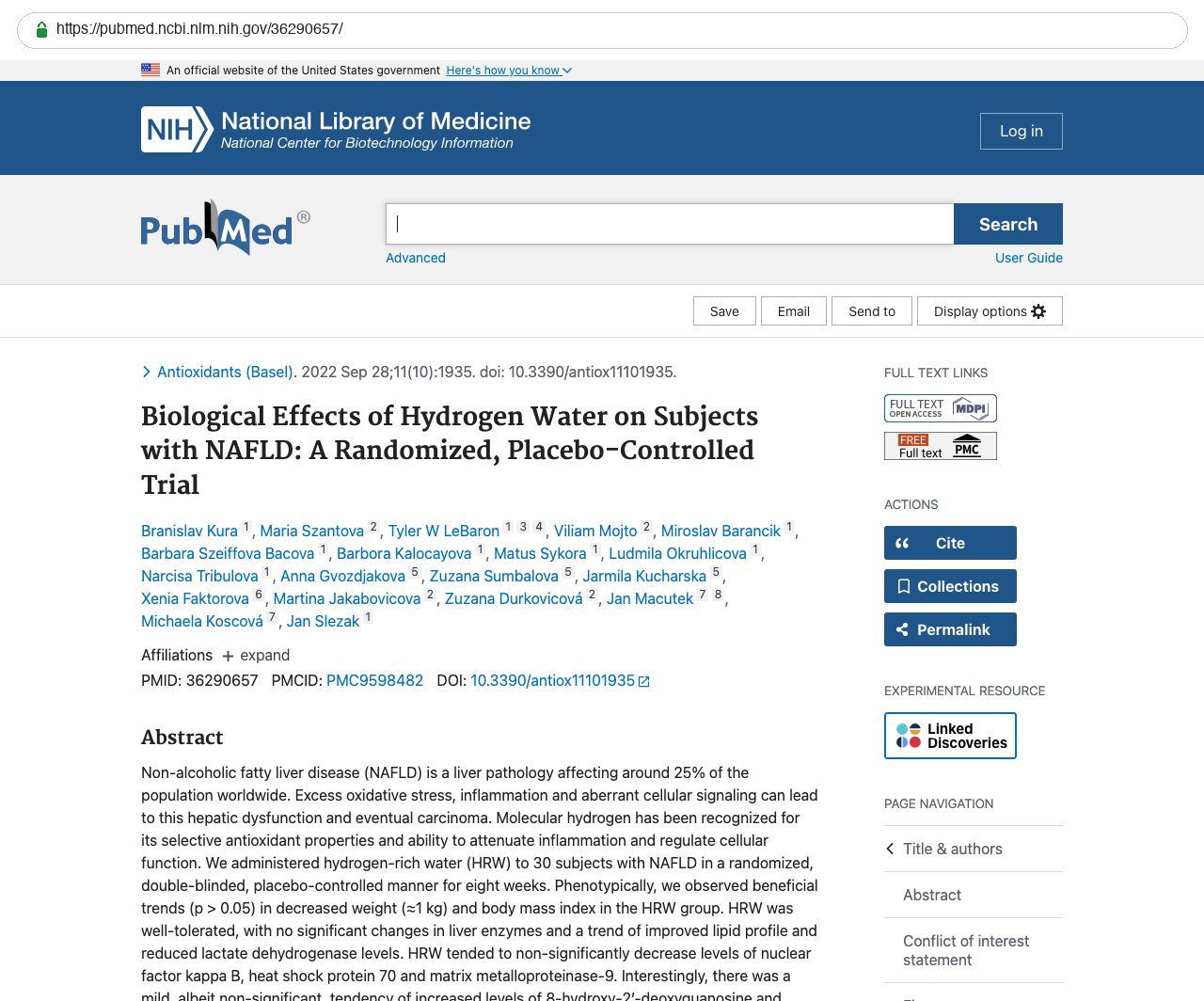
This page mirrors the published abstract (© the authors / publisher) for reference and citation. The canonical source is the PubMed record linked above. This is not medical advice.