2024 Antioxidants (Basel, Switzerland) RCT Human H₂ therapy Drinking (HRW) MetabolicOxidative stress
2024 · Moribe et al. — Health Effects of Electrolyzed Hydrogen Water for the Metabolic Syndrome and Pre-Metabolic Syndrome: A 3-Month Randomized Controlled Trial and Subsequent Analyses
Super-Abstract
In 181 people with metabolic or pre-metabolic syndrome, three months of drinking electrolyzed hydrogen water reduced waist circumference significantly more than filtered water only in the subgroup with high physical activity. The abstract names no primary endpoint and reports no statistically significant difference for the whole sample. Urinary 8-OHdG, urinary nitrotyrosine, HbA1c and blood glucose rose with filtered water and fell with hydrogen water, but the abstract gives no p-values for these changes and speaks of positive results without a significant difference. (Antioxidants, 2024.)
Commentary
The authors note that oxidative stress rises during exercise and that active oxygen species are said to be higher in metabolic syndrome than in healthy people. This was a randomised, double-blind, parallel-group trial with filtered water as placebo. It included 181 people with metabolic syndrome or pre-metabolic syndrome. For three months, one group drank electrolyzed hydrogen water produced with a commercially available electrolysis apparatus, the other drank filtered water. The abstract gives neither the daily volume nor the hydrogen concentration, nor the size of each group. Reported outcomes include waist circumference, urinary 8-OHdG, urinary nitrotyrosine, 8-isoprostane, HbA1c, blood glucose and high-sensitivity CRP. Results were also analysed by the participants' level of physical activity. The study was carried out jointly by a city, a university and the company that makes the electrolysis apparatus, as part of a local revitalisation project with health as a keyword.
Key quotes
- „In subgroup analysis, the EHW group showed a significantly greater reduction in waist circumference than the FW group only when controlled for high physical activity.“ — the only statistically significant result, limited to a subgroup with high physical activity
- „Although no significant difference was observed, several positive results were found in the participants who engaged in a high level of physical activity.“ — the authors state that the favourable changes did not reach statistical significance
- „Based on the result, we suggest that, among participants in the study who suffered from metabolic syndrome and pre-metabolic syndrome in which the level of active oxygen species is said to be higher than in healthy subjects, the group that consumed EHW and also engaged in a high level of physical activity experienced a suppressed or reduced increase in active oxygen species.“ — the authors' conclusion, which links the effect to physical activity and active oxygen species
Our assessment
Randomisation and double blinding protect this trial against some biases. For the sample as a whole, the abstract reports no statistically significant benefit of hydrogen water. The one significant result, a greater reduction in waist circumference, appeared only among participants with high physical activity in a subgroup analysis. A subgroup finding of this kind can generate a hypothesis but cannot by itself show an effect of the water. Limitations: the abstract names no primary endpoint and does not report group sizes, daily volume, hydrogen concentration, dropouts or adverse events. Many outcomes were measured, and the favourable changes in oxidative stress markers come without significance tests. The authors' conclusion about active oxygen species rests on these markers. The company that makes the electrolysis apparatus helped carry out the study.
Study design
- Type: randomised, double-blind, parallel-group trial against filtered water, 3 months · n: 181 people with metabolic syndrome or pre-metabolic syndrome, group sizes not reported · H₂ delivery: drinking electrolyzed hydrogen water, volume and H₂ concentration not reported
- Comparator: filtered water as placebo
- Result: no primary endpoint named. Waist circumference fell significantly more with hydrogen water only in the subgroup with high physical activity. Urinary 8-OHdG, urinary nitrotyrosine, HbA1c and blood glucose rose with filtered water and fell with hydrogen water. High-sensitivity CRP rose less and 8-isoprostane fell more with hydrogen water. No p-values are given for these markers
Abstract
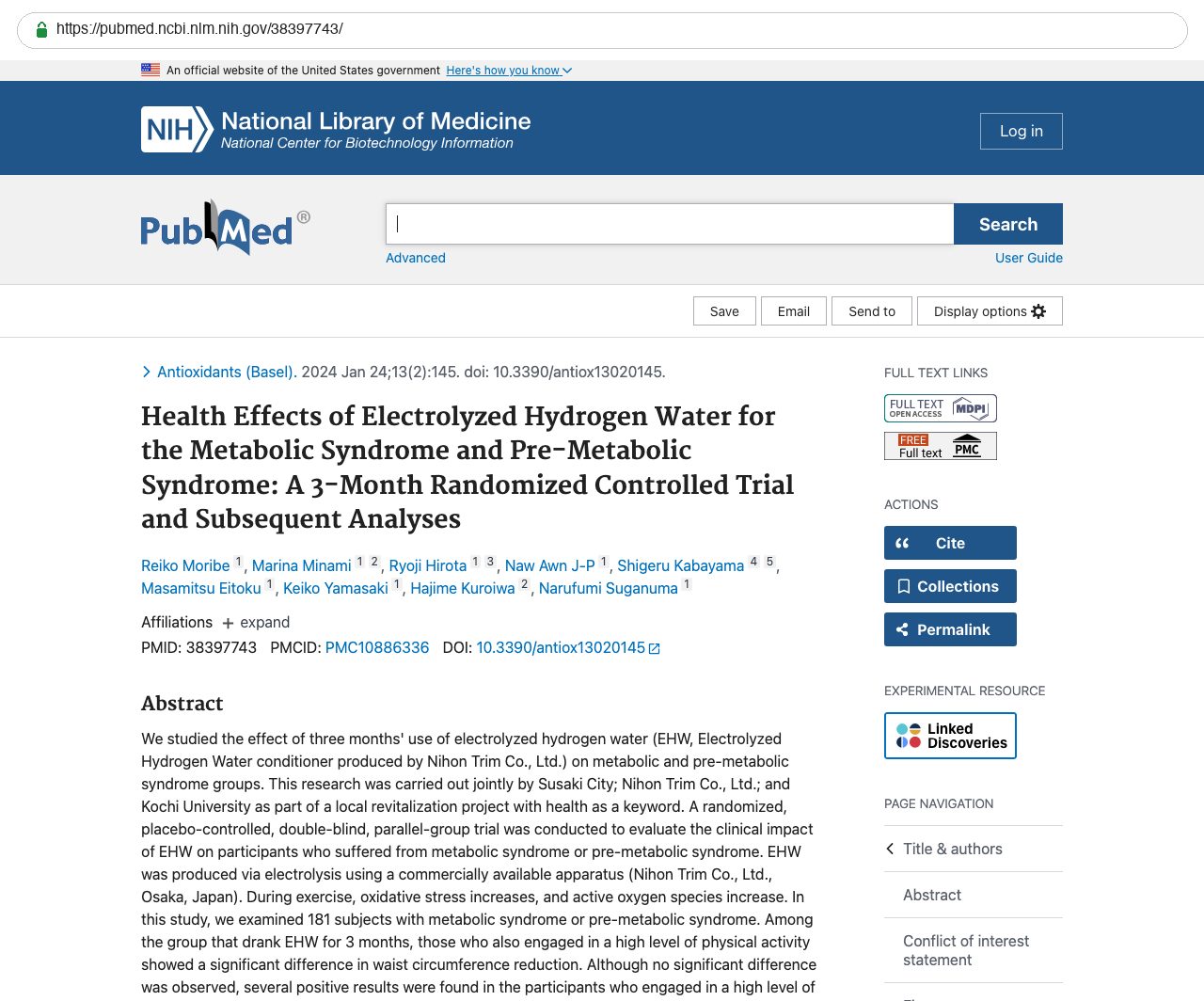
We studied the effect of three months' use of electrolyzed hydrogen water (EHW, Electrolyzed Hydrogen Water conditioner produced by Nihon Trim Co., Ltd.) on metabolic and pre-metabolic syndrome groups. This research was carried out jointly by Susaki City; Nihon Trim Co., Ltd.; and Kochi University as part of a local revitalization project with health as a keyword. A randomized, placebo-controlled, double-blind, parallel-group trial was conducted to evaluate the clinical impact of EHW on participants who suffered from metabolic syndrome or pre-metabolic syndrome. EHW was produced via electrolysis using a commercially available apparatus (Nihon Trim Co., Ltd., Osaka, Japan). During exercise, oxidative stress increases, and active oxygen species increase. In this study, we examined 181 subjects with metabolic syndrome or pre-metabolic syndrome. Among the group that drank EHW for 3 months, those who also engaged in a high level of physical activity showed a significant difference in waist circumference reduction. Although no significant difference was observed, several positive results were found in the participants who engaged in a high level of physical activity. Urinary 8-OHdG, urinary nitrotyrosine, HbA1c, and blood glucose levels increased in the filtered water (FW) group but decreased in the EHW group. High-sensitivity CRP increased less in the EHW group. 8-Isoprostane decreased more in the EHW group. In subgroup analysis, the EHW group showed a significantly greater reduction in waist circumference than the FW group only when controlled for high physical activity. Based on the result, we suggest that, among participants in the study who suffered from metabolic syndrome and pre-metabolic syndrome in which the level of active oxygen species is said to be higher than in healthy subjects, the group that consumed EHW and also engaged in a high level of physical activity experienced a suppressed or reduced increase in active oxygen species.
Source & links
Screenshot of the PubMed page
This page mirrors the published abstract (© the authors / publisher) for reference and citation. The canonical source is the PubMed record linked above. This is not medical advice.