2014 · Xie et al. — Hydrogen gas presents a promising therapeutic strategy for sepsis.
Super-Abstract
This review summarises preclinical evidence that inhaled molecular hydrogen (H₂) improved survival and reduced organ damage in animal models of sepsis. The authors propose that H₂ acts via antioxidant, anti-inflammatory, and anti-apoptotic pathways — particularly through NF-κB and Nrf2/HO-1 signalling — but this remains entirely animal-level evidence with no confirmed human data.
Commentary
Sepsis is a life-threatening systemic inflammatory response to infection and a leading cause of intensive-care mortality. This review by Xie et al. compiles the authors' own experimental work alongside related studies, focusing on cecal ligation and puncture (CLP), zymosan, and LPS-induced sepsis models in mice and rats. The mechanistic pathways proposed — suppression of oxidative stress, modulation of inflammatory cytokines, reduction of apoptosis — are biologically plausible and consistent with the broader H₂ literature. However, as an author-led narrative review of predominantly self-cited preclinical work, it does not meet the standards of a systematic review and should be read as a hypothesis-framing paper rather than conclusive evidence. Translation to human sepsis therapy remains unproven.
Key quotes
- „hydrogen gas can improve the survival and organ damage in mice and rats with cecal ligation and puncture, zymosan, and lipopolysaccharide-induced sepsis.“ — core preclinical finding: survival benefit in animal sepsis models
- „The mechanisms are associated with the regulation of oxidative stress, inflammatory response, and apoptosis, which might be through NF- κ B and Nrf2/HO-1 signaling pathway.“ — proposed molecular mechanisms
- „Sepsis is characterized by a severe inflammatory response to infection. It remains a major cause of morbidity and mortality in critically ill patients.“ — clinical context: the urgency driving this research
Our assessment
This is a narrative review of preclinical (animal) studies. It presents a coherent mechanistic rationale for H₂ in sepsis, but the evidence base is entirely rodent data. Key limitations: no human clinical trials are reviewed; the paper is largely self-referential (authors reviewing their own prior work); and it does not perform systematic literature search or meta-analysis. The hypothesis is scientifically interesting, but H₂ cannot be considered a proven therapy for sepsis in humans based on this review alone.
Study design
- Type: narrative review (preclinical focus) · Models reviewed: murine/rat CLP, zymosan, and LPS sepsis models · H₂ delivery: inhalation (primary method in reviewed studies)
- Result: improved survival and reduced organ damage in animal sepsis models; mechanisms proposed: anti-oxidative, anti-inflammatory, anti-apoptotic via NF-κB and Nrf2/HO-1 pathways; no human data
Abstract
Sepsis is characterized by a severe inflammatory response to infection. It remains a major cause of morbidity and mortality in critically ill patients despite developments in monitoring devices, diagnostic tools, and new therapeutic options. Recently, some studies have found that molecular hydrogen is a new therapeutic gas. Our studies have found that hydrogen gas can improve the survival and organ damage in mice and rats with cecal ligation and puncture, zymosan, and lipopolysaccharide-induced sepsis. The mechanisms are associated with the regulation of oxidative stress, inflammatory response, and apoptosis, which might be through NF- κ B and Nrf2/HO-1 signaling pathway. In this paper, we summarized the progress of hydrogen treatment in sepsis.
Source & links
Screenshot of the PubMed page
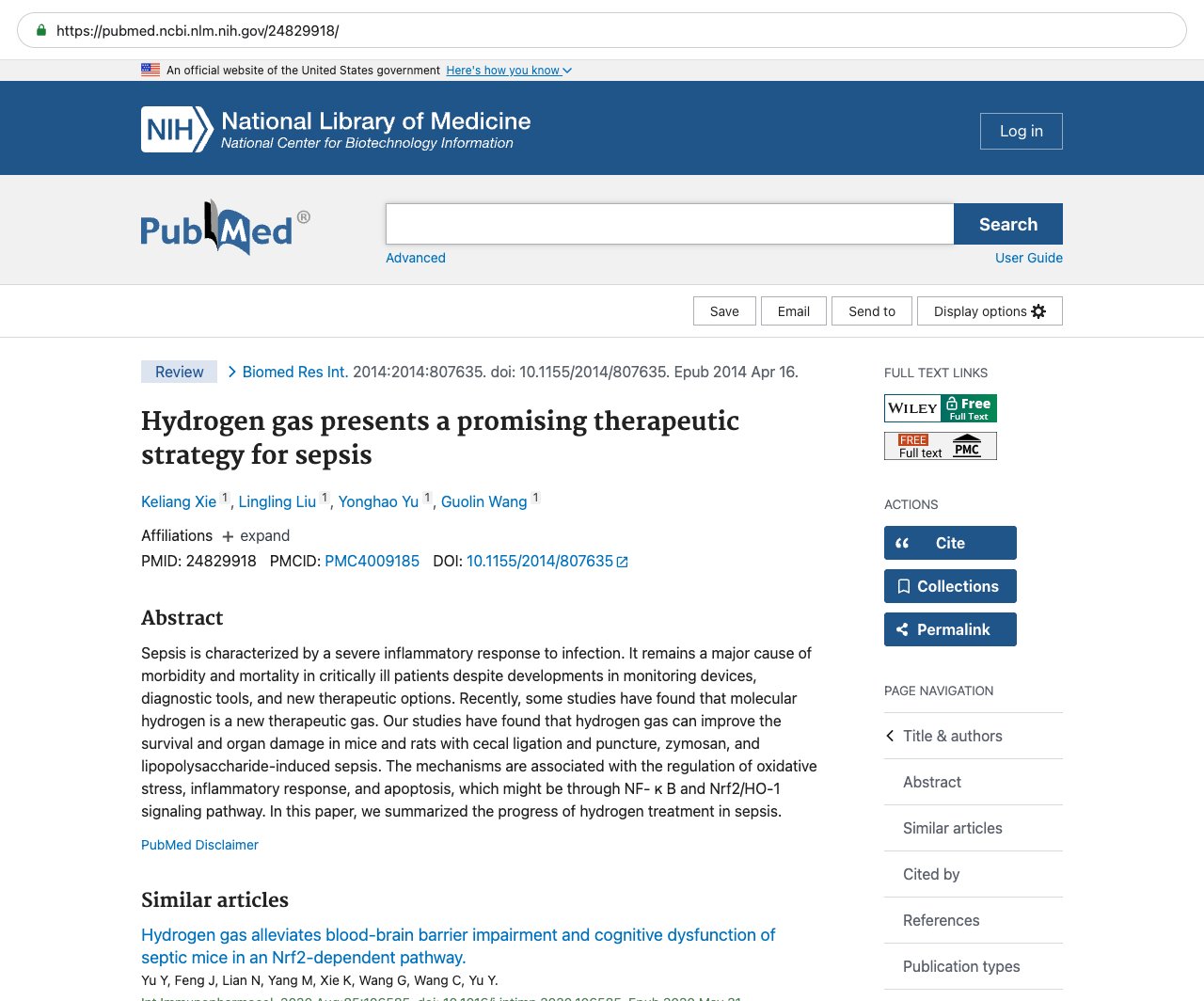
This page mirrors the published abstract (© the authors / publisher) for reference and citation. The canonical source is the PubMed record linked above. This is not medical advice.