2025 · Xu — Innovations in peritoneal dialysis fluid: biocompatible formulations and expanded therapeutic applications
Super-Abstract
Conventional peritoneal dialysis fluids cause peritoneal fibrosis and metabolic damage — new biocompatible formulations combining novel osmotic agents, advanced buffers, and molecular hydrogen aim to overcome these limitations. This review also explores the expanding role of peritoneal dialysis in refractory heart failure. (Renal Failure, 2025.)
Commentary
Peritoneal dialysis (PD) is an established renal replacement therapy, yet its long-term use is hampered by fibrosis of the peritoneal membrane caused largely by conventional glucose-based fluids. This review systematically maps three innovation tracks: (1) novel osmotic agents such as L-carnitine and hyperbranched polyglycerol offering dual renal/peritoneal protection, (2) physiological buffers like citrate and pyruvate replacing the standard lactate, and (3) peritoneal protectants — among them molecular hydrogen — that reduce fibrotic and oxidative damage. The H₂ component is discussed as one additive among several, not as a standalone cure. Beyond kidney failure, the authors present emerging data on PD in refractory heart failure, where optimised fluid protocols improve volume control in cardiorenal syndrome. The review is largely preclinical and mechanistic in scope; clinical translation of the more novel agents remains at an early stage.
Key quotes
- „molecular hydrogen) that collectively mitigate fibrosis while protecting membrane function.“ — H₂ listed as one of the peritoneal protectants in the proposed multi-functional fluid concept
- „These developments indicate a future direction for biocompatible PDF: integrating dual or triple protective functions of „osmotic agents + buffers + additives” synergy-optimizing hybrid formulations and accelerating clinical translation.“ — the authors' vision for next-generation peritoneal dialysis fluid
- „specialized PDF and steady-concentration protocols enhanced ultrafiltration efficiency.“ — on the emerging application of peritoneal dialysis in heart failure management
Our assessment
This is a narrative review summarising the state of innovation in peritoneal dialysis fluid technology. Molecular hydrogen appears as one component in a broader multi-agent strategy and is not the central focus of the paper. No new experimental data are presented. Clinical evidence for the most novel agents — including H₂ as a PD additive — is sparse; the authors themselves call for accelerated clinical translation. The review is useful for understanding where H₂ research fits within a wider biomedical innovation landscape, but should not be read as proof of clinical efficacy for H₂ in dialysis patients.
Study design
- Type: narrative review · n: n/a (literature synthesis) · H₂ delivery: molecular hydrogen as peritoneal protectant additive to dialysis fluid (discussed conceptually)
- Result: no pooled effect sizes; authors conclude that hybrid „osmotic agent + buffer + additive” formulations represent the future direction for biocompatible peritoneal dialysis fluids; H₂ is identified as one promising protectant alongside glycosaminoglycans
Abstract
Peritoneal dialysis (PD) is a critical renal replacement therapy for end-stage kidney disease. However, its adoption remains limited, partly due to peritoneal fibrosis and metabolic complications induced by conventional glucose-based peritoneal dialysis fluid (PDF), the primary complications in PD patients and the leading cause of technique failure. This review outlines three innovative approaches to overcome these limitations: (1) novel biocompatible osmotic agents (L-carnitine can improve the metabolism of the peritoneum, and hyperbranched polyglycerol provides sustained ultrafiltration with dual peritoneal/renal protection), (2) advanced biocompatible buffers (citrate and pyruvate), and (3) peritoneal protectants (glycosaminoglycans and molecular hydrogen) that collectively mitigate fibrosis while protecting membrane function. These developments indicate a future direction for biocompatible PDF: integrating dual or triple protective functions of "osmotic agents + buffers + additives" synergy-optimizing hybrid formulations and accelerating clinical translation. Furthermore, we explored the emerging role of PD in refractory heart failure, where specialized PDF and steady-concentration protocols enhanced ultrafiltration efficiency. These advances address volume overload in cardiorenal syndrome, expanding PD's therapeutic scope of PD to systemic conditions such as heart failure.
Source & links
Screenshot of the PubMed page
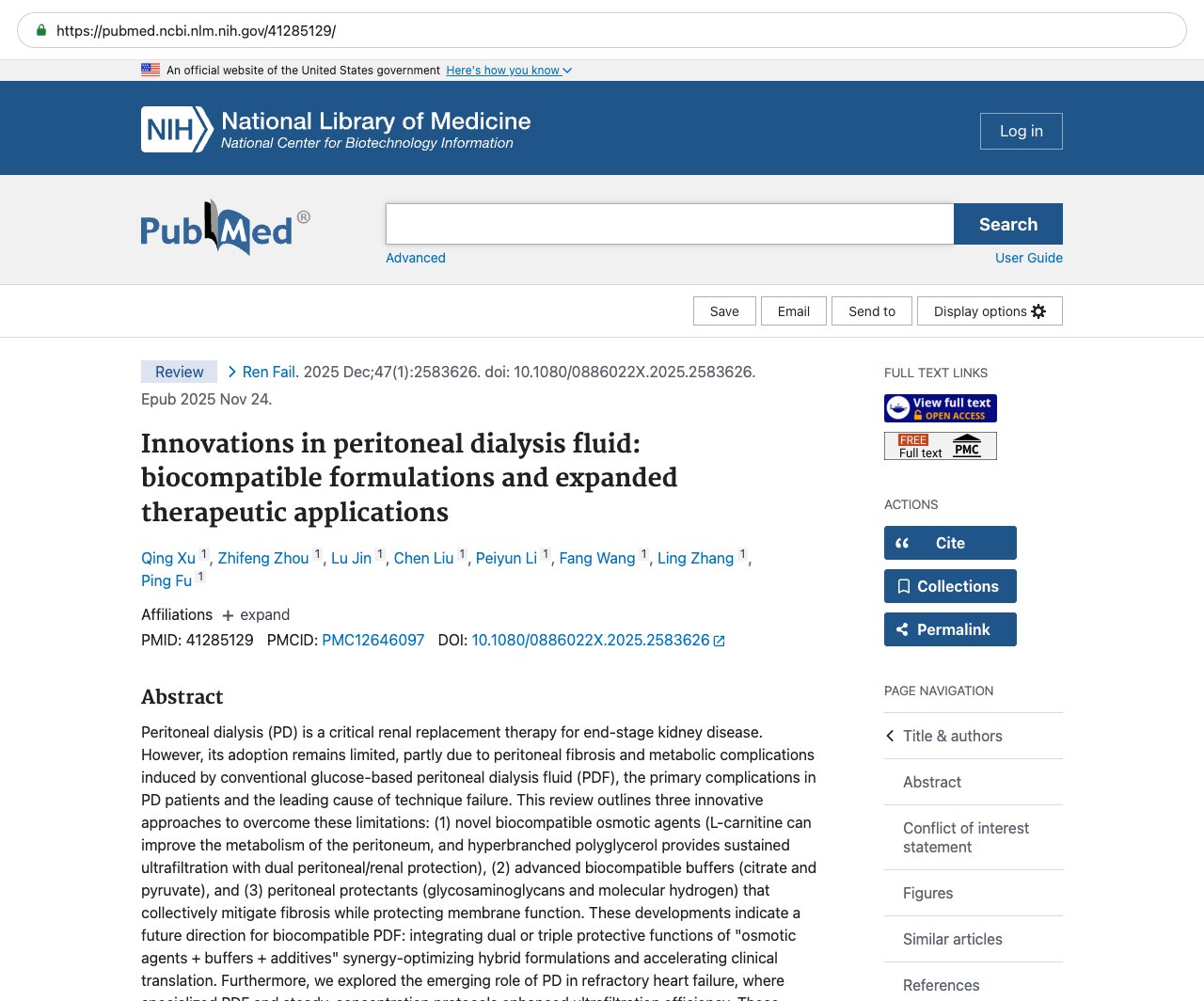
This page mirrors the published abstract (© the authors / publisher) for reference and citation. The canonical source is the PubMed record linked above. This is not medical advice.