2021 · Yamamoto — Molecular Hydrogen as a Novel Protective Agent against Pre-Symptomatic Diseases.
Super-Abstract
This review explores how molecular hydrogen (H₂) may help prevent „mibyou“ — the Japanese concept of pre-symptomatic illness in which disease silently develops before symptoms appear — by suppressing the chronic inflammation and oxidative stress that underlie many modern inflammatory conditions. (International Journal of Molecular Sciences, 2021.)
Commentary
The concept of „mibyou“ (未病) from traditional medicine describes a state between full health and diagnosable disease — a grey zone of subclinical dysfunction, particularly relevant to chronic inflammatory conditions. Yamamoto et al. use this framework to argue that H₂ is uniquely well-suited as a preventive agent: because it targets the root driver (oxidative stress from ·OH, which activates NLRP3 inflammasomes, which fuel chronic cytokine release), it could theoretically interrupt disease processes before symptoms emerge. The mechanistic chain from H₂ → ·OH scavenging → NLRP3 suppression → reduced inflammatory cytokines is supported by existing literature, which the review cites. However, the paper is a review without new experimental data, and the leap from mechanism to clinical prevention is substantial. Demonstrating that a preventive intervention reduces disease incidence requires large, long-term trials — none of which exist for H₂ at this scale. The paper is a thoughtful conceptual synthesis, but the clinical preventive claim is not yet backed by that level of evidence.
Key quotes
- „H2 has the ability to treat chronic inflammation by eliminating hydroxyl radicals (·OH), a mitochondrial reactive oxygen species (ROS).“ — proposed primary mechanism of H₂ in this preventive context
- „H2 is able to suppress the pathogenesis of pre-symptomatic diseases, and thus exhibits prospects as a novel protective agent.“ — authors' conclusion — framed as a prospect, not an established clinical fact
- „chronic inflammation is triggered by the uncontrolled release of proinflammatory cytokines by neutrophils and macrophages in the innate immune system.“ — the biological target H₂ is proposed to address
Our assessment
This is a conceptual review, not a clinical trial. The paper presents a coherent mechanistic hypothesis for H₂ as a preventive agent against chronic inflammation, grounded in existing preclinical data. The concept of pre-symptomatic disease prevention is clinically relevant, but demonstrating actual preventive efficacy in humans would require robust long-term intervention trials that do not yet exist. The review is best understood as a scientific rationale piece — not as evidence that H₂ prevents disease in practice.
Study design
- Type: narrative review · Scope: H₂ mechanisms (·OH scavenging, NLRP3 inhibition, cytokine suppression) applied to pre-symptomatic inflammatory disease · H₂ delivery: various modalities discussed
- Conclusion: mechanistic rationale for H₂ as a pre-symptomatic disease preventive agent is supported by preclinical evidence; clinical preventive efficacy not yet demonstrated
Abstract
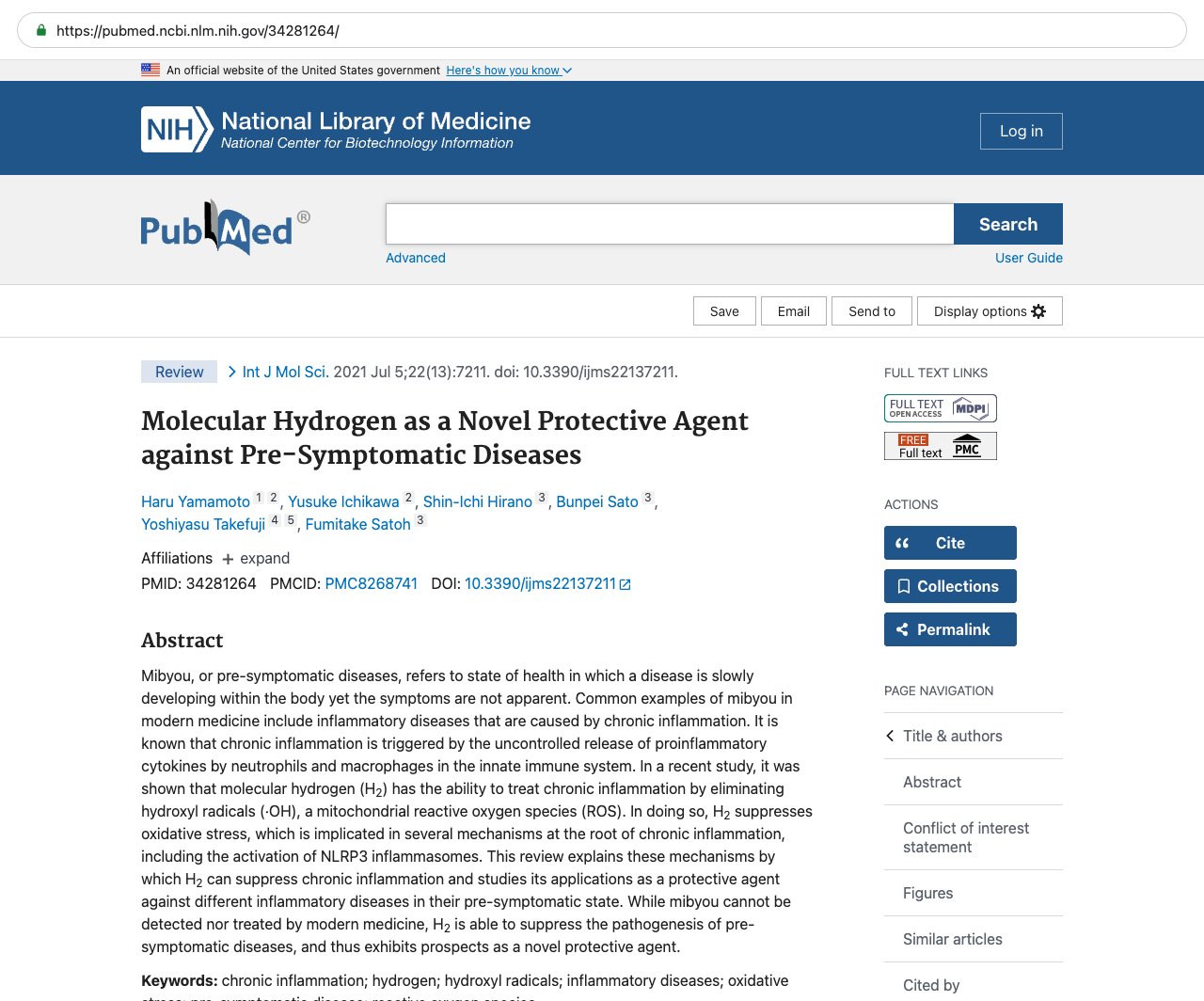
Mibyou, or pre-symptomatic diseases, refers to state of health in which a disease is slowly developing within the body yet the symptoms are not apparent. Common examples of mibyou in modern medicine include inflammatory diseases that are caused by chronic inflammation. It is known that chronic inflammation is triggered by the uncontrolled release of proinflammatory cytokines by neutrophils and macrophages in the innate immune system. In a recent study, it was shown that molecular hydrogen (H2) has the ability to treat chronic inflammation by eliminating hydroxyl radicals (·OH), a mitochondrial reactive oxygen species (ROS). In doing so, H2 suppresses oxidative stress, which is implicated in several mechanisms at the root of chronic inflammation, including the activation of NLRP3 inflammasomes. This review explains these mechanisms by which H2 can suppress chronic inflammation and studies its applications as a protective agent against different inflammatory diseases in their pre-symptomatic state. While mibyou cannot be detected nor treated by modern medicine, H2 is able to suppress the pathogenesis of pre-symptomatic diseases, and thus exhibits prospects as a novel protective agent.
Source & links
Screenshot of the PubMed page
This page mirrors the published abstract (© the authors / publisher) for reference and citation. The canonical source is the PubMed record linked above. This is not medical advice.