2016 · Yang — Hydrogen-Rich Medium Ameliorates Lipopolysaccharide-Induced Barrier Dysfunction via RhoA-mDia1 Signaling in Caco-2 Cells
Super-Abstract
In intestinal epithelial cells (Caco-2), hydrogen-rich medium protected the gut barrier from LPS-induced permeability increase by modulating the RhoA-mDia1 signaling pathway, which governs tight junction and adherens junction integrity. This is a mechanistically detailed in-vitro cell study relevant to sepsis-associated gut failure — not a human or animal experiment. (Shock, 2016.)
Commentary
Gut barrier breakdown is a key driver of sepsis severity: when the intestinal barrier becomes „leaky“, bacteria and their toxins translocate into the bloodstream, amplifying systemic inflammation. Previous animal studies showed H₂ can reduce multi-organ damage in sepsis, but the intracellular mechanisms at the gut epithelium were unclear. Yang et al. used Caco-2 monolayers (a widely used intestinal barrier model) stimulated with LPS (100 µg/mL) to recreate barrier dysfunction. H₂-rich medium counteracted LPS-induced permeability increase (measured by transepithelial resistance and FITC-dextran flux), preserved occludin and E-cadherin expression and distribution, and reduced oxidative stress. Mechanistically, LPS activated RhoA (a cytoskeletal regulator), which H₂ attenuated; and LPS downregulated mDia1 (a downstream effector promoting tight junction stability), which H₂ restored. Using a RhoA agonist (CN03) reversed H₂'s benefits; mDia1 knockdown abolished them — confirming the pathway's causal role. The study is methodologically rigorous for an in-vitro system, but Caco-2 cells are a simplified model and the 100 µg/mL LPS dose is supraphysiological.
Key quotes
- „H2 improves LPS-induced hyperpermeability of the intestinal barrier and disruptions of TJ and AJ by moderating RhoA-mDia1 signaling.“ — the study's central mechanistic conclusion
- „H2 alleviated LPS-caused RhoA activation, and the beneficial effects of H2 on barrier were counteracted by RhoA agonist CN03.“ — causal evidence for RhoA as the mechanistic target
- „mDia1 knockdown abolished protections of H2 on barrier permeability.“ — mDia1 confirmed as the downstream effector required for H₂'s barrier-protective effect
Our assessment
This is a rigorous in-vitro cell study that provides a plausible and specific molecular mechanism for how H₂ may protect the gut barrier during sepsis: RhoA suppression and mDia1 upregulation stabilize tight junctions and adherens junctions. The gene-knockdown controls strengthen the causal interpretation. Limitations: Caco-2 monolayers are a simplified single-cell-type model; the LPS dose is very high; results need validation in vivo (animal model) and then in humans before any clinical implications can be drawn. No human relevance can be directly claimed. Scientifically, this is a useful mechanistic piece in the H₂/sepsis puzzle.
Study design
- Type: in-vitro cell study · Model: Caco-2 intestinal epithelial cell monolayers, stimulated with LPS (100 µg/mL) · H₂ delivery: hydrogen-rich culture medium
- Result: H₂-rich medium restored transepithelial resistance and reduced FITC-dextran flux; preserved occludin and E-cadherin; reduced oxidative stress; attenuated RhoA activation; restored mDia1 expression; RhoA agonist and mDia1 knockdown abolished H₂ effects — all in Caco-2 cells in vitro
Abstract
Gastrointestinal barrier dysfunction is associated with the severity and prognosis of sepsis. Hydrogen gas (H2) can ameliorate multiple organ damage in septic animals. Ras homolog gene family member A (RhoA) and mammalian diaphanous-related formin 1 (mDia1) are important to regulate tight junction (TJ) and adherens junction (AJ), both of which determine the integrity of the intestinal barrier. This study was aimed to investigate whether H2 could modulate lipopolysaccharide (LPS)-stimulated dysfunction of the intestinal barrier and whether RhoA-mDia1 signaling is involved. Caco-2 cells were exposed to different concentrations of LPS (1 μg/mL-1 mg/mL). The permeability of the intestinal barrier was evaluated by transepithelial resistance (TER) and fluorescein-isothiocyanate-dextran flux. Expression and distribution of occludin and E-cadherin were analyzed by Western blot and immunofluorescence. RhoA activity was measured by G-Lisa assay, and mDia1 expression was assessed by Western blot. LPS (100 μg/mL) decreased TER and increased fluorescein-isothiocyanate-dextran flux, which were alleviated by H2-rich medium. Also, H2 down-regulated LPS-induced oxidative stress. Moreover, H2 improved the down-regulated expression and redistribution of occludin and E-cadherin caused by LPS. Additionally, H2 alleviated LPS-caused RhoA activation, and the beneficial effects of H2 on barrier were counteracted by RhoA agonist CN03. Rho inhibitor C3 exoenzyme mitigated LPS-induced barrier breakdown. Furthermore, H2-rich medium increased mDia1 expression, and mDia1 knockdown abolished protections of H2 on barrier permeability. mDia1 knockdown eliminated H2-induced benefits for occludin and E-cadherin. These findings suggest that H2 improves LPS-induced hyperpermeability of the intestinal barrier and disruptions of TJ and AJ by moderating RhoA-mDia1 signaling.
Source & links
Screenshot of the PubMed page
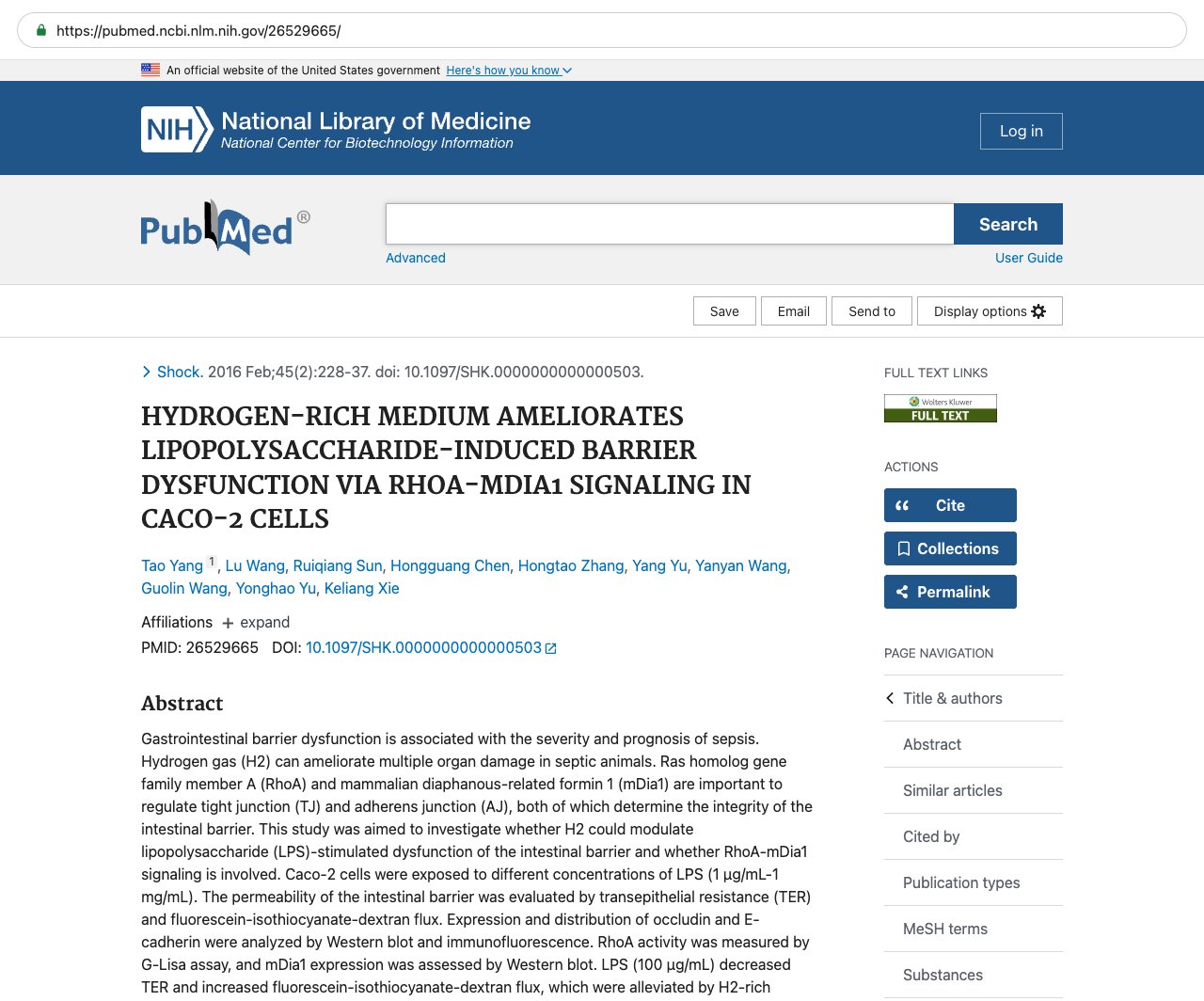
This page mirrors the published abstract (© the authors / publisher) for reference and citation. The canonical source is the PubMed record linked above. This is not medical advice.