2019 · Yang et al. — Skin ulcers infected with conditional pathogenic strains treated with local hydrogen water packing in two pemphigus vulgaris patients: Case reports with follow-up for 2 months.
Super-Abstract
Two patients with pemphigus vulgaris — an autoimmune blistering disorder — developed secondary skin ulcer infections with opportunistic pathogens that were treated with local wet packing using hydrogen water, resulting in healing over two months of follow-up. The authors describe this as a novel approach to infected chronic inflammatory skin ulcers. This is a two-patient case series with no control condition. (Dermatologic Therapy, 2019.)
Commentary
Pemphigus vulgaris causes fragile, blistering skin that is highly susceptible to secondary infection. Standard care uses immunosuppression (which paradoxically increases infection risk) plus topical and systemic antibiotics. The hypothesis that H₂ water packing might reduce local inflammation and support wound healing is mechanistically reasonable given H₂'s documented anti-inflammatory effects. However, the abstract is extremely brief and provides almost no quantitative outcome data — we do not know wound size, healing time, microbiological outcomes, or the concurrent immunosuppressive therapy used. The claim of being „the first“ to report this is consistent with the novelty of the approach but also underscores the complete absence of prior evidence. This is informative but not evidence of effectiveness.
Key quotes
- „We are the first to report on a new, safe, and effective treatment of infections induced by conditional pathogenic strains with local wet packing with hydrogen water.“ — authors' claim of novelty and effectiveness — the latter is strongly overstated for a 2-patient report
- „The new treatment method may also shed light on the therapy of chronic, inflammatory skin ulcers.“ — broader implication — appropriately stated as potential signal only
Our assessment
Two-patient case series with a very short abstract — the weakest study in this chunk by evidence level. The approach (local H₂ water packing for infected skin ulcers in immunocompromised patients) is novel and the safety profile appears acceptable, but efficacy cannot be assessed from 2 uncontrolled cases. The claim of „effective treatment“ in the abstract is stronger than the evidence justifies. Limitations: n = 2; no control; no quantitative wound healing data reported in the abstract; concurrent immunosuppressive treatment not described; 2-month follow-up only; pathogen clearance not detailed.
Study design
- Type: case series · n: 2 (pemphigus vulgaris patients with secondary skin ulcer infections by conditional pathogens) · H₂ delivery: local wet packing with hydrogen water (duration and concentration not specified in abstract)
- Follow-up: 2 months · Result: ulcer healing reported — no quantitative outcome data in abstract
- Note: concurrent immunosuppressive therapy (standard for pemphigus vulgaris) not described; its role in healing cannot be separated
Abstract
We are the first to report on a new, safe, and effective treatment of infections induced by conditional pathogenic strains with local wet packing with hydrogen water. The new treatment method may also shed light on the therapy of chronic, inflammatory skin ulcers.
Source & links
Screenshot of the PubMed page
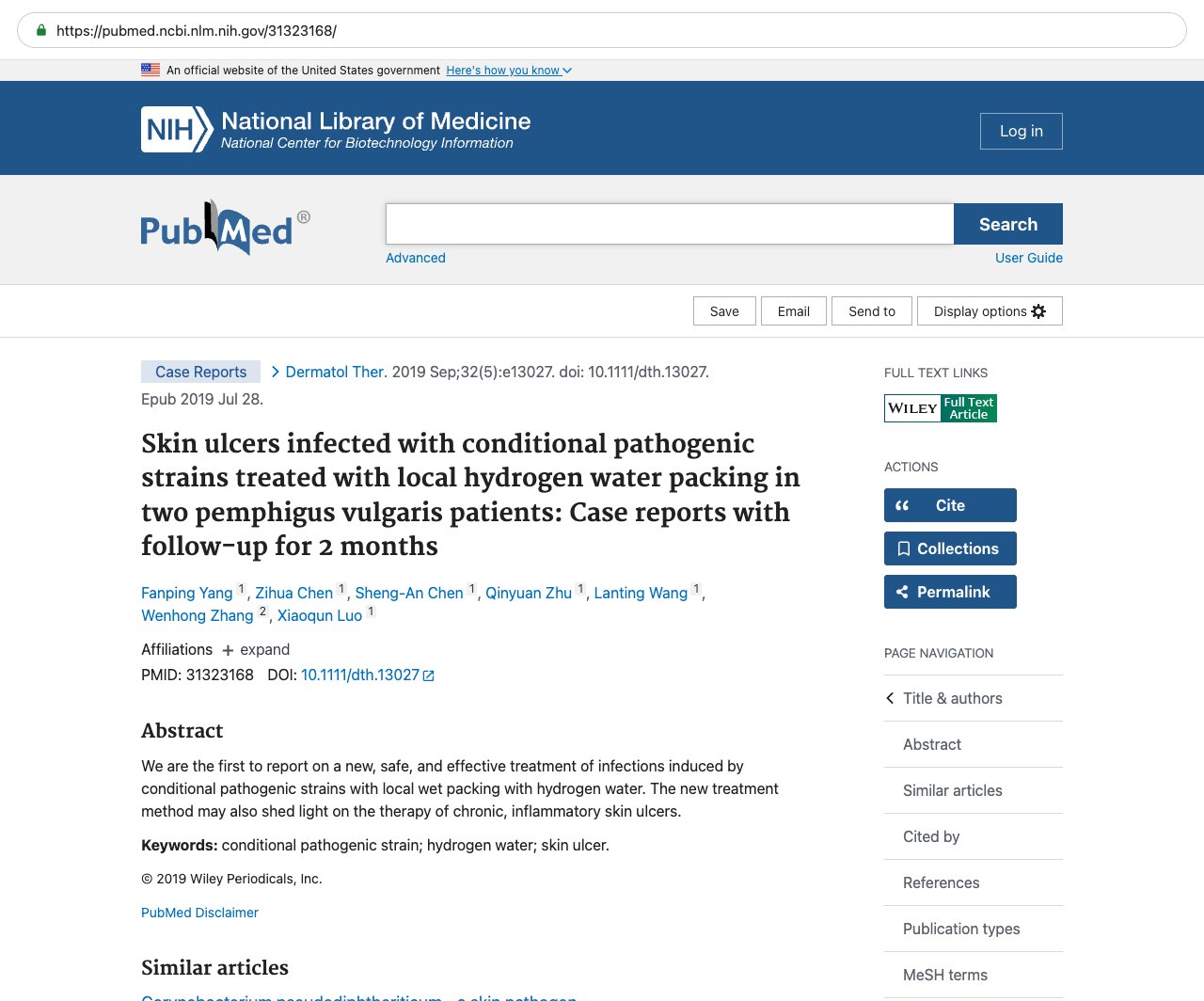
This page mirrors the published abstract (© the authors / publisher) for reference and citation. The canonical source is the PubMed record linked above. This is not medical advice.