2020 · Yang — Hydrogen inhibits endometrial cancer growth via a ROS/NLRP3/caspase-1/GSDMD-mediated pyroptotic pathway.
Super-Abstract
In endometrial cancer cell lines and a xenograft mouse model, hydrogen-rich water increased reactive oxygen species (ROS) in cancer cells, activated the NLRP3 inflammasome/GSDMD pyroptosis pathway, and suppressed tumour growth. This is an in-vitro and animal study — the paradoxical pro-oxidant effect of H₂ specifically in tumour cells is the central finding, but no clinical evidence in cancer patients exists.
Commentary
This study explores a provocative and counter-intuitive angle: while molecular hydrogen is widely studied as an antioxidant that protects healthy cells, here the authors report a pro-oxidant effect specifically in endometrial cancer cells — elevating ROS to trigger pyroptosis (an inflammatory form of programmed cell death) via the NLRP3/caspase-1/GSDMD cascade. The xenograft mouse model confirms tumour volume and weight reduction with hydrogen-rich water. The mechanistic story — GSDMD as the terminal executor of pyroptosis, and its higher baseline expression in cancer tissue — is scientifically interesting and internally consistent. However, several caveats apply: the dual ROS role of H₂ (antioxidant in normal cells, pro-oxidant in cancer cells) is not fully explained; xenograft models are imperfect proxies for human tumours; and no safety or efficacy data in humans exist.
Key quotes
- „Hydrogen pretreatment upregulated ROS and the expression of pyroptosis-related proteins, and increased the number of PI- and TUNEL-positive cells, as well as the release of LDH and IL-1β.“ — H₂ triggered cell death markers in cancer cells via ROS accumulation
- „hydrogen supplementation in mice was sufficient for the anti-tumor effect to inhibit xenograft volume and weight of endometrial tumors.“ — tumour suppression confirmed in vivo in a mouse xenograft model
- „This study extended our original analysis of the ability of hydrogen to stimulate NLRP3 inflammasome/GSDMD activation in pyroptosis and revealed possible mechanism(s) for improvement of anti-tumor effects in the clinical management of endometrial cancer.“ — authors frame this as mechanistic groundwork for future clinical exploration
Our assessment
This is an in-vitro and animal xenograft study — not a clinical trial. The pyroptosis mechanism through which H₂ may selectively kill cancer cells is scientifically interesting and adds to mechanistic understanding. Key limitations: the pro-oxidant effect of H₂ in cancer cells versus its antioxidant effect in healthy cells needs more explanation; xenograft models are artificial; clinical safety and efficacy in endometrial cancer patients are entirely unknown. No therapeutic claims about H₂ for cancer treatment can be supported by this data alone.
Study design
- Type: in-vitro (endometrial cancer cell lines) + in-vivo (human xenograft mouse model) · H₂ delivery: hydrogen-rich water (in-vitro culture medium and in-vivo drinking water)
- Outcome: elevated intracellular ROS in cancer cells; upregulated NLRP3/caspase-1/GSDMD expression; increased PI+/TUNEL+ cells and LDH/IL-1β release; GSDMD knockdown reduced these effects; xenograft tumour volume and weight reduced with H₂-rich water
Abstract
BACKGROUND: Pyroptosis belongs to a novel inflammatory programmed cell death pathway, with the possible prognosis of endometrial cancer related to the terminal protein GSDMD. Hydrogen exerts a biphasic effect on cancer by promoting tumor cell death and protecting normal cells, which might initiate GSDMD pathway-mediated pyroptosis. METHODS: We performed immunohistochemical staining and western immunoblotting analysis to observe expression of NLRP3, caspase-1, and GSDMD in human and xenograft mice endometrial cancer tissue and cell lines. We investigated treatment with hydrogen could boost ROS accumulation in endometrial cancer cells by intracellular and mitochondrial sources. GSDMD shRNA lentivirus was used to transfect endometrial cancer cells to investigate the function of GSDMD protein in pyroptosis. Propidium iodide (PI) staining, TUNEL assay, measurement of lactate dehydrogenase (LDH) release and IL-1β ELISA were used to analysis pyroptosis between hydrogen-supplemented or normal culture medium. We conducted in vivo human endometrial tumor xenograft mice model to observe anti-tumor effect in hydrogen supplementation. RESULTS: We observed overexpression of NLRP3, caspase-1, and GSDMD in human endometrial cancer and cell lines by IHC and western immunoblotting. Hydrogen pretreatment upregulated ROS and the expression of pyroptosis-related proteins, and increased the number of PI- and TUNEL-positive cells, as well as the release of LDH and IL-1β, however, GSDMD depletion reduced their release. We further demonstrated that hydrogen supplementation in mice was sufficient for the anti-tumor effect to inhibit xenograft volume and weight of endometrial tumors, as mice subjected to hydrogen-rich water displayed decreased radiance. Tumor tissue sections in the HRW groups presented moderate-to-strong positive expression of NLRP3, caspase-1 and GSDMD. Hydrogen attenuated tumor volume and weight in a xenograft mouse model though the pyroptotic pathway. CONCLUSIONS: This study extended our original analysis of the ability of hydrogen to stimulate NLRP3 inflammasome/GSDMD activation in pyroptosis and revealed possible mechanism (s) for improvement of anti-tumor effects in the clinical management of endometrial cancer.
Source & links
Screenshot of the PubMed page
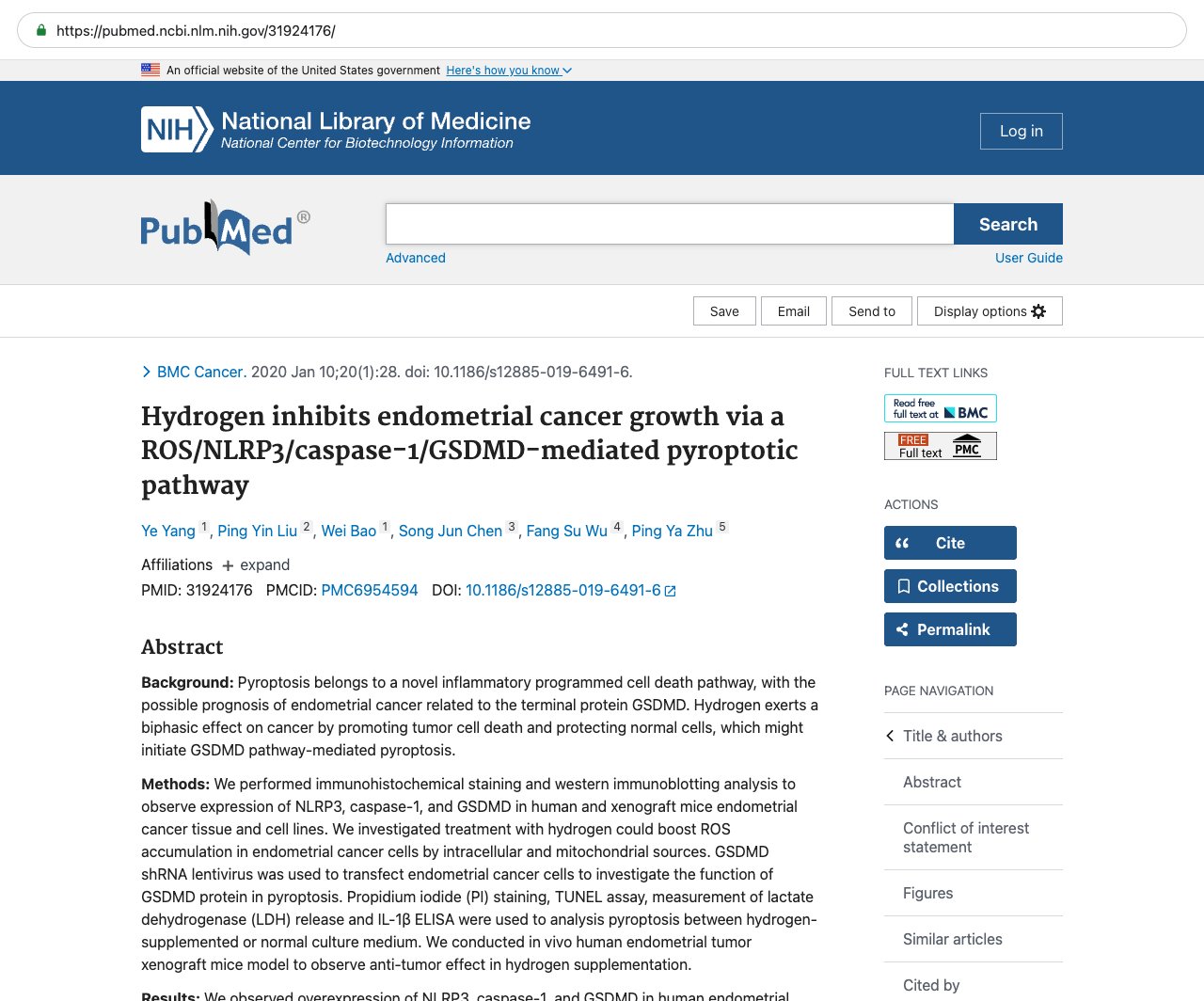
This page mirrors the published abstract (© the authors / publisher) for reference and citation. The canonical source is the PubMed record linked above. This is not medical advice.