2026 · Yano — Electrolyzed Hydrogen Water Improves Chemosensitivity to Anticancer Drugs by Potently Suppressing Autophagy
Super-Abstract
Electrolyzed hydrogen water (EHW) suppressed autophagy — a recycling process cancer cells exploit to survive chemotherapy — and when combined with standard anticancer drugs (5-fluorouracil or paclitaxel), significantly reduced the viability of cervical and colorectal cancer cells in laboratory experiments. The mechanism involves activation of the mTORC1 signalling pathway, which normally inhibits autophagy. The authors propose EHW as a potentially safe adjuvant to existing chemotherapy protocols. (Journal of Cellular and Molecular Medicine, 2026.)
Commentary
Autophagy is a well-established survival mechanism in cancer: when chemotherapy stresses cancer cells, they activate autophagy to „eat“ damaged components and regenerate energy, effectively resisting cell death. Chloroquine and hydroxychloroquine inhibit autophagy and are under clinical investigation as chemotherapy adjuvants, but carry significant side effects. This study explored whether EHW could serve the same function more safely. Using genome-wide RNA sequencing, the authors identified mTORC1 activation as the key pathway through which EHW inhibits autophagy. The combination effect with 5-FU and paclitaxel was demonstrated in cervical and colorectal cancer cell lines only — this is an in-vitro study, and all observations are made in cell culture dishes, not in animals or humans.
Key quotes
- „using genome-wide RNA sequencing analysis, we deciphered a novel function of electrolyzed hydrogen water (EHW) in suppressing autophagy by activating mammalian target of rapamycin complex 1 signalling.“ — the mechanism identified: EHW → mTORC1 activation → autophagy suppression
- „The combination of EHW with anticancer drugs, such as 5-fluorouracil or paclitaxel, which activate autophagy, significantly decreased the viability of cervical and colorectal cancer cells.“ — the central in-vitro finding: EHW potentiates chemotherapy effect in cell culture
- „Considering its safety, we propose that EHW can act as a novel adjuvant to anticancer therapy.“ — authors' conclusion — framed as hypothesis, not clinical proof
Our assessment
An in-vitro study with mechanistic novelty. The use of genome-wide RNA sequencing to identify the mTORC1 pathway adds scientific depth beyond simple cell-viability readouts. However, no animal models and no human data are presented. The safety claim in the conclusion is extrapolated from EHW's known low-risk profile, not from toxicology data in this paper. The combination of EHW and chemotherapy would require animal and then clinical trials before any therapeutic conclusions can be drawn. This is not evidence that hydrogen water improves chemotherapy outcomes in humans.
Study design
- Type: in-vitro study · Model: cervical cancer cells (HeLa) and colorectal cancer cells · H₂ delivery: electrolyzed hydrogen water (EHW)
- Result: EHW suppressed autophagy via mTORC1 activation (genome-wide RNA sequencing); combination with 5-FU or paclitaxel significantly reduced cancer cell viability in culture
Abstract
Autophagy is an intracellular recycling system that contributes to the maintenance of cellular homeostasis. However, by providing tolerance to various stressors, autophagy promotes the survival and proliferation of cancer cells and confers resistance to chemotherapy. Anticancer drugs activate autophagy, leading to drug resistance in cancer cells. Autophagy inhibitors, such as chloroquine and hydroxychloroquine, enhance the antitumor effects of anticancer drugs when used in combination with them. However, these inhibitors are associated with several adverse effects. Here, using genome-wide RNA sequencing analysis, we deciphered a novel function of electrolyzed hydrogen water (EHW) in suppressing autophagy by activating mammalian target of rapamycin complex 1 signalling. The combination of EHW with anticancer drugs, such as 5-fluorouracil or paclitaxel, which activate autophagy, significantly decreased the viability of cervical and colorectal cancer cells. Mechanistically, molecular hydrogen and trace elements in EHW may suppress autophagy and potentiate anticancer effects. Considering its safety, we propose that EHW can act as a novel adjuvant to anticancer therapy.
Source & links
Screenshot of the PubMed page
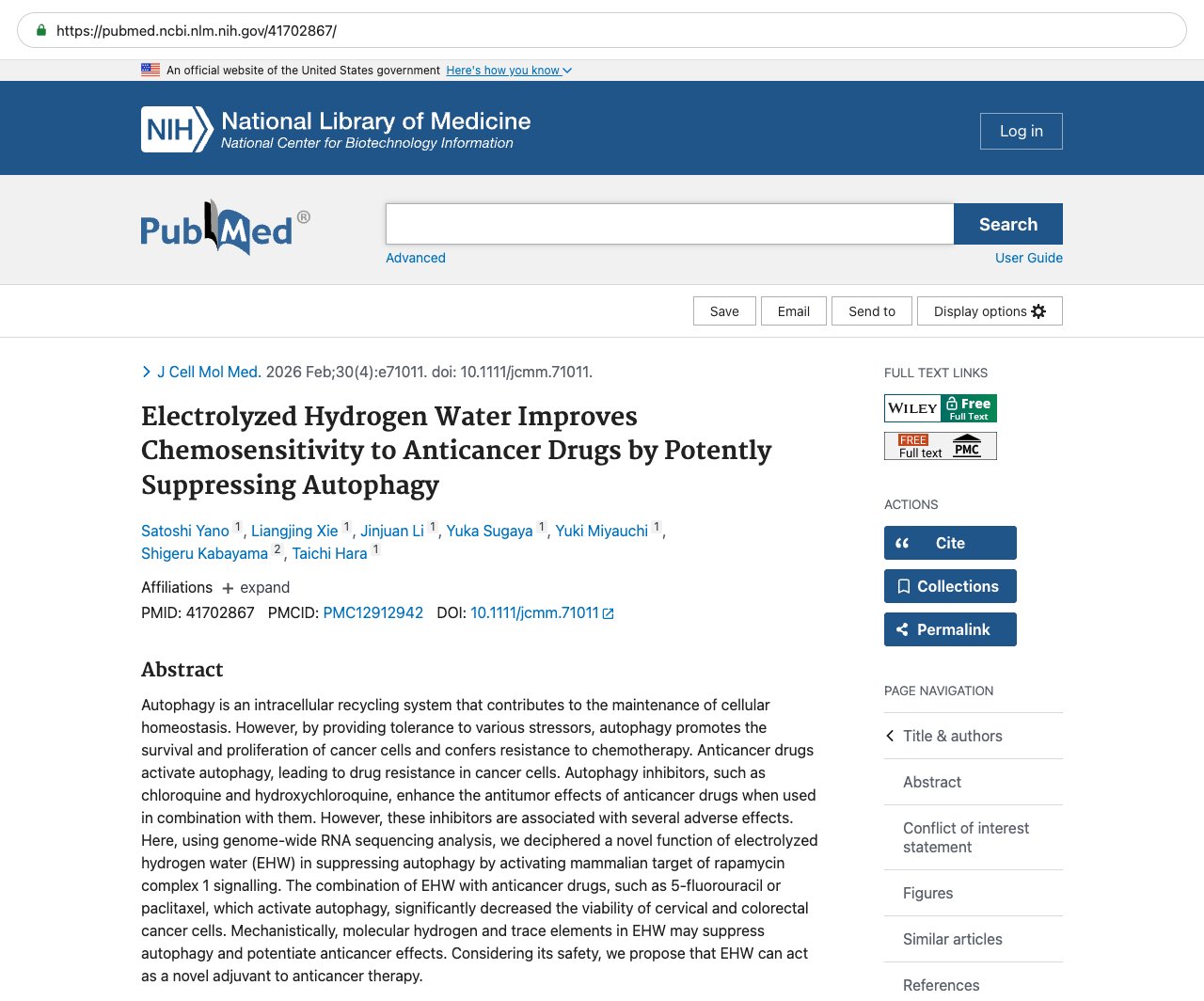
This page mirrors the published abstract (© the authors / publisher) for reference and citation. The canonical source is the PubMed record linked above. This is not medical advice.