2018 · Ye — Recent Advances in the Electro-Oxidation of Urea for Direct Urea Fuel Cell and Urea Electrolysis.
Super-Abstract
This review covers recent advances in the electro-oxidation of urea — the electrochemical reaction that makes it possible to use urea (from urine, wastewater, or industrial sources) as a fuel in direct urea fuel cells, or as a feedstock to produce hydrogen gas through urea electrolysis. Development of improved catalysts is identified as the key bottleneck for both applications. (Topics in Current Chemistry, 2018.)
Commentary
This is a chemistry/materials-science review paper, not a biomedical or health study. Its connection to hydrogen medicine is indirect: urea electrolysis is one of several proposed methods for producing molecular hydrogen at lower energy cost than conventional water electrolysis. The review systematically summarizes the mechanisms of urea decomposition in alkaline and neutral media, and catalogues the development of anode electrocatalysts. From a hydrogen-production perspective, the relevance is that cheaper and more efficient H₂ generation could make dissolved-H₂ applications more accessible. However, this paper does not investigate the biological effects of hydrogen, contains no health data, and is not a clinical study. It is an electrochemistry literature review.
Key quotes
- „As a hydrogen-rich chemical fuel, urea can also be electrolyzed to produce hydrogen for energy storage in the near future.“ — urea as an H₂-production feedstock: the energy/chemistry application
- „The development of anodic electro-catalysts is of great significance for improving the electrochemical performance of both DUFCs and urea electrolysis cells.“ — the central bottleneck: better catalysts are needed for practical application
- „Challenges and prospects on the future development of urea electro-oxidation are particularly proposed.“ — the review closes with an outlook on open research questions
Our assessment
This is a chemistry/materials-science review — it has no direct relevance to therapeutic hydrogen medicine. It reviews electrochemical methods for urea oxidation as an approach to hydrogen production and fuel cells. No biological or health data are discussed. The connection to H₂ medicine is indirect: more efficient H₂ production technologies could eventually support the manufacturing of H₂-enriched solutions or gases — but this paper makes no claims about health effects and should not be cited as health evidence.
Study design
- Type: narrative review of electrochemistry literature · Topic: urea electro-oxidation mechanisms, catalyst development for direct urea fuel cells (DUFCs) and urea electrolysis · H₂ relevance: urea electrolysis as an alternative low-energy route to H₂ production (not therapeutic H₂)
- Result: no experimental data; summary of catalytic mechanisms in alkaline vs. neutral media; catalogue of anode catalyst developments; identification of challenges for improving electrochemical efficiency
Abstract
This paper provides an overview of recent advances in urea electro-oxidation. Urea sources are abundant from human urine, urea-containing wastewater, and industrial urea, thus becoming an attractive option as anodic fuel for the application in direct urea fuel cells (DUFCs). Besides, as a hydrogen-rich chemical fuel, urea can also be electrolyzed to produce hydrogen for energy storage in the near future. The exact mechanisms of urea decomposition are pretty different in alkaline or neutral mediums and are separately discussed in detail. More importantly, the development of anodic electro-catalysts is of great significance for improving the electrochemical performance of both DUFCs and urea electrolysis cells, which is systematically summarized in our review. Challenges and prospects on the future development of urea electro-oxidation are particularly proposed.
Source & links
Screenshot of the PubMed page
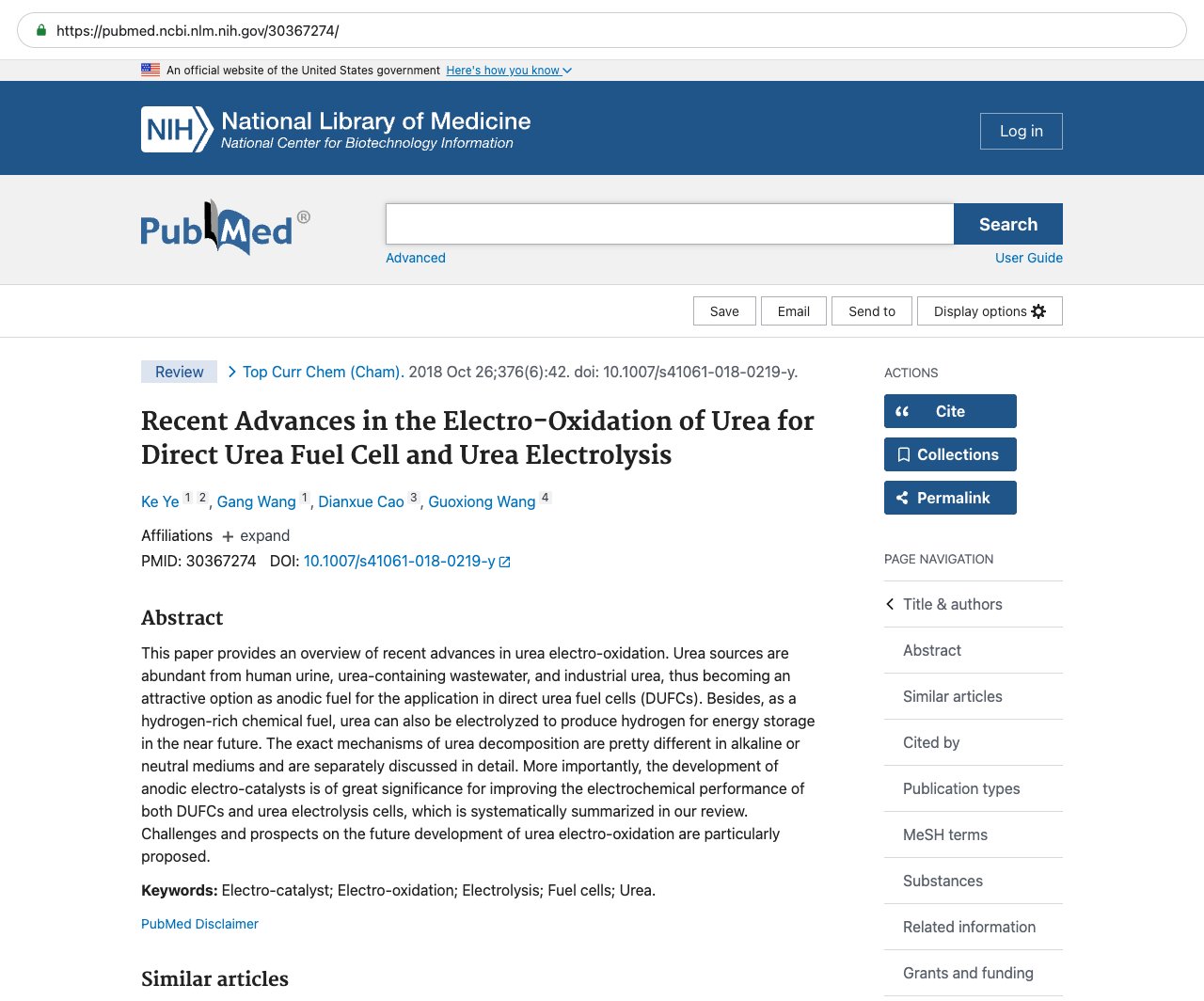
This page mirrors the published abstract (© the authors / publisher) for reference and citation. The canonical source is the PubMed record linked above. This is not medical advice.