2025 · Yin — Research on the Inhibitory Effect of Hydrogen Gas on Ovarian Cancer and Potential Mechanisms
Super-Abstract
Hydrogen gas inhibited ovarian cancer cell viability, migration, and invasion, promoted apoptosis, and reduced tumour size in both cell and animal experiments by modulating oxidative stress markers and suppressing key oncogenic proteins (HIF-1α, NF-κB p65). This preclinical study in SKOV3 cells and mice provides mechanistic insight into hydrogen's anti-tumour potential against one of the deadliest gynaecological cancers. (European Journal of Medical Research, 2025.)
Commentary
Ovarian cancer has the highest mortality among gynaecological malignancies, largely because it is diagnosed late and quickly becomes resistant to chemotherapy. Yin et al. investigate hydrogen gas as a potential adjuvant approach, combining in-vitro work (SKOV3 ovarian cancer cell line) with in-vivo mouse experiments. The in-vitro results are comprehensive: reduced cell viability, inhibited migration and invasion, G1/G2 phase cell cycle arrest, promoted apoptosis, and modulation of oxidative stress markers (MDA increased, SOD decreased — indicating a pro-oxidant shift in tumour cells, consistent with other H₂-cancer studies). The animal experiments confirm smaller tumour volumes and weights, and reduced angiogenesis markers. The downregulation of HIF-1α and NF-κB p65 is notable — these proteins are central to tumour survival under hypoxia and inflammatory signalling respectively. The study is solidly constructed at the preclinical level. However, all data are from cell lines and mouse models — these findings cannot be used to guide treatment decisions in patients.
Key quotes
- „Hydrogen inhibited cell viability, migration, and invasion, promoted apoptosis, and induced G1/G2 phase arrest in SKOV3 cells.“ — the full range of anti-tumour effects observed in the ovarian cancer cell line
- „Hydrogen promoted ROS production, downregulated the expression of HIF-1α, NF-κB p65, and P-p65 proteins, decreased SOD levels, and increased MDA levels.“ — the pro-oxidant and oncogenic protein-suppressing mechanisms in tumour cells
- „The tumor weight and volume in the hydrogen group were significantly smaller than those in the control group.“ — in-vivo confirmation of tumour growth inhibition in mice
Our assessment
This is a preclinical study (cell lines + mouse model) — no human data exist. Ovarian cancer is a serious illness; this research does not constitute evidence that hydrogen treats ovarian cancer in humans. The mechanistic findings are scientifically interesting and consistent with other preclinical H₂-oncology work. Independent replication and progression through animal toxicology and eventually controlled clinical trials would be required before any clinical application.
Study design
- Type: animal and in-vitro study · Model: SKOV3 human ovarian cancer cell line (in vitro) + SKOV3 xenograft mice (in vivo) · H₂ delivery: hydrogen gas inhalation (in vivo); dissolved H₂ in cell medium (in vitro)
- Result: in vitro: inhibited cell viability, migration, invasion; G1/G2 arrest; promoted apoptosis; increased ROS and MDA; decreased SOD; downregulated HIF-1α, NF-κB p65 · in vivo: significantly smaller tumour weight and volume; increased tumour cell apoptosis (TUNEL); reduced angiogenesis markers; lower HIF-1α and p65; increased MDA; decreased SOD
Abstract
Ovarian cancer is one of the most fatal malignancies in women worldwide; current treatment approaches still struggle to effectively control tumor progression. Therefore, it is imperative to explore novel and more effective therapeutic approaches. Hydrogen shows promise as a novel adjuvant therapy, offering new perspectives for ovarian cancer treatment. This study primarily investigates the effects of hydrogen on SKOV3 ovarian cancer cell line viability, apoptosis, migration, invasion, MDA, SOD levels, and key regulatory proteins through experiments including CCK-8, flow cytometry, scratch assay, Transwell assay, immunofluorescence, Western blot, and ELISA. HE staining, TUNEL, immunohistochemistry, immunofluorescence, Western blot, and ELISA were used to verify the antitumor effects of hydrogen in vivo. The results showed that hydrogen inhibited cell viability, migration, and invasion, promoted apoptosis, and induced G1/G2 phase arrest in SKOV3 cells. Additionally, hydrogen promoted ROS production, downregulated the expression of HIF-1α, NF-κB p65, and P-p65 proteins, decreased SOD levels, and increased MDA levels. The results of animal experiments showed that the tumor weight and volume in the hydrogen group were significantly smaller than those in the control group. At the same time, hydrogen promoted tumor cell apoptosis, reduced the levels of angiogenesis markers within the tumor, lowered the protein levels of HIF-1α and p65, increased MDA levels, and decreased SOD levels. Hydrogen provides a new approach for the treatment of ovarian cancer.
Source & links
Screenshot of the PubMed page
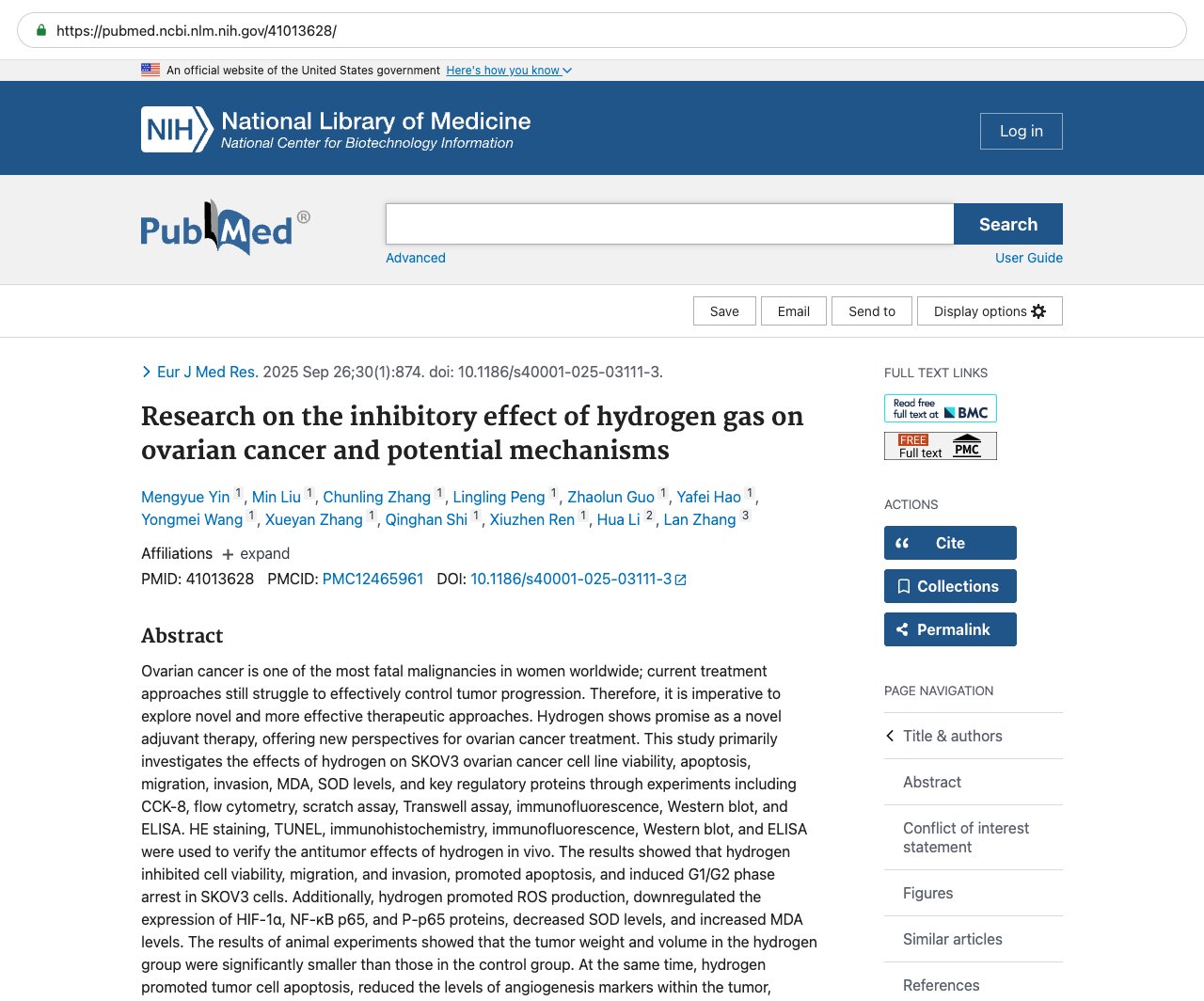
This page mirrors the published abstract (© the authors / publisher) for reference and citation. The canonical source is the PubMed record linked above. This is not medical advice.