2004 · Yu et al. — Studies on human breast cancer tissues with Raman microspectroscopy
Super-Abstract
This in-vitro spectroscopy study uses Raman microspectroscopy to identify molecular differences between normal and malignant human breast tissue samples, finding changes in nucleic acids, proteins, and lipids in cancer tissue. Molecular hydrogen (H₂) is mentioned only peripherally — the paper notes that hydrogen bonds in proteins are disrupted in cancer tissue. There is no H₂ intervention or supplementation aspect.
Commentary
Raman microspectroscopy is a technique that identifies molecular species by their vibrational spectra. This study measured Raman spectra from normal and cancerous human breast tissue and found characteristic spectral differences: increased and shifted DNA/RNA signals (suggesting conformational changes in nucleic acids), altered amide band profiles (protein secondary structure changes), and decreased lipid content in cancer tissue. The only connection to molecular hydrogen is the observation that in cancer tissue, „the proteins show various conformations and disorder structures with their molecular hydrogen bonds nearly broken.“ Here, „molecular hydrogen bonds“ refers to intra- and inter-molecular hydrogen bonding in protein structure — a fundamental chemical concept entirely distinct from dissolved molecular hydrogen (H₂) gas used in supplementation research. No H₂ intervention, no supplementation, no animal model. This is a diagnostic tissue characterisation study.
Key quotes
- „The proteins show various conformations and disorder structures with their molecular hydrogen bonds nearly broken.“ — the only mention of „hydrogen“ — refers to intramolecular hydrogen bonds in protein structure, not H₂ gas
- „This investigation shows that Raman microspectroscopy is useful to biochemical study and vivo diagnosis of human breast cancers.“ — the paper's primary conclusion: Raman spectroscopy as a diagnostic tool
- „The contents of lipids decrease obviously.“ — one of three main biochemical changes characterising malignant vs. normal breast tissue
Our assessment
This is an in-vitro tissue spectroscopy study about breast cancer tissue characterisation using Raman microspectroscopy. The word „hydrogen“ in the abstract refers to chemical hydrogen bonds within proteins — not to molecular hydrogen (H₂) gas. This paper has no relevance to H₂ supplementation, antioxidant H₂, or any therapeutic H₂ application.
Study design
- Type: in-vitro tissue study · Model: normal and malignant human breast tissue samples (ex vivo) · H₂ relevance: none — „hydrogen bonds“ in the text refers to intramolecular protein chemistry, not H₂ gas
- Result: Raman spectra distinguish normal from malignant breast tissue via nucleic acid, protein, and lipid spectral signatures; proposed as a diagnostic tool
Abstract
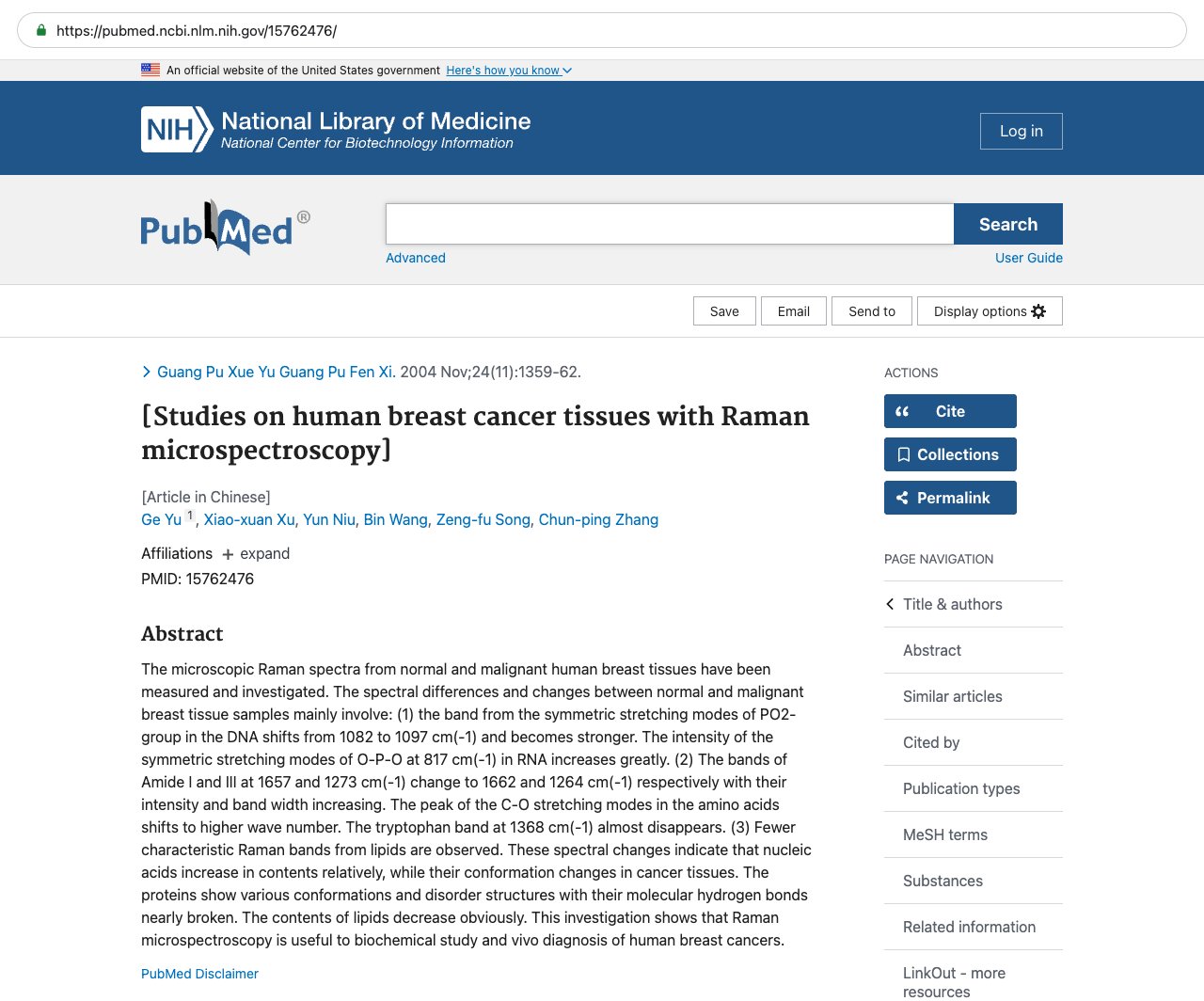
The microscopic Raman spectra from normal and malignant human breast tissues have been measured and investigated. The spectral differences and changes between normal and malignant breast tissue samples mainly involve: (1) the band from the symmetric stretching modes of PO2- group in the DNA shifts from 1082 to 1097 cm(-1) and becomes stronger. The intensity of the symmetric stretching modes of O-P-O at 817 cm(-1) in RNA increases greatly. (2) The bands of Amide I and III at 1657 and 1273 cm(-1) change to 1662 and 1264 cm(-1) respectively with their intensity and band width increasing. The peak of the C-O stretching modes in the amino acids shifts to higher wave number. The tryptophan band at 1368 cm(-1) almost disappears. (3) Fewer characteristic Raman bands from lipids are observed. These spectral changes indicate that nucleic acids increase in contents relatively, while their conformation changes in cancer tissues. The proteins show various conformations and disorder structures with their molecular hydrogen bonds nearly broken. The contents of lipids decrease obviously. This investigation shows that Raman microspectroscopy is useful to biochemical study and vivo diagnosis of human breast cancers.
Source & links
Screenshot of the PubMed page
This page mirrors the published abstract (© the authors / publisher) for reference and citation. The canonical source is the PubMed record linked above. This is not medical advice.