2025 · Zamanian — The Roles of Neuroinflammation in l-DOPA-Induced Dyskinesia: Dissecting the Roles of NF-κB and TNF-α for Novel Pharmacological Therapeutic Approaches
Super-Abstract
Levodopa-induced dyskinesia (LID) — involuntary movements that develop in Parkinson's patients on long-term levodopa therapy — involves neuroinflammation driven by NF-κB and TNF-α; this review surveys pharmacological approaches targeting these pathways, including hydrogen gas inhalation as one agent that reduces pro-inflammatory cytokines associated with dyskinesia. (The European Journal of Neuroscience, 2025.)
Commentary
Levodopa is the most effective treatment for Parkinson's disease, but chronic use leads to levodopa-induced dyskinesia (LID) in the majority of patients over time. LID involves aberrant dopaminergic signalling, excessive synaptic plasticity, and — increasingly recognised — sustained neuroinflammation. This review focuses on the NF-κB and TNF-α signalling axes: NF-κB activation in glial cells fuels chronic neuroinflammation that degrades dopaminergic neurons; TNF-α levels correlate with dyskinesia severity. Pharmacological agents reviewed include agmatine, resveratrol, doxycycline, fasudil (ROCK inhibitor), CB2 agonists, and hydrogen gas. For H₂, the authors note that hydrogen gas inhalation decreases pro-inflammatory cytokine levels associated with LID — a finding drawn from experimental (animal) studies. H₂ is one agent among seven discussed; the review does not provide dedicated clinical trial data on hydrogen in LID.
Key quotes
- „Hydrogen gas inhalation decreases pro-inflammatory cytokine levels associated with LID.“ — the specific claim about H₂: reduced neuroinflammatory cytokines in levodopa-induced dyskinesia models
- „NF-κB activation in glial cells contributes to sustained neuroinflammation and exacerbates dopaminergic neuron loss.“ — the central neuroinflammatory mechanism driving LID progression
- „Targeting neuroinflammation and glial activation through these pathways represents a promising strategy for developing novel LID treatments.“ — the therapeutic rationale: neuroinflammation as a modifiable driver of dyskinesia
Our assessment
This is a narrative review on neuroinflammatory mechanisms in LID. Hydrogen gas inhalation is mentioned as one of several anti-inflammatory candidates — the claim of reduced cytokines in LID is based on animal models, not human clinical trials. No dedicated phase II/III data on H₂ in Parkinson's dyskinesia are cited. The NF-κB/TNF-α mechanistic framework is well-supported by the cited literature and represents a legitimate therapeutic hypothesis. Overall, this is an early-stage, preclinical evidence paper for H₂ in this specific indication; results cannot be directly extrapolated to patients.
Study design
- Type: narrative review (neuroinflammation and LID) · n: n/a (literature synthesis) · H₂ delivery: inhalation of hydrogen gas (as cited in animal studies of LID models)
- Result: NF-κB and TNF-α identified as neuroinflammatory drivers of LID; H₂ inhalation associated with reduced pro-inflammatory cytokines in LID models (preclinical); listed alongside agmatine, resveratrol, doxycycline, fasudil, CB2 agonists as candidate approaches; no human trial data for H₂ in LID
Abstract
Levodopa-induced dyskinesia (LID) is a common and debilitating complication of long-term Parkinson's disease treatment. This review explores the roles of NF-κB and TNF-α signalling pathways in LID pathophysiology and potential therapeutic approaches targeting these mechanisms. Chronic levodopa treatment leads to aberrant neuroplasticity and neuroinflammation, involving activation of NF-κB and increased production of pro-inflammatory cytokines like TNF-α. NF-κB activation in glial cells contributes to sustained neuroinflammation and exacerbates dopaminergic neuron loss. TNF-α levels are elevated in brain regions affected by LID and correlate with dyskinesia severity. Several compounds are involved in mitigating LID by modulating these pathways. Agmatine reduces NF-κB activation and NMDA receptor expression while protecting dopaminergic neurons. Resveratrol and doxycycline demonstrate antidyskinetic effects by attenuating neuroinflammation and TNF-α production. The Rho-kinase (ROCK) inhibitor fasudil and cannabinoid receptor 2 (CB2) receptor agonists also show efficacy in reducing LID severity and neuroinflammation. Hydrogen gas inhalation decreases pro-inflammatory cytokine levels associated with LID. These findings highlight the complex interplay between NF-κB, TNF-α and other neurotransmitter systems in LID pathogenesis. Targeting neuroinflammation and glial activation through these pathways represents a promising strategy for developing novel LID treatments. Further research is needed to fully elucidate the mechanisms and optimize therapeutic approaches targeting NF-κB and TNF-α signalling in LID.
Source & links
Screenshot of the PubMed page
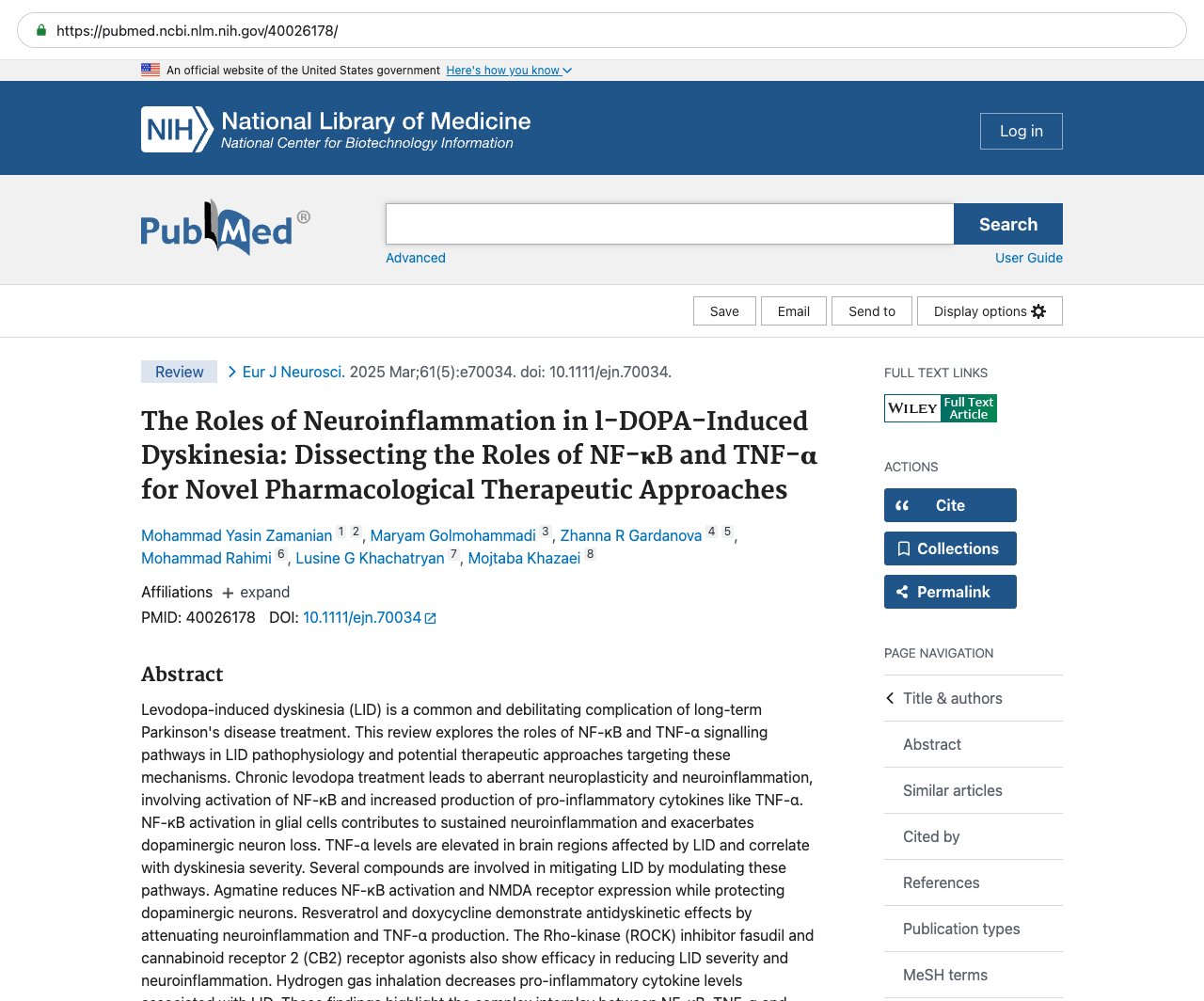
This page mirrors the published abstract (© the authors / publisher) for reference and citation. The canonical source is the PubMed record linked above. This is not medical advice.