2023 · Zeng et al. — Effect of Hydrogen/Oxygen Therapy for Ordinary COVID-19 Patients: A Propensity-Score Matched Case-Control Study
Super-Abstract
In a retrospective comparison of 33 patients with ordinary COVID-19 who inhaled a hydrogen/oxygen mixture and 55 matched patients who received oxygen, the median hospital stay was 12 days compared with 13 days (hazard ratio 1.91, p < 0.05). Discharge rates were higher in the hydrogen/oxygen group at 21 and 28 days, but the difference at 14 days (69.7% compared with 56.4%) was not statistically significant. Oxygen saturation after 5 days of therapy was 98.5% compared with 97.8% (p < 0.001). Treatment was not randomly assigned, so unmeasured differences between the groups may account for part of the results. (BMC Infectious Diseases, 2023.)
Commentary
Hydrogen/oxygen therapy is reported to ease breathlessness and slow disease progression in respiratory diseases, and the authors asked whether it shortens hospital stays in ordinary COVID-19, which per full text means mild symptoms with typical lung changes but no severe pneumonia. The retrospective study drew on 180 hospitalised patients from 3 centres in China. Propensity-score matching at a 1:2 ratio selected 33 patients who had received hydrogen/oxygen and 55 who had received oxygen. Per full text, patients were treated between December 2019 and March 2020, and matching used only sex, age and days from symptom onset to admission. Per full text, the hydrogen/oxygen mixture (2:1 by volume) was given by nasal mask at 3.0 L/min for at least 6 hours a day over more than 7 consecutive days, while the oxygen group received oxygen at under 3.0 L/min for a period set by clinical need. Both groups received standard care. The primary endpoint was length of hospital stay. Secondary endpoints were discharge rates and oxygen saturation (SpO2).
Key quotes
- „Findings confirmed a significantly lower median length of hospitalization (HR = 1.91; 95% CIs, 1.25-2.92; p < 0.05) in the hydrogen/oxygen group (12 days; 95% CI, 9-15) versus the oxygen group (13 days; 95% CI, 11-20).“ — the primary endpoint: a one-day difference in median hospital stay
- „The higher hospital discharge rates were observed in the hydrogen/oxygen group at 21 days (93.9% vs. 74.5%; p < 0.05) and 28 days (97.0% vs. 85.5%; p < 0.05) compared with the oxygen group, except for 14 days (69.7% vs. 56.4%).“ — a secondary endpoint; the 14-day difference was not statistically significant
- „This study indicated that hydrogen/oxygen might be a useful therapeutic medical gas to enhance SpO2 and shorten length of hospitalization in patients with ordinary COVID-19.“ — the authors' conclusion, phrased with 'might'
Our assessment
The study compares patients who received different treatments in routine care early in the pandemic. Median hospital stay was one day shorter with hydrogen/oxygen (12 compared with 13 days), and the 14-day discharge rate did not differ significantly. Propensity-score matching made the groups similar in sex, age and time from symptom onset, but it cannot balance unmeasured factors, such as the reasons a patient received one treatment or the other. Per full text, the groups also differed in flow rate and treatment duration, so the comparison is between two regimens rather than hydrogen alone, and baseline SpO2 was already 98.1% compared with 97.4% (p = 0.056). The subgroup analysis compared younger with older patients and those with and without comorbidities within the hydrogen/oxygen group only, so it cannot show who benefits more from hydrogen. Limitations: retrospective design, no randomisation, blinding not reported, 33 and 55 matched patients, 3 centres in one country, and per full text incomplete SpO2 data.
Study design
- Type: retrospective, propensity-score matched case-control study at 3 centres in China, not randomised · n: 33 hydrogen/oxygen and 55 oxygen after 1:2 matching, from 180 patients · H₂ delivery: inhaled hydrogen/oxygen mixture (2:1 by volume) by nasal mask, per full text 3.0 L/min for at least 6 hours a day over more than 7 days
- Comparator: oxygen therapy, per full text at under 3.0 L/min with duration set by clinical need; standard care in both groups
- Result: median hospital stay 12 vs. 13 days (HR 1.91, 95% CI 1.25–2.92, p < 0.05). Discharge at 14 days 69.7% vs. 56.4% (not significant), at 21 days 93.9% vs. 74.5% and at 28 days 97.0% vs. 85.5% (both p < 0.05). SpO2 after 5 days 98.5% vs. 97.8% (p < 0.001). Per full text no deaths or significant adverse effects
Abstract
BACKGROUND: Hydrogen/oxygen therapy contribute to ameliorate dyspnea and disease progression in patients with respiratory diseases. Therefore, we hypothesized that hydrogen/oxygen therapy for ordinary coronavirus disease 2019 (COVID-19) patients might reduce the length of hospitalization and increase hospital discharge rates. METHODS: This retrospective, propensity-score matched (PSM) case-control study included 180 patients hospitalized with COVID-19 from 3 centers. After assigned in 1:2 ratios by PSM, 33 patients received hydrogen/oxygen therapy and 55 patients received oxygen therapy included in this study. Primary endpoint was the length of hospitalization. Secondary endpoints were hospital discharge rates and oxygen saturation (SpO2). Vital signs and respiratory symptoms were also observed. RESULTS: Findings confirmed a significantly lower median length of hospitalization (HR = 1.91; 95% CIs, 1.25-2.92; p < 0.05) in the hydrogen/oxygen group (12 days; 95% CI, 9-15) versus the oxygen group (13 days; 95% CI, 11-20). The higher hospital discharge rates were observed in the hydrogen/oxygen group at 21 days (93.9% vs. 74.5%; p < 0.05) and 28 days (97.0% vs. 85.5%; p < 0.05) compared with the oxygen group, except for 14 days (69.7% vs. 56.4%). After 5-day therapy, patients in hydrogen/oxygen group exhibited a higher level of SpO2 compared with that in the oxygen group (98.5%±0.56% vs. 97.8%±1.0%; p < 0.001). In subgroup analysis of patients received hydrogen/oxygen, patients aged < 55 years (p = 0.028) and without comorbidities (p = 0.002) exhibited a shorter hospitalization (median 10 days). CONCLUSION: This study indicated that hydrogen/oxygen might be a useful therapeutic medical gas to enhance SpO2 and shorten length of hospitalization in patients with ordinary COVID-19. Younger patients or those without comorbidities are likely to benefit more from hydrogen/oxygen therapy.
Source & links
Screenshot of the PubMed page
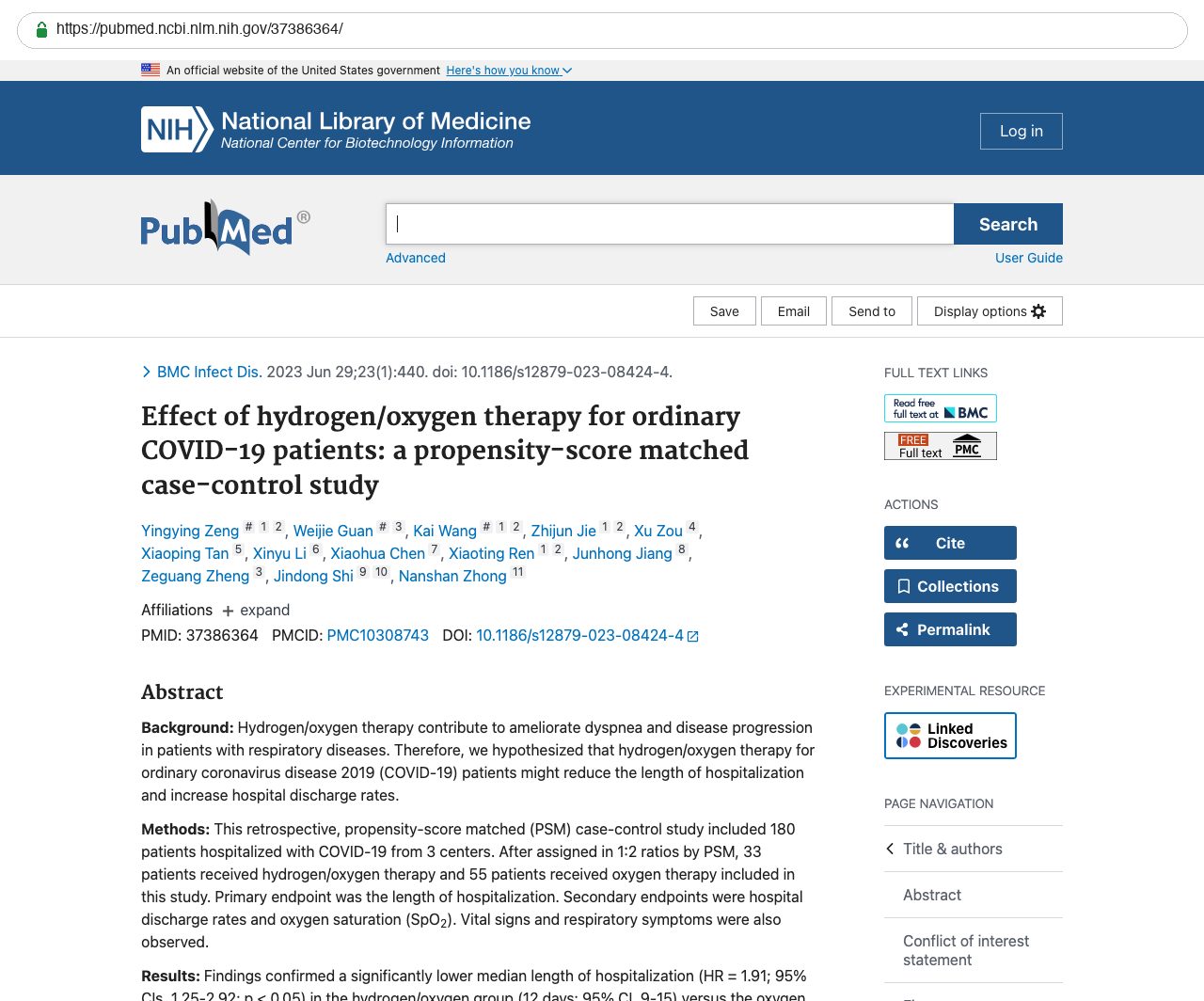
This page mirrors the published abstract (© the authors / publisher) for reference and citation. The canonical source is the PubMed record linked above. This is not medical advice.