2022 · Zhang — Metal-Organic-Framework-Based Hydrogen-Release Platform for Multieffective Helicobacter Pylori Targeting Therapy and Intestinal Flora Protective Capabilities
Super-Abstract
Researchers developed a pH-responsive nanoparticle system (palladium-hydrogen loaded into a zinc-based metal-organic framework, coated with an anti-inflammatory hydrogel) that, in both cell and animal experiments, selectively targets stomach inflammation sites, releases hydrogen to kill H. pylori, reduces inflammation, and protects the intestinal microbiome. This is an in-vitro and animal study; no clinical human data exist. (Advanced Materials, 2022.)
Commentary
Helicobacter pylori infection affects roughly half the world's population and drives chronic gastritis, peptic ulcer disease, and gastric cancer risk. The standard treatment — antibiotic triple therapy — is increasingly compromised by antibiotic resistance and causes collateral damage to the gut microbiome. This study proposes an elegant engineering solution: a palladium-loaded, hydrogen-storing metal-organic framework (Pd(H) @ ZIF-8) encapsulated in an ascorbate palmitate (AP) hydrogel. The AP outer layer is designed to adhere to inflamed tissue via electrostatic interactions and is then cleaved by matrix metalloproteinases (MMPs) enriched at inflammatory sites — providing targeted release. The freed Pd(H) @ ZIF-8 nanoparticles are further dissolved by gastric acid, releasing zinc ions (Zn²⁺) with direct antimicrobial activity and hydrogen gas with antioxidant and anti-inflammatory properties. An unexpected but potentially important secondary finding was that the platform appeared to protect intestinal flora balance — unlike standard antibiotics. Both in-vitro and in-vivo (mouse) experiments supported efficacy. The complexity of the nanotechnology platform means clinical translation will face significant regulatory and manufacturing challenges.
Key quotes
- „the outer AP hydrogel can target and adhere to the inflammatory site through electrostatic interactions, and is then hydrolyzed by matrix metalloproteinase (MMP) enriching in inflammatory sites.“ — the targeted delivery mechanism exploiting the inflammatory microenvironment
- „the released Pd(H) @ ZIF-8 nanoparticles are further decomposed by gastric acid to generate zinc ions (Zn2+) and hydrogen, thus effectively killing H. pylori, alleviating inflammation and restoring impaired gastric mucosa simultaneously.“ — the triple-action mechanism: antimicrobial Zn²⁺ + anti-inflammatory H₂ + mucosal repair
- „this metal-organic framework hydrogen-generation platform also has an effect toward avoiding the imbalance of intestinal flora, which thus provides a more precise, effective, and healthy strategy for the treatment of H. pylori infection.“ — the unexpected microbiome-protective finding
Our assessment
A sophisticated in-vitro and animal proof-of-concept study for nanoparticle-mediated targeted H₂ delivery against H. pylori. The multi-mechanism design (targeted delivery + antimicrobial Zn²⁺ + H₂ anti-inflammation + microbiome protection) is scientifically creative. However, this is entirely preclinical research. The safety, pharmacokinetics, manufacturability, and regulatory pathway for such a complex nanoparticle system in humans are entirely untested. The findings are a compelling research direction, not a clinical application.
Study design
- Type: in-vitro + preclinical animal study · Model: in-vitro H. pylori infection model + in-vivo mouse gastritis model · H₂ delivery: Pd(H) @ ZIF-8 @ AP nanoparticle system releasing H₂ and Zn²⁺ on contact with gastric acid
- Result: targeted adhesion to inflamed gastric tissue via MMP cleavage; effective H. pylori elimination in vitro and in vivo; simultaneous anti-inflammatory and mucosal-repair effects; intestinal flora imbalance avoided
Abstract
Helicobacter pylori (H. pylori) infection is the leading cause of chronic gastritis, peptic ulcer, and gastric cancer. Antibiotics, as traditional method for eliminating H. pylori, have no targeting effect, which causes serious bacterial resistance and gut dysbacteriosis. Moreover, antibiotics can hardly address hyperactive inflammatory response or damaged gastric mucosal barrier caused by H. pylori infection. Here, a pH-responsive metal-organic framework hydrogen-generation nanoparticle (Pd(H) @ ZIF-8) is reported, which is encapsulated with ascorbate palmitate (AP) hydrogel. Both in vitro and in vivo experiments demonstrate that the outer AP hydrogel can target and adhere to the inflammatory site through electrostatic interactions, and is then hydrolyzed by matrix metalloproteinase (MMP) enriching in inflammatory sites. The released Pd(H) @ ZIF-8 nanoparticles are further decomposed by gastric acid to generate zinc ions (Zn2+ ) and hydrogen, thus effectively killing H. pylori, alleviating inflammation and restoring impaired gastric mucosa simultaneously. Unexpectedly, this metal-organic framework hydrogen-generation platform (Pd(H) @ ZIF-8 @ AP) also has an effect toward avoiding the imbalance of intestinal flora, which thus provides a more precise, effective, and healthy strategy for the treatment of H. pylori infection.
Source & links
Screenshot of the PubMed page
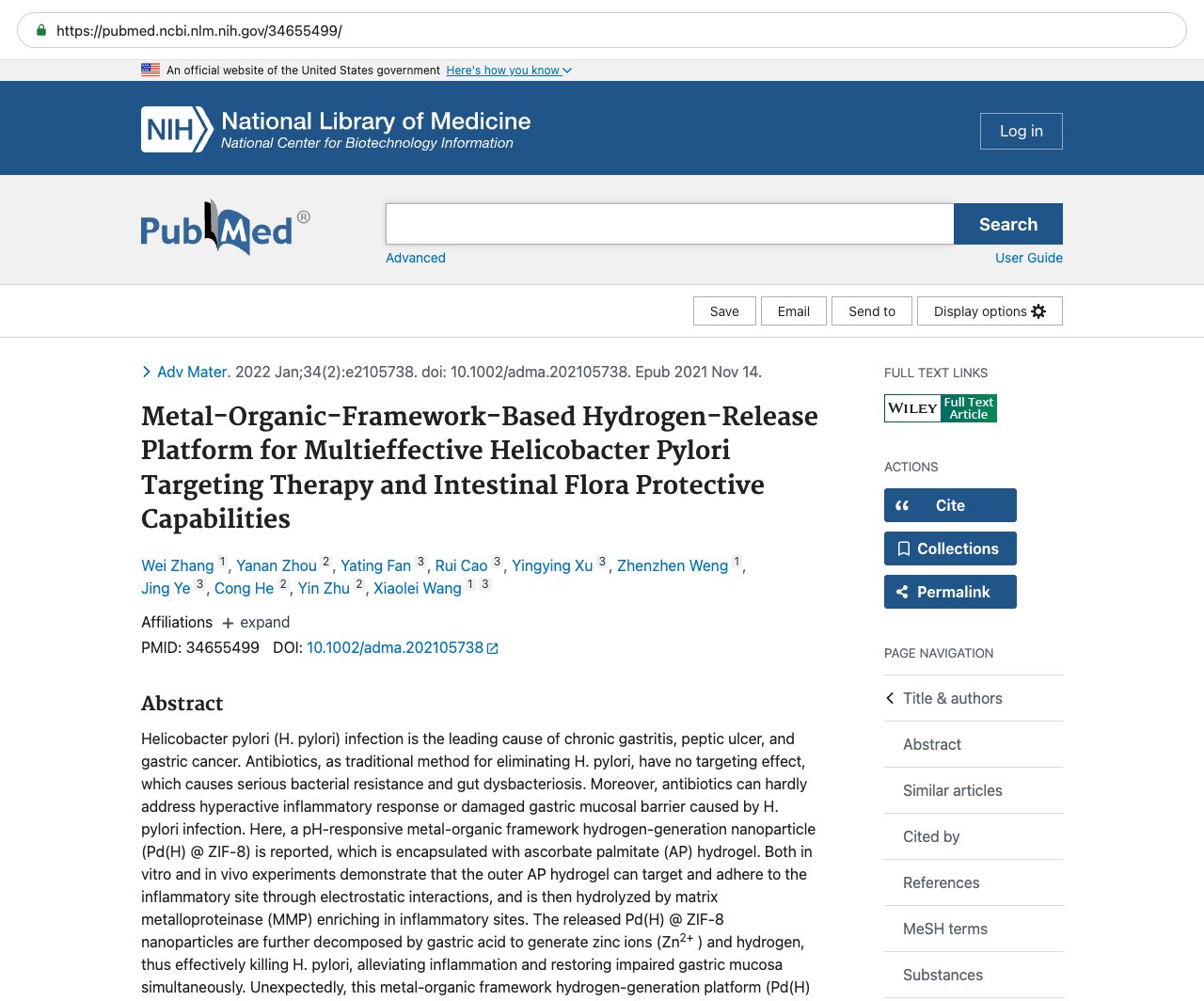
This page mirrors the published abstract (© the authors / publisher) for reference and citation. The canonical source is the PubMed record linked above. This is not medical advice.