2022 · Zhang et al. — Molecular Hydrogen Is a Potential Protective Agent in the Management of Acute Lung Injury
Super-Abstract
Molecular hydrogen (H₂) may offer protective effects in acute lung injury (ALI) and acute respiratory distress syndrome (ARDS) — two life-threatening conditions seen in critically ill patients, including those with severe COVID-19. This review summarises the key biological mechanisms by which H₂ may counteract the underlying pathology of ALI, including anti-inflammation, antioxidation, and regulation of cell death. (Molecular Medicine, 2022.)
Commentary
ALI and ARDS remain difficult to treat, and the COVID-19 pandemic brought renewed urgency to the search for supportive therapies. This narrative review surveys the existing evidence — primarily from animal models and in-vitro experiments — on H₂ as a potential intervention. The authors highlight three main mechanistic avenues: selective scavenging of hydroxyl radicals and peroxynitrite, modulation of inflammatory cytokines, and regulation of autophagy and apoptosis. While the mechanistic picture is plausible and internally consistent, the clinical evidence base for H₂ in ALI remains thin. The paper explicitly frames H₂ as a theoretical basis for future clinical trials in ALI and COVID-19, not as an established treatment.
Key quotes
- „The biological effects of molecular hydrogen mainly involve anti-inflammation, antioxidation, and autophagy and cell death modulation.“ — summary of the three main mechanistic pathways attributed to H₂ in ALI
- „Several studies have demonstrated the preventive and therapeutic effects of molecular hydrogen in the various diseases.“ — the broader evidence base that motivates focusing on H₂ for lung injury
- „This review focuses on the potential therapeutic effects of molecular hydrogen on ALI and its underlying mechanisms and aims to provide a theoretical basis for the clinical treatment of ALI and COVID-19.“ — the authors frame this explicitly as a theoretical foundation, not a clinical proof
Our assessment
This is a review article — it synthesises existing preclinical and theoretical literature but presents no new experimental data. The mechanistic arguments for H₂ in lung injury are scientifically grounded and consistent with the broader H₂ biology literature. However, robust clinical evidence from randomised controlled trials in ALI/ARDS patients is still lacking. Honest limitation: the COVID-19 connection in particular is speculative, as the review does not present controlled human trial data for H₂ in COVID-19 patients. The paper is useful as a research roadmap but should not be read as clinical evidence of efficacy.
Study design
- Type: narrative review · n: n/a (literature analysis) · H₂ delivery: various (as discussed in reviewed studies — inhalation and dissolved H₂)
- Result: no pooled effect sizes; narrative synthesis concludes H₂ has anti-inflammatory, antioxidative, and autophagy-regulatory potential in ALI models; authors call for clinical trials to establish efficacy in humans
Abstract
Acute lung injury (ALI) and acute respiratory distress syndrome, which is a more severe form of ALI, are life-threatening clinical syndromes observed in critically ill patients. Treatment methods to alleviate the pathogenesis of ALI have improved to a great extent at present. Although the efficacy of these therapies is limited, their relevance has increased remarkably with the ongoing pandemic caused by the novel coronavirus disease 2019 (COVID-19), which causes severe respiratory distress syndrome. Several studies have demonstrated the preventive and therapeutic effects of molecular hydrogen in the various diseases. The biological effects of molecular hydrogen mainly involve anti-inflammation, antioxidation, and autophagy and cell death modulation. This review focuses on the potential therapeutic effects of molecular hydrogen on ALI and its underlying mechanisms and aims to provide a theoretical basis for the clinical treatment of ALI and COVID-19.
Source & links
Screenshot of the PubMed page
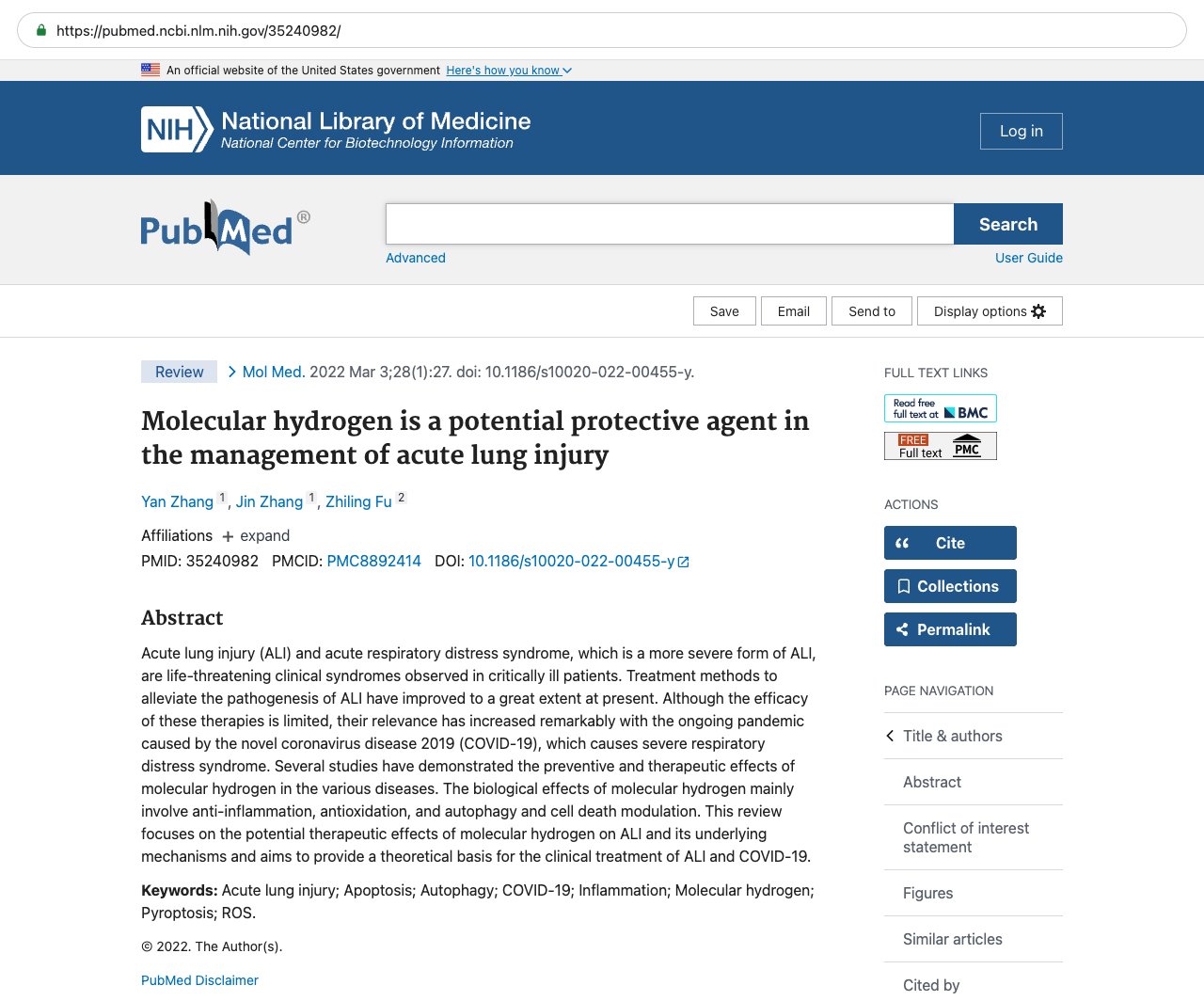
This page mirrors the published abstract (© the authors / publisher) for reference and citation. The canonical source is the PubMed record linked above. This is not medical advice.