2023 Diseases (Basel, Switzerland) Pilot / Observational Human H₂ therapy Drinking (HRW)Tablets Respiratory / COVIDOxidative stress
2023 · Singh et al. — Can Hydrogen Water Enhance Oxygen Saturation in Patients with Chronic Lung Disease? A Non-Randomized, Observational Pilot Study
Super-Abstract
In 10 patients with chronic lung disease and reduced oxygen saturation, 4 weeks of high-concentration hydrogen-rich water was associated with higher oxygen saturation and lower oxidative stress markers compared with baseline, in a small study without a control group. The abstract reports no values or p-values. Per full text, 7 of the 10 patients showed improved oxygen saturation and 3 did not. Patients continued other treatments per full text, so the changes cannot be attributed to hydrogen. (Diseases, 2023.)
Commentary
Chronic lung diseases are linked to inflammation and oxidative stress, and this pilot study asked whether hydrogen-rich water raises oxygen saturation in such patients. Ten patients took part: 7 with COPD, 2 with bronchial asthma and 1 with lung tuberculosis, all with oxygen saturation of 90-95%. Per full text, they were 63.1 ± 8.3 years old, had not responded to 7 to 10 days of conventional treatment and were seen at one hospital in India. They drank high-concentration (>5 mM) hydrogen-rich water made with hydrogen-producing tablets for 4 weeks; per full text, 5 tablets a day (3 in the morning, 2 in the evening), each dissolved in 200 to 300 mL of water. There was no control group or placebo. Oxygen saturation was measured by oximeter and blood pressure by an automatic recorder. Blood markers of oxidative stress (TBARS, MDA, diene conjugates), vitamin E and nitrite were also measured. The abstract does not name a primary endpoint.
Key quotes
- „HRW administration was associated with a significant increase in oxygen saturation (SpO2) and decrease in TBARS, MDA, and diene conjugates, with an increase in vitamin E and nitrite levels, compared to baseline levels.“ — the main result, measured against each patient's own baseline
- „Physical training carried out after HRW therapy appeared to increase exercise tolerance and decrease hypoxia, as well as delay the need for oxygen therapy.“ — an observation without reported measurements or numbers in the abstract
- „Treatment with HRW in patients with hypoxia from chronic lung diseases may decrease oxidative stress and improve oxygen saturation in some patients.“ — the authors' conclusion, limited to some patients
Our assessment
This non-randomised pilot study compares each patient's values after 4 weeks with the values at baseline. Oxygen saturation rose and oxidative stress markers fell compared with baseline. Without a control group, the study cannot separate an effect of hydrogen from other treatments, natural fluctuation or the fact that patients were enrolled at a low point. Per full text, patients entered after not responding to conventional treatment and continued other therapies, and 3 of 10 showed no gain in oxygen saturation. The statement on exercise tolerance and delayed oxygen therapy is not backed by measurements in the abstract. Limitations: a small group with different lung diseases, one centre, open treatment, no values or p-values in the abstract, no primary endpoint named, and laboratory markers rather than clinical outcomes. Per full text, the number of men is given inconsistently (7 or 8 of 10). The findings are preliminary.
Study design
- Type: observational pilot study without randomisation, one group measured before and after, no control group · n: 10 (7 COPD, 2 asthma, 1 lung tuberculosis) · H₂ delivery: drinking hydrogen-rich water (>5 mM) made with hydrogen-producing tablets for 4 weeks; per full text 5 tablets a day
- Comparator: none; each patient's own baseline values
- Result: oxygen saturation increased, TBARS, MDA and diene conjugates decreased, vitamin E and nitrite increased compared with baseline (reported as significant, no figures in the abstract). Per full text, 7 of 10 had improved oxygen saturation. Exercise tolerance: descriptive statement only
Abstract
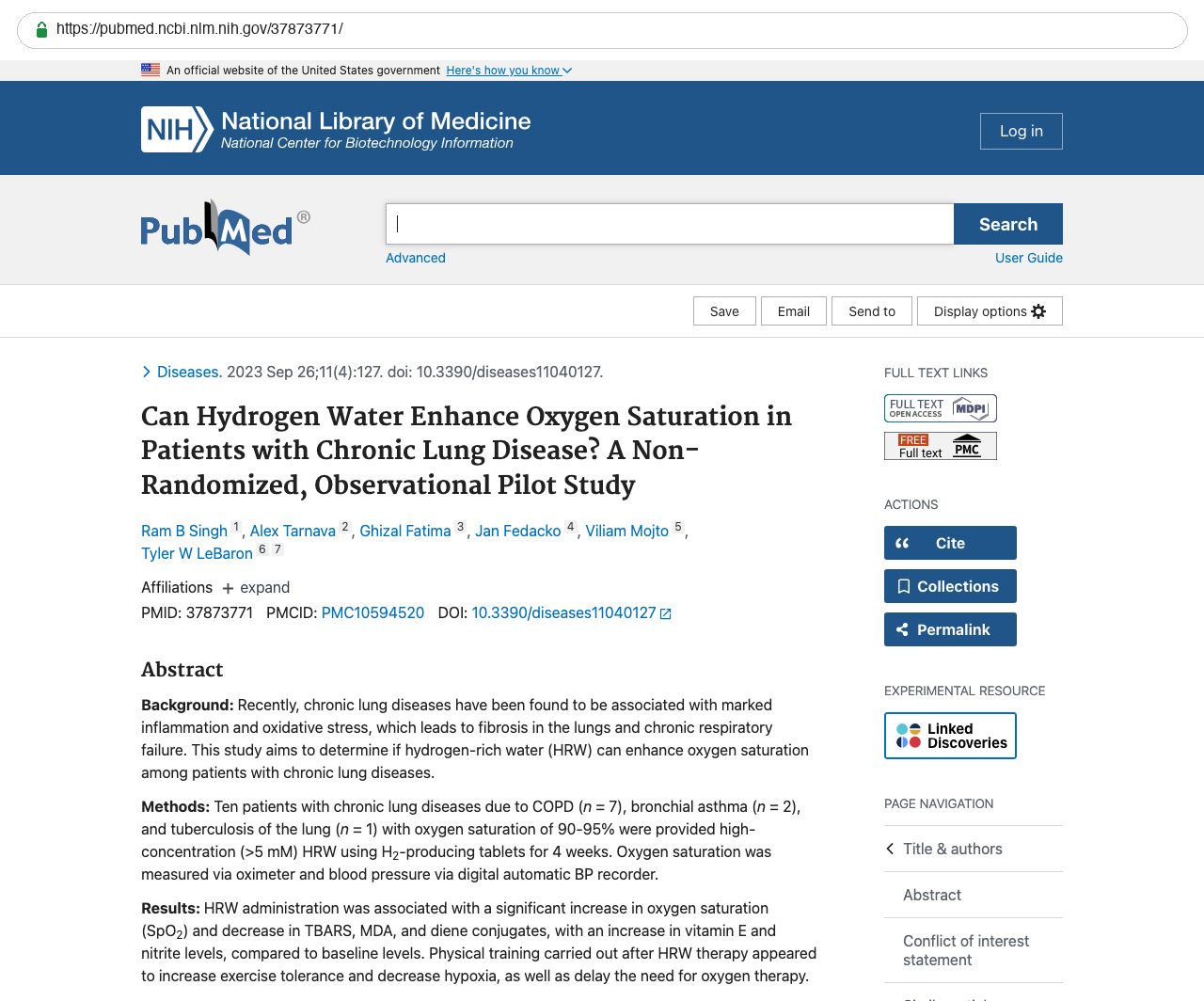
BACKGROUND: Recently, chronic lung diseases have been found to be associated with marked inflammation and oxidative stress, which leads to fibrosis in the lungs and chronic respiratory failure. This study aims to determine if hydrogen-rich water (HRW) can enhance oxygen saturation among patients with chronic lung diseases. METHODS: Ten patients with chronic lung diseases due to COPD (n = 7), bronchial asthma (n = 2), and tuberculosis of the lung (n = 1) with oxygen saturation of 90-95% were provided high-concentration (>5 mM) HRW using H2-producing tablets for 4 weeks. Oxygen saturation was measured via oximeter and blood pressure via digital automatic BP recorder. RESULTS: HRW administration was associated with a significant increase in oxygen saturation (SpO2) and decrease in TBARS, MDA, and diene conjugates, with an increase in vitamin E and nitrite levels, compared to baseline levels. Physical training carried out after HRW therapy appeared to increase exercise tolerance and decrease hypoxia, as well as delay the need for oxygen therapy. CONCLUSION: Treatment with HRW in patients with hypoxia from chronic lung diseases may decrease oxidative stress and improve oxygen saturation in some patients. HRW therapy may also provide increased exercise tolerance in patients with chronic hypoxia, but further research is needed.
Source & links
Screenshot of the PubMed page
This page mirrors the published abstract (© the authors / publisher) for reference and citation. The canonical source is the PubMed record linked above. This is not medical advice.