2025 Journal of thoracic disease Pilot / Observational Human H₂ therapy Inhalation Sports & ExerciseOxidative stressRespiratory / COVID
2025 · Zhang et al. — Alleviation of Exercise-Induced Injury by Hydrogen Inhalation via the Reduction of Oxidative Stress and Inflammation in Athletes
Super-Abstract
In 31 healthy athletes assigned to groups without randomisation, those who inhaled hydrogen once after exercise showed improved antioxidant capacity and reduced white blood cell count and C-reactive protein, according to an abstract that gives no figures or P values. Per full text, the C-reactive protein difference before winter training was not statistically significant, and after winter training C-reactive protein was significantly higher in the hydrogen group. The abstract describes only blood markers, so its conclusion about lung injury does not rest on lung measurements. (Journal of Thoracic Disease, 2025.)
Commentary
Strenuous exercise can cause exercise-induced lung injury, which the authors attribute mainly to oxidative stress and systemic inflammation. The study asked whether hydrogen inhalation reduces exercise-induced stress responses in athletes. Per full text, it was a non-randomised controlled study at a sports school in Shanghai. Of 46 recruited athletes aged 15 to 27, 31 were analysed and assigned by willingness and training schedule to a control group (n = 14), an infrared blanket group (n = 9) or a hydrogen group (n = 8). Per full text, after a sprint cycling test the hydrogen group inhaled 66.7% hydrogen and 33.3% oxygen at 3 L/min for 20 minutes, once, without blinding. Blood was taken before and after winter training and analysed for oxidative stress markers, white blood cell count, C-reactive protein, red blood cell values, creatine kinase, urea nitrogen and hormones (per full text testosterone and cortisol, labelled cholesterol in the abstract). Per full text, 24 participants were retested after winter training. The abstract does not name a primary endpoint.
Key quotes
- „After a single postexercise intervention, the H2 group showed improved antioxidant capacity and reduced WBC and CRP levels.“ — the main result, reported without figures or P values
- „Moreover, the H2 group maintained stable RBC, HB, and HCT levels, unlike the infrared blanket group, suggesting better preservation of oxygen-carrying capacity and hematological stability.“ — a secondary comparison with the infrared blanket group
- „H2 inhalation attenuates exercise-induced lung injury by reducing oxidative stress and inflammation.“ — the authors' conclusion, although no lung measurements are described
Our assessment
The abstract reports better antioxidant and inflammation markers after hydrogen inhalation but gives no figures, P values or primary endpoint. Limitations: per full text, groups were formed by willingness and training schedule, not randomly, and participants knew their group. Only 8 athletes inhaled hydrogen, and 6 of them were retested after winter training. Per full text (methods), the hydrogen mixture contained 33.3% oxygen while controls breathed room air with 21%, so oxygen exposure was not matched and hydrogen's contribution cannot be isolated. Hydrogen was given once, so differences after winter training are hard to attribute to it. The abstract describes only blood markers, so the conclusion about lung injury is not based on lung measurements. Per full text, C-reactive protein was not significantly lower before winter training and significantly higher in the hydrogen group afterwards, and creatine kinase was significantly higher than in controls after the single session. The results do not show that hydrogen protects the lungs.
Study design
- Type: non-randomised controlled intervention study with three groups, open label (per full text) · n: 31 analysed (14 control, 9 infrared blanket, 8 hydrogen), per full text 46 recruited and 24 retested after winter training · H₂ delivery: inhalation once after exercise, per full text 66.7% hydrogen and 33.3% oxygen at 3 L/min for 20 minutes
- Comparator: per full text natural recovery breathing room air (control) and a 20-minute infrared blanket session
- Result: after the single session, improved antioxidant capacity and lower WBC and CRP reported, with effects described as persisting after winter training (no figures or P values in the abstract). RBC, HB and HCT stable in the hydrogen group, unlike the infrared blanket group. Per full text, CRP not significantly lower before winter training and significantly higher in the hydrogen group after it. No lung measurements described
Abstract
BACKGROUND: Strenuous exercise can lead to exercise-induced lung injury, primarily driven by elevated oxidative stress and systemic inflammation. Although hydrogen (H2) inhalation has been proposed as a nonpharmacological intervention with antioxidant and anti-inflammatory potential, its effects in the context of exercise remain poorly understood. This study aimed to investigate whether H2 inhalation could mitigate exercise-induced systemic stress responses in athletes. METHODS: Thirty-one healthy athletes were divided into a control group (n=14), an infrared blanket group (n=9), and a H2 inhalation group (n=8). Blood samples were collected before and after winter training to evaluate oxidative stress [total antioxidant capacity (T-AOC), superoxide dismutase (SOD), and malondialdehyde (MDA)], inflammation and lung injury-related markers [white blood cell count (WBC)], C-reactive protein (CRP), hematological indicators [red blood cell count (RBC), hemoglobin (HB), hematocrit (HCT), and mean corpuscular volume (MCV)], biochemical indicators [creatine kinase (CK) and blood urea nitrogen (BUN)], and stress-related hormones [total cholesterol (T), cholesterol (C), and ferritin (FE)]. Lung injury was considered to reflect exercise-induced lung stress. The systemic and inflammatory indices of stimulation were inferred. RESULTS: After a single postexercise intervention, the H2 group showed improved antioxidant capacity and reduced WBC and CRP levels. These effects persisted after winter training. Moreover, the H2 group maintained stable RBC, HB, and HCT levels, unlike the infrared blanket group, suggesting better preservation of oxygen-carrying capacity and hematological stability. CONCLUSIONS: H2 inhalation attenuates exercise-induced lung injury by reducing oxidative stress and inflammation. It may represent a promising adjunctive approach for protecting pulmonary function during intensive athletic training in the winter.
Source & links
Screenshot of the PubMed page
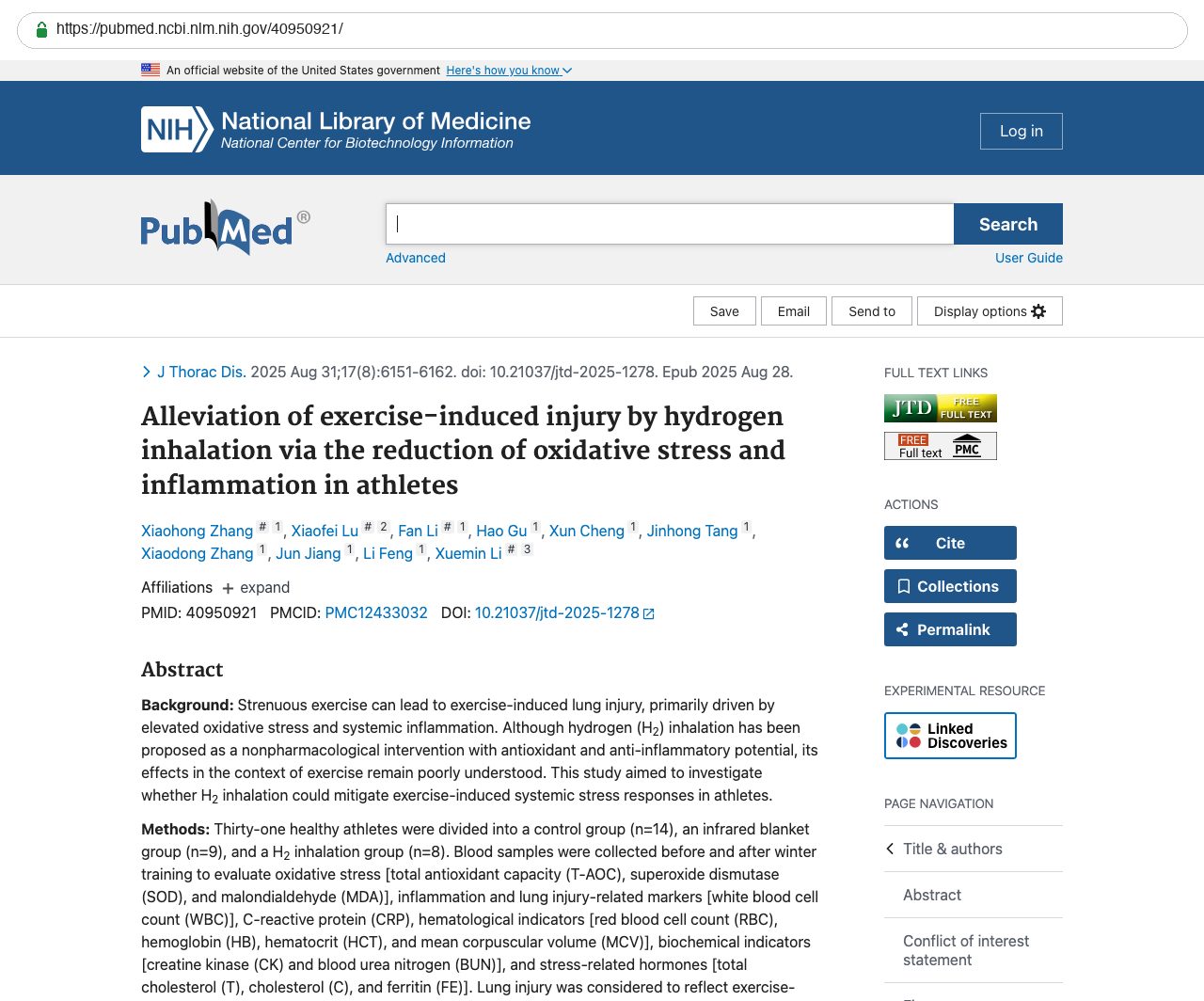
This page mirrors the published abstract (© the authors / publisher) for reference and citation. The canonical source is the PubMed record linked above. This is not medical advice.