2019 Respiration; international review of thoracic diseases Pilot / Observational Human H₂ therapy Inhalation Respiratory / COVID
2019 · Zhou et al. — Breathing Hydrogen-Oxygen Mixture Decreases Inspiratory Effort in Patients with Tracheal Stenosis
Super-Abstract
In 35 patients with severe acute tracheal stenosis, inspiratory effort measured by diaphragm electromyography was lower while breathing a hydrogen-oxygen mixture than while breathing air or oxygen (mean reduction 10.53 ± 6.83%). Transdiaphragmatic pressure fell by a mean of 4.77 ± 3.51 cmH2O, and the Borg breathlessness score and airway resistance improved significantly. Vital signs did not change, and no adverse reactions occurred. All patients went through the same fixed sequence of gases in one session, and the abstract reports neither randomisation nor blinding, so effects of order and time cannot be ruled out. (Respiration, 2019.)
Commentary
Patients with acute severe narrowing of the windpipe must work hard to breathe in, and according to the abstract, data supporting clinical use of a hydrogen-oxygen mixture in this setting are insufficient. This prospective self-controlled study recruited 35 consecutive patients with severe acute tracheal stenosis. Each patient breathed in 4 consecutive steps: air for 15 min, hydrogen-oxygen mixture (6 L per min, hydrogen to oxygen 2:1) for 15 min, oxygen (3 L per min) for 15 min, and hydrogen-oxygen mixture again for 120 min. The primary endpoint was inspiratory effort, measured by diaphragm electromyography (EMGdi). Secondary endpoints were transdiaphragmatic pressure (Pdi), Borg score, vital signs and airway resistance by impulse oscillometry (IOS). Hydrogen in the room air was checked with 12 monitors, and adverse reactions were recorded. The abstract does not mention randomisation or blinding.
Key quotes
- „The EMGdi significantly decreased during 2 H2-O2 inhalation steps (Steps 2 and 4) compared with air (Step 1) and O2 (Step 3) (52.95 ± 15.00 vs. 42.46 ± 13.90 vs. 53.20 ± 14.74 vs. 42.50 ± 14.12% for Steps 1 through 4, p < 0.05).“ — the primary endpoint across the four breathing steps
- „Breathing H2-O2 significantly improved the Borg score and resistance parameters of IOS but not vital signs. No adverse reactions occurred.“ — secondary endpoints and safety during the short inhalation period
- „Breathing H2-O2 may reduce the inspiratory effort in patients with acute severe tracheal stenosis and can be used for this purpose safely.“ — the authors' conclusion on effect and safety
Our assessment
The study measured breathing effort in the same patients under different gases during one session. Inspiratory effort was lower during both hydrogen-oxygen steps than during the air and oxygen steps. Because every patient received the gases in the same order, the design cannot separate the effect of the gas from changes over time, and the hydrogen-oxygen mixture was given at 6 L per min compared with 3 L per min for oxygen. The abstract does not report blinding, which matters for the self-rated Borg score. PubMed lists the paper as a randomised controlled trial, but the abstract describes no randomisation. Limitations: 35 patients, no separate control group, short exposure of 15 to 120 min, physiological measurements rather than clinical outcomes, and safety observed only during the session. In this sample the results suggest a short-term reduction in breathing effort while the mixture is inhaled.
Study design
- Type: prospective self-controlled study with a fixed sequence of 4 breathing steps, randomisation and blinding not reported · n: 35 consecutive patients · H₂ delivery: inhaled hydrogen-oxygen mixture (H₂:O₂ = 2:1, 6 L per min) for 15 min and later for 120 min
- Comparator: air (15 min) and oxygen at 3 L per min (15 min) in the same patients
- Result: EMGdi 52.95 ± 15.00 (air) vs. 42.46 ± 13.90 (H₂-O₂) vs. 53.20 ± 14.74 (oxygen) vs. 42.50 ± 14.12% (H₂-O₂), p < 0.05; mean reduction 10.53 ± 6.83%. Pdi lower by a mean of 4.77 ± 3.51 cmH2O. Borg score and IOS resistance improved, vital signs unchanged. No adverse reactions. H₂ undetectable in room air
Abstract
BACKGROUND: Hydrogen-oxygen mixture (H2-O2) may reduce airway resistance in patients with acute severe tracheal stenosis, yet data supporting the clinical use of H2-O2 are insufficient. OBJECTIVES: To evaluate the efficacy and safety of breathing H2-O2 in acute severe tracheal stenosis. METHODS: Thirty-five consecutive patients with severe acute tracheal stenosis were recruited in this prospective self-control study. Air, H2-O2 and O2 inhalation was given in 4 consecutive breathing steps: air for 15 min, H2-O2 (6 L per min, H2:O2 = 2: 1) for 15 min, oxygen (3 L per min) for 15 min, and H2-O2 for 120 min. The primary endpoint was inspiratory effort as assessed by diaphragm electromyography (EMGdi); the secondary endpoints were transdiaphragmatic pressure (Pdi), Borg score, vital signs, and impulse oscillometry (IOS). The concentration of H2 in the ambient environment was obtained with 12 monitors. Adverse reactions during the inhalation were recorded. RESULTS: The mean reduction in the EMGdi under H2-O2 was 10.53 ± 6.83%. The EMGdi significantly decreased during 2 H2-O2 inhalation steps (Steps 2 and 4) compared with air (Step 1) and O2 (Step 3) (52.95 ± 15.00 vs. 42.46 ± 13.90 vs. 53.20 ± 14.74 vs. 42.50 ± 14.12% for Steps 1 through 4, p < 0.05). The mean reduction in the Pdi under H2-O2 was 4.77 ± 3.51 cmH2O. Breathing H2-O2 significantly improved the Borg score and resistance parameters of IOS but not vital signs. No adverse reactions occurred. H2 was undetectable in the environment throughout the procedure. CONCLUSIONS: Breathing H2-O2 may reduce the inspiratory effort in patients with acute severe tracheal stenosis and can be used for this purpose safely.
Source & links
Screenshot of the PubMed page
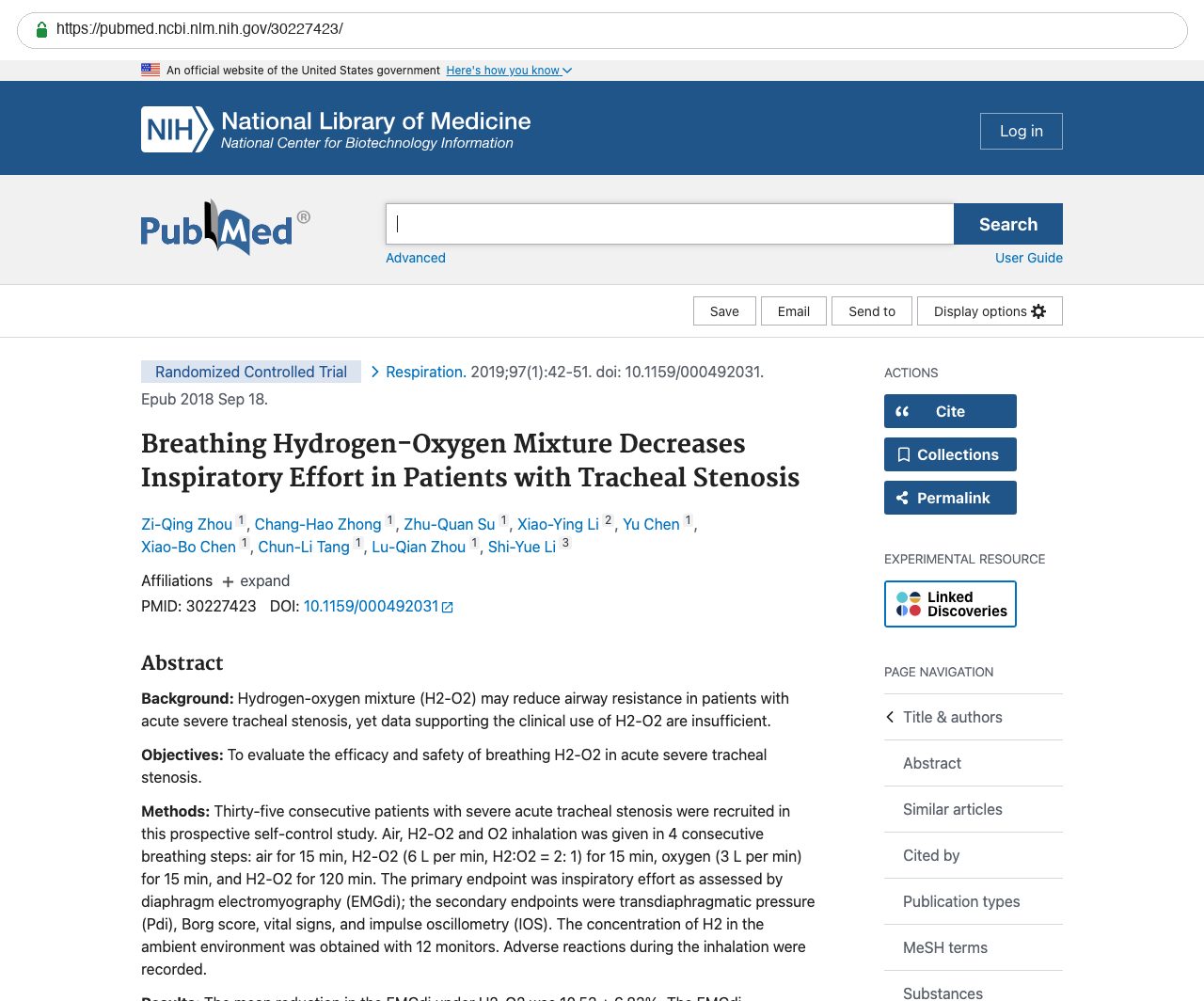
This page mirrors the published abstract (© the authors / publisher) for reference and citation. The canonical source is the PubMed record linked above. This is not medical advice.