2009 · Zhu — A novel antibody fragment targeting HAb18G/CD147 with cytotoxicity and decreased immunogenicity.
Super-Abstract
This in-vitro study describes the engineering of a humanized antibody fragment targeting CD147, a protein overexpressed on hepatocellular carcinoma cells, to reduce immunogenicity while maintaining cytotoxic activity. The resulting construct showed reduced reactivity with anti-mouse antibodies from patients while retaining binding affinity and the ability to mediate cancer cell killing. (Cancer Biology and Therapy, 2009.)
Commentary
This paper is primarily an antibody engineering study in the context of liver cancer treatment. The connection to molecular hydrogen (H₂) is incidental: the authors mention „molecular hydrogen bond“ as a structural chemistry term within their protein modelling work — a routine reference to the hydrogen bonds that stabilize protein structure, not to therapeutic hydrogen gas. This paper does not investigate H₂ as a medical treatment, H₂-rich water, or any hydrogen-related therapy. It is included in the H₂ literature database apparently due to keyword matching on „hydrogen bond“ chemistry. The science described — humanizing a murine antibody fragment — is valid cancer biology, but it is essentially unrelated to the therapeutic H₂ field.
Key quotes
- „Considering the surface accessibility of non-human like framework residues and the potential to form a molecular hydrogen bond within the context of the homology modeled Fv of HAb18, three residues in a single chain fragment of antibody variable region of HAb18 (HAb18scFv) were replaced by their human counterparts.“ — the only mention of „hydrogen“ — refers to structural hydrogen bonds in protein modelling, not to therapeutic H₂
- „the reactivity of (HAb18-huscFv)(2)-Fc to the serum of patients with HAMA response was decreased while its specificity and similar binding activity (K(D) = 1.5 x 10(-9) M) were retained.“ — the antibody engineering outcome: reduced immunogenicity, maintained binding
- „these results suggest (HAb18-huscFv)(2)-Fc could be a more efficient antibody fragment with less immunogenicity and additional cytotoxicity function.“ — conclusion of the antibody study
Our assessment
This paper has no meaningful relevance to therapeutic molecular hydrogen (H₂). The term „hydrogen“ in this study refers exclusively to hydrogen bonds in protein structural chemistry — a fundamentally different concept from dissolved H₂ gas as an antioxidant therapy. The study is a solid in-vitro antibody engineering paper in liver cancer research, but should not be cited as evidence for H₂ therapeutic effects. Its presence in an H₂ database appears to be a false-positive due to keyword overlap.
Study design
- Type: in-vitro study (protein engineering + cell-based assays) · Model: hepatocellular carcinoma cells; patient serum with HAMA response · H₂ connection: none (hydrogen bond = structural chemistry term only)
- Result: humanized antibody fragment (HAb18-huscFv)₂-Fc maintained binding affinity (Kd ~1.5 nM), showed reduced HAMA reactivity, and mediated ADCC and CDC cytotoxicity in vitro
Abstract
[(131)I]Metuximab injection (Licartin) was an efficient therapeutic anti-hepatocellular carcinoma (HCC) radioimmunological agent generated by labeling (131)I with the murine monoclonal antibody fragment HAb18-F(ab')(2) but human anti-mouse antibody (HAMA) response in some patients after administration limited its clinical use. To reduce the immunogenicity of murine antibody, we attempted to humanize HAb18 by variable domain resurfacing based on the three-dimensional structure of Fv fragment. Considering the surface accessibility of non-human like framework residues and the potential to form a molecular hydrogen bond within the context of the homology modeled Fv of HAb18, three residues in a single chain fragment of antibody variable region of HAb18 (HAb18scFv) were replaced by their human counterparts. We fabricated a humanized version of HAb18scFv, HAb18-huscFv, to the human IgG1Fc fragment to form (HAb18-huscFv)(2)-Fc. The reactivity of (HAb18-huscFv)(2)-Fc to the serum of patients with HAMA response was decreased while its specificity and similar binding activity (K(D) = 1.5 x 10(-9) M) were retained compared with its parental antibody. In addition, this antibody is an efficient mediator of antibody-dependent cell-mediated cytotoxicity (ADCC) and complement-dependent cytotoxicity (CDC). These results suggest (HAb18-huscFv)(2)-Fc could be a more efficient antibody fragment with less immunogenicity and additional cytotoxicity function.
Source & links
Screenshot of the PubMed page
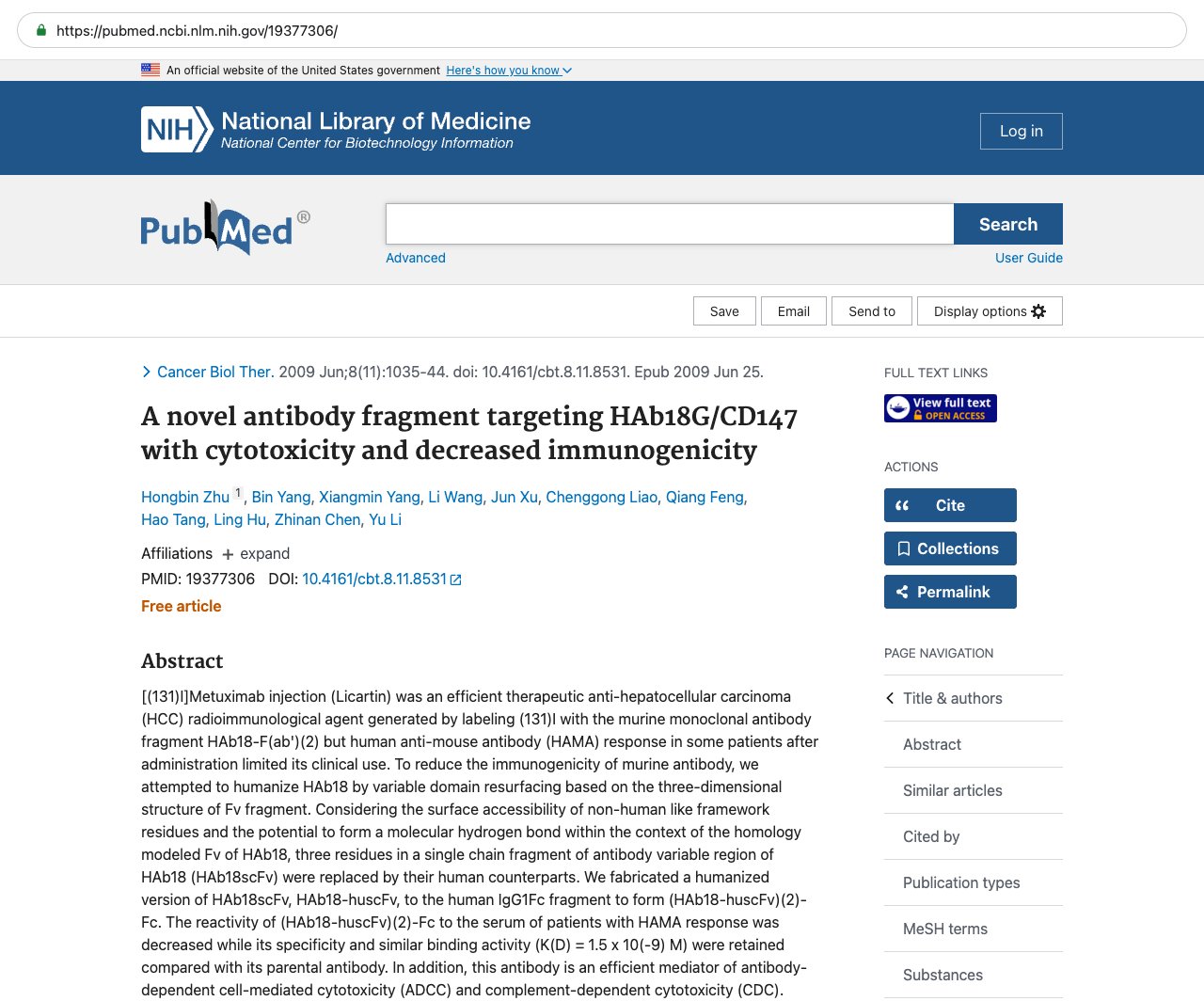
This page mirrors the published abstract (© the authors / publisher) for reference and citation. The canonical source is the PubMed record linked above. This is not medical advice.