2020 International journal of sports physiology and performance RCT Human H₂ therapy Drinking (HRW) Sports & Exercise
2020 · Botek et al. — Hydrogen-Rich Water Supplementation and Up-Hill Running Performance: Effect of Athlete Performance Level
Super-Abstract
In 16 male runners, drinking 1680 mL of hydrogen-rich water between 24 hours and 40 minutes before a 4.2-km up-hill race had an unclear effect on race time compared with placebo (90% confidence interval -10 to 7 s). Effects on average heart rate and on perceived exertion after the race were likely trivial. In the 4 slowest runners, race time likely improved (-36 to -3 s), while the effect in the 4 fastest runners was unclear. These subgroups have four runners each, and the abstract reports qualitative effect ratings with 90% confidence intervals instead of p-values. (International Journal of Sports Physiology and Performance, 2020.)
Commentary
Hydrogen-rich water has been reported to reduce fatigue, and this study asked whether it improves up-hill running and whether any effect depends on running ability. Sixteen male runners of mixed ability took part (mean age 31.6 years, VO2max 57.2 mL·kg-1·min-1). The design was a randomised, double-blind, placebo-controlled crossover. Each runner drank 1680 mL of either hydrogen-rich water or placebo between 24 hours and 40 minutes before a 4.2-km up-hill race. The two races were a week apart. The abstract does not give the hydrogen concentration of the water or describe the placebo. Outcomes were race time, average heart rate during the race and rating of perceived exertion immediately after the race. Race time is the main performance measure, but the abstract does not label a primary endpoint. Results were analysed for all runners and separately for the 4 slowest and the 4 fastest runners.
Key quotes
- „After analysis of data for all runners, HRW effect was unclear (-10 to 7 s, 90% confidence interval) for RT, likely trivial for heart rate (-2 to 3 beats·min-1), and likely trivial for postrace rating of perceived exertion (-0.1 to 1.0).“ — the result for the whole group, with no clear effect on any outcome
- „HRW for the 4 slowest runners (RT = 1490 [91] s) likely improved the RT (-36 to -3 s), whereas for the 4 fastest runners (RT = 1069 [53] s) the performance effect of HRW was unclear (-10 to 26 s).“ — the subgroup result, based on four runners in each group
- „HRW intake had an unclear antifatigue effect on performance in terms of mean group values. However, it appears that the magnitude of the antifatigue effect of HRW on performance depends on individual running ability.“ — the authors' conclusion, which separates the group result from the subgroup signal
Our assessment
The trial is randomised, double-blind and placebo-controlled, with each runner serving as his own control. For the whole group, hydrogen-rich water had no clear effect on race time, heart rate or perceived exertion. The signal in the 4 slowest runners rests on a subgroup of four participants and on a correlation between race time and the difference between conditions, so it can only generate a hypothesis. Limitations: 16 men, a single race per condition and one dosing schedule. The abstract does not state the hydrogen concentration, the nature of the placebo or any adverse events. Results are given as qualitative ratings with 90% confidence intervals instead of p-values, the abstract does not say whether the subgroup analysis was planned in advance, and the correlation interval (r = -.79 to -.15) is wide.
Study design
- Type: randomised, double-blind, placebo-controlled crossover trial, races one week apart · n: 16 men · H₂ delivery: 1680 mL hydrogen-rich water between 24 hours and 40 minutes before the race, concentration not given
- Comparator: placebo drink (not described in the abstract)
- Result: whole group: race time unclear (90% CI -10 to 7 s), heart rate likely trivial (-2 to 3 beats per minute), post-race perceived exertion likely trivial (-0.1 to 1.0). Possible negative correlation between race time differences and average race time (r = -.79 to -.15). 4 slowest runners: race time likely improved (-36 to -3 s). 4 fastest runners: unclear (-10 to 26 s)
Abstract
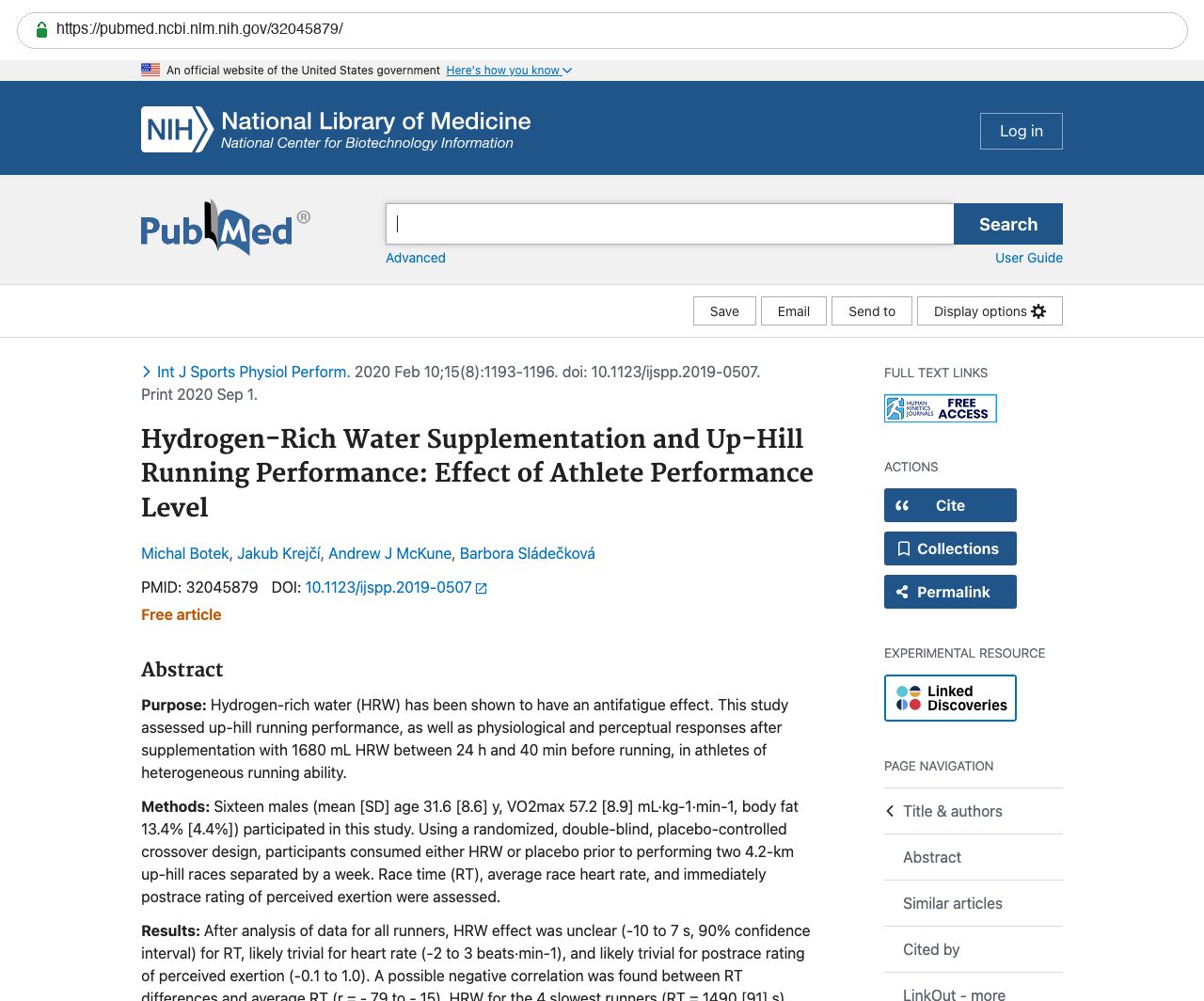
PURPOSE: Hydrogen-rich water (HRW) has been shown to have an antifatigue effect. This study assessed up-hill running performance, as well as physiological and perceptual responses after supplementation with 1680 mL HRW between 24 h and 40 min before running, in athletes of heterogeneous running ability. METHODS: Sixteen males (mean [SD] age 31.6 [8.6] y, VO2max 57.2 [8.9] mL·kg-1·min-1, body fat 13.4% [4.4%]) participated in this study. Using a randomized, double-blind, placebo-controlled crossover design, participants consumed either HRW or placebo prior to performing two 4.2-km up-hill races separated by a week. Race time (RT), average race heart rate, and immediately postrace rating of perceived exertion were assessed. RESULTS: After analysis of data for all runners, HRW effect was unclear (-10 to 7 s, 90% confidence interval) for RT, likely trivial for heart rate (-2 to 3 beats·min-1), and likely trivial for postrace rating of perceived exertion (-0.1 to 1.0). A possible negative correlation was found between RT differences and average RT (r = -.79 to -.15). HRW for the 4 slowest runners (RT = 1490 [91] s) likely improved the RT (-36 to -3 s), whereas for the 4 fastest runners (RT = 1069 [53] s) the performance effect of HRW was unclear (-10 to 26 s). CONCLUSIONS: HRW intake had an unclear antifatigue effect on performance in terms of mean group values. However, it appears that the magnitude of the antifatigue effect of HRW on performance depends on individual running ability.
Source & links
Screenshot of the PubMed page
This page mirrors the published abstract (© the authors / publisher) for reference and citation. The canonical source is the PubMed record linked above. This is not medical advice.