2026 · Chen et al. — Effects of Hydrogen-Rich Water Supplementation on Exercise Performance, Autonomic Nervous System Recovery, and Blood Lactate Concentration During Repeated Sprint Exercise in Male University Athletes
Super-Abstract
In 13 male university athletes, drinking hydrogen-rich water before repeated cycling sprints led to significantly higher average power output and a smaller decline in performance than placebo (effect sizes d = 0.61 to 0.64). Heart rate variability recovered faster after exercise, and blood lactate 3 minutes after exercise was about 1 mmol/L lower. The study was small and single-blind and named no primary endpoint, and the abstract reports effect sizes without p-values or the hydrogen dose. (Journal of Sports Science and Medicine, 2026.)
Commentary
Hydrogen-rich water has been proposed to reduce fatigue during exercise, but its effect on repeated sprinting and autonomic nervous system function was unclear. This randomised, single-blind, placebo-controlled crossover study included 13 male university athletes (mean age 23.9 ± 2.0 years). Each athlete completed two sessions, one after acute pre-exercise intake of hydrogen-rich water and one after placebo, separated by a one-week washout. Each session consisted of 7 all-out cycling sprints of 6 seconds with 30-second recovery intervals. The abstract does not give the hydrogen concentration, the volume or the exact timing of intake. Critical flicker fusion frequency, heart rate, heart rate variability (HRV) and blood lactate were measured at baseline, during exercise and at 0 to 5 and 10 minutes after exercise. Performance was described by average power output, total work decrement and fatigue index. The abstract does not name a primary endpoint.
Key quotes
- „Compared to the placebo trial, the HRW trial demonstrated significantly higher average power output (d = 0.61) and significantly lower total work decrement and fatigue index (d = 0.62; d = 0.64).“ — the performance results, reported as effect sizes without p-values
- „Blood lactate at 3 min post-exercise was approximately 1 mmol/L lower in the HRW trial (d = 0.64).“ — a single lactate time point, given as an approximate difference
- „These findings suggest that acute HRW ingestion attenuates the decline in power output, accelerates ANS recovery, and enhances lactate clearance following repeated sprint exercise.“ — the authors' conclusion on performance, recovery and lactate
Our assessment
The placebo-controlled crossover design lets each athlete serve as his own control, which helps in a sample of 13. The performance measures favoured hydrogen-rich water, and several HRV measures recovered faster. The abstract gives effect sizes but no p-values, confidence intervals or absolute power values. Limitations: a very small sample of young male university athletes, single blinding, no named primary endpoint, and many outcomes measured at several time points, which raises the chance of false-positive findings. The hydrogen dose is not reported. The conclusion about faster lactate clearance rests on a single time point at 3 minutes. Results for critical flicker fusion frequency and heart rate are not given in the abstract. In this setting the findings suggest an acute effect on sprint performance and recovery, which larger, double-blind trials would need to confirm.
Study design
- Type: randomised, single-blind, placebo-controlled crossover study with a washout of one week · n: 13 male university athletes (mean age 23.9 years) · H₂ delivery: hydrogen-rich water drunk once before exercise, concentration and volume not given
- Comparator: placebo
- Result: no primary endpoint named, effect sizes only. Hydrogen-rich water compared with placebo: higher average power output (d = 0.61), lower total work decrement (d = 0.62) and fatigue index (d = 0.64). Faster post-exercise HRV recovery for RMSSD (d = 0.62), LF/HF ratio (d = 0.82), SampEn (d = 0.79) and DFAα1 (d = 0.79). Blood lactate about 1 mmol/L lower at 3 minutes after exercise (d = 0.64)
Abstract
Hydrogen-rich water (HRW) supplementation has been proposed to exert anti-fatigue effects during exercise; however, its impact on exercise performance and autonomic nervous system (ANS) function during repeated sprinting remains unclear. The aim of this study was to examine the effects of acute pre-exercise HRW ingestion on repeated sprint performance, ANS regulation, and blood lactate concentration. This randomized, single-blind, placebo-controlled crossover study included 13 male university athletes (23.9 ± 2.0 years). Each participant completed two sessions of 7×6-second all-out cycling sprints interspersed with 30-second recovery intervals, with a one-week washout period between sessions. Critical flicker fusion frequency, heart rate, heart rate variability (HRV), and blood lactate were assessed at baseline, during exercise, and at 0-5 min and 10 min post-exercise. Compared to the placebo trial, the HRW trial demonstrated significantly higher average power output (d = 0.61) and significantly lower total work decrement and fatigue index (d = 0.62; d = 0.64). Post-exercise HRV recovery was significantly accelerated in the HRW trial, including RMSSD (d = 0.62), LF/HF ratio (d = 0.82), SampEn (d = 0.79), and DFAα1 (d = 0.79). Blood lactate at 3 min post-exercise was approximately 1 mmol/L lower in the HRW trial (d = 0.64). These findings suggest that acute HRW ingestion attenuates the decline in power output, accelerates ANS recovery, and enhances lactate clearance following repeated sprint exercise.
Source & links
Screenshot of the PubMed page
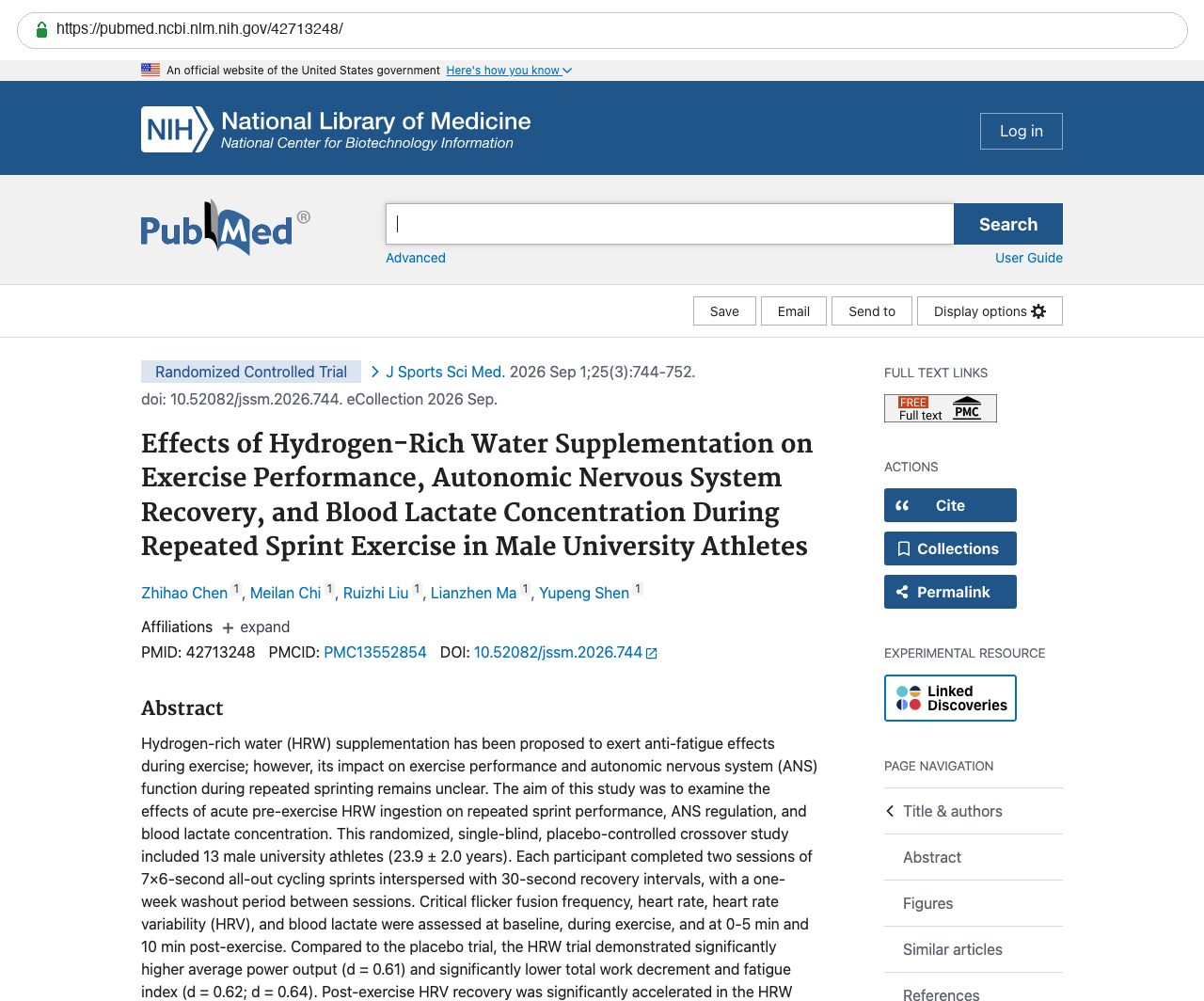
This page mirrors the published abstract (© the authors / publisher) for reference and citation. The canonical source is the PubMed record linked above. This is not medical advice.