2024 · Sládečková et al. — Hydrogen-Rich Water Supplementation Promotes Muscle Recovery After Two Strenuous Training Sessions Performed on the Same Day in Elite Fin Swimmers: Randomized, Double-Blind, Placebo-Controlled, Crossover Trial
Super-Abstract
In 12 elite fin swimmers, four days of hydrogen-rich water lowered creatine kinase and muscle soreness and increased countermovement jump height 12 hours after the second of two hard sessions on one day, compared with placebo (p = 0.043, 0.045 and 0.014). Mean values were 156 compared with 190 U/L for creatine kinase, 34 compared with 42 mm for soreness, and 30.7 compared with 29.8 cm for jump height. The abstract reports results only for the 12-hour time point, although measurements were also taken during the test day and at 24 hours. (Frontiers in Physiology, 2024.)
Commentary
The authors asked whether hydrogen-rich water supports muscle recovery after two hard training sessions on the same day. Eight female (mean age 21.5 years) and four male (mean age 18.9 years) elite fin swimmers took part. The title describes the trial as randomised, double-blind, placebo-controlled and crossover. The swimmers did 12 × 50 m sprints in the morning and a 400 m competitive performance in the afternoon. They drank hydrogen-rich water or placebo for 3 days before the sessions at 1,260 mL per day, and 2,520 mL on the experimental day. Countermovement jump height (muscle performance), blood creatine kinase (muscle damage) and muscle soreness on a 100 mm visual analogue scale were measured during the experimental day and at 12 and 24 hours after the afternoon session. The abstract does not give the hydrogen concentration, the washout period, a primary endpoint or adverse events. The same group of swimmers and the same trial registration also appear in Sládečková 2026.
Key quotes
- „HRW compared to placebo reduced blood activity of creatine kinase (156 ± 63 vs. 190 ± 64 U.L-1, p = 0.043), muscle soreness perception (34 ± 12 vs. 42 ± 12 mm, p = 0.045), and improved countermovement jump height (30.7 ± 5.5 cm vs. 29.8 ± 5.8 cm, p = 0.014) at 12 h after the afternoon session.“ — the main results, all reported for the 12-hour time point
- „Muscle performance (countermovement jump), muscle damage (creatine kinase), and muscle soreness (100 mm visual analogue scale) were measured during the experimental day and at 12 and 24 h after the afternoon session.“ — measurements covered more time points than the results report
- „Four days of HRW supplementation is a promising hydration strategy for promoting muscle recovery after two strenuous training sessions performed on the same day in elite fin swimmers.“ — the authors' conclusion, based on 12 swimmers and one reported time point
Our assessment
Double blinding and the crossover design are strengths, and the three recovery markers point in the same direction at 12 hours. The differences between conditions were smaller than the spread between swimmers, shown by the standard deviations. The results suggest faster recovery in this small group, but they need confirmation. Limitations: only 12 swimmers, results reported for one of several measurement points, no 24-hour results in the abstract, four days of supplementation, no named primary endpoint, and recovery markers rather than competition results. Randomisation is stated in the title but not described in the abstract. Hydrogen concentration, washout and adverse events are not reported.
Study design
- Type: randomised, double-blind, placebo-controlled crossover trial (as stated in the title) · n: 12 elite fin swimmers (eight women, four men) · H₂ delivery: hydrogen-rich water, 1,260 mL per day for 3 days plus 2,520 mL on the experimental day, concentration not stated
- Comparator: placebo (composition not described in the abstract)
- Result: 12 h after the afternoon session: creatine kinase 156 ± 63 vs. 190 ± 64 U/L (p = 0.043), muscle soreness 34 ± 12 vs. 42 ± 12 mm (p = 0.045), countermovement jump 30.7 ± 5.5 vs. 29.8 ± 5.8 cm (p = 0.014). No primary endpoint named, and no results reported for the other time points
Abstract
Purpose: Molecular hydrogen has been shown to possess antioxidant, anti-inflammatory, ergogenic, and recovery-enhancing effects. This study aimed to assess the effect of molecular hydrogen administration on muscle performance, damage, and perception of soreness up to 24 h of recovery after two strenuous training sessions performed on the same day in elite fin swimmers. Methods: Eight females (mean ± SD; age 21.5 ± 5.0 years, maximal oxygen consumption 45.0 ± 2.5 mL.kg-1.min-1) and four males (age 18.9 ± 1.3 years, maximal oxygen consumption 52.2 ± 1.7 mL.kg-1.min-1) performed 12 × 50 m sprints in the morning session and a 400 m competitive performance in the afternoon session. Participants consumed hydrogen-rich water (HRW) or placebo 3 days before the sessions (1,260 mL/day) and 2,520 mL on the experimental day. Muscle performance (countermovement jump), muscle damage (creatine kinase), and muscle soreness (100 mm visual analogue scale) were measured during the experimental day and at 12 and 24 h after the afternoon session. Results: HRW compared to placebo reduced blood activity of creatine kinase (156 ± 63 vs. 190 ± 64 U.L-1, p = 0.043), muscle soreness perception (34 ± 12 vs. 42 ± 12 mm, p = 0.045), and improved countermovement jump height (30.7 ± 5.5 cm vs. 29.8 ± 5.8 cm, p = 0.014) at 12 h after the afternoon session. Conclusion: Four days of HRW supplementation is a promising hydration strategy for promoting muscle recovery after two strenuous training sessions performed on the same day in elite fin swimmers. Clinical Trial Registration: clinicaltrials.gov, identifier NCT05799911.
Source & links
Screenshot of the PubMed page
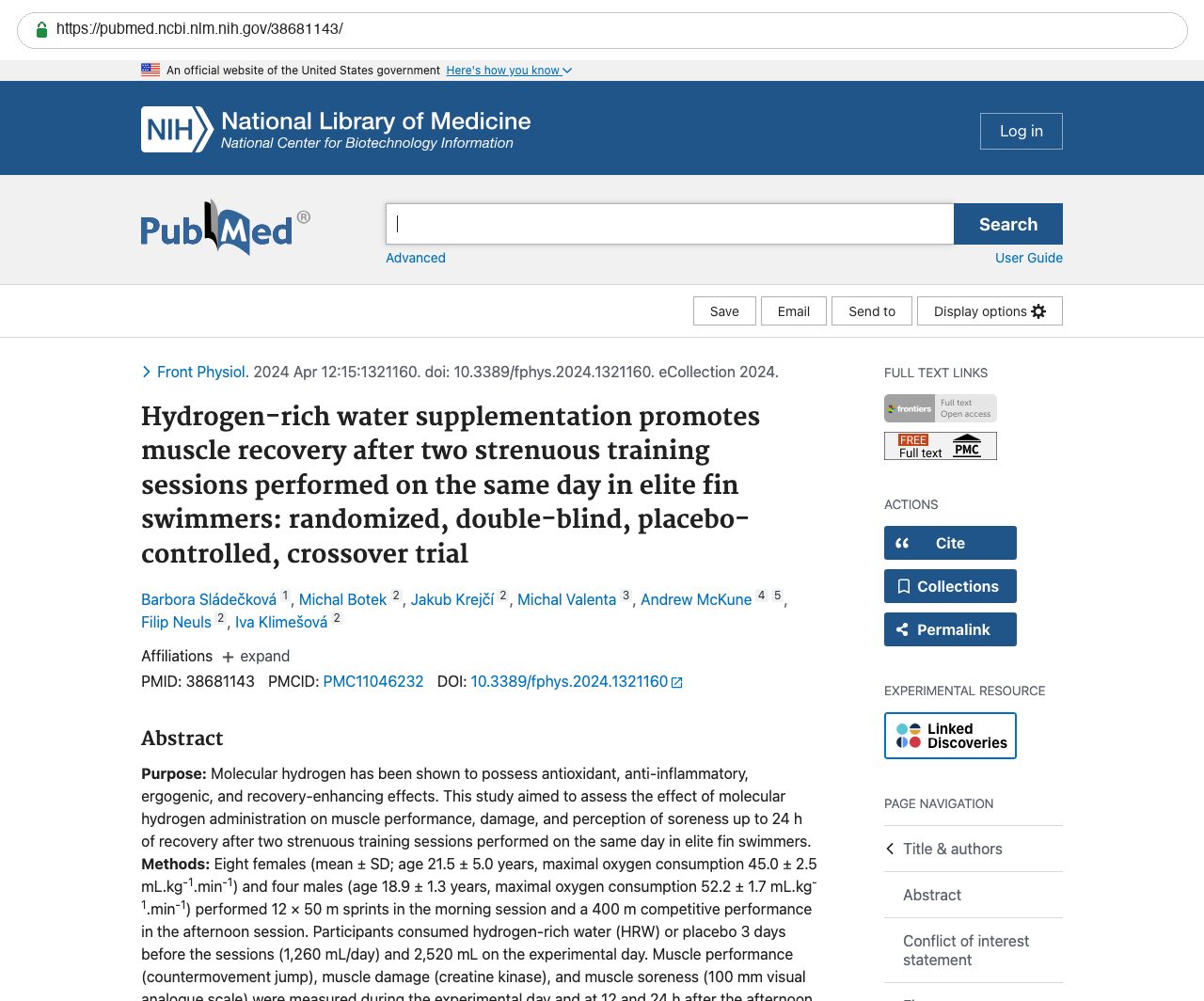
This page mirrors the published abstract (© the authors / publisher) for reference and citation. The canonical source is the PubMed record linked above. This is not medical advice.