2024 · Chitapanarux et al. — Pilot Feasibility and Safety Study of Hydrogen Gas Inhalation in Locally Advanced Head and Neck Cancer Patients
Super-Abstract
In 10 patients with locally advanced head and neck cancer receiving chemoradiotherapy, a daily one-hour hydrogen gas inhalation given as an add-on met the feasibility endpoint: all 10 completed 33 inhalation sessions, and no hydrogen-related adverse events were reported. The pilot had no control group, so it cannot show whether hydrogen changed the side effects of chemoradiotherapy. According to the abstract, grade 3 leukopenia occurred in two patients (20%) and grade 2 radiation dermatitis and pharyngitis in three (30%). (OncoTargets and Therapy, 2024.)
Commentary
The authors write that hydrogen gas might ease acute side effects of radiotherapy by scavenging free radicals and through anti-inflammatory effects. This prospective pilot study enrolled 10 patients with locally advanced head and neck cancer between July 2023 and December 2023. All received standard concurrent chemoradiotherapy: daily intensity-modulated radiotherapy in 33 weekday fractions and six cycles of weekly chemotherapy. Hydrogen was given in addition to this treatment. Patients inhaled hydrogen gas through a cannula or mask for 1 hour a day, 1–2 hours before radiotherapy. Per full text, the gas contained 66% hydrogen in air at a flow of 1.2 L/min, and the trial had a single arm without a control group. The primary endpoint was feasibility, defined as at least 80% of patients completing at least 20 inhalations. Secondary endpoints were safety during inhalation (vital signs and symptoms related to hydrogen) and acute toxicities during chemoradiotherapy.
Key quotes
- „All patients received 33 fractions of H2 gas inhalation on the same day as the IMRT.“ — the feasibility result: every patient completed all planned inhalation sessions
- „No adverse events related to H2 gas inhalation, such as cough, nasal bleeding, dizziness, headache, nausea, or vomiting, were reported.“ — safety during inhalation, reported for 10 patients without a comparison group
- „H2 gas inhalation combined with CCRT is feasible and safe for patients with LAHNC.“ — the authors' conclusion, limited to feasibility and safety
Our assessment
This pilot answers a narrow question: can patients undergoing chemoradiotherapy for head and neck cancer manage a daily hour of hydrogen inhalation? In 10 patients, all 33 planned sessions were completed and no hydrogen-related symptoms were reported. The study cannot show whether hydrogen reduces radiotherapy side effects, because every patient received it and there was no comparison group. The toxicity figures describe what happened during chemoradiotherapy, not an effect of hydrogen. Limitations: 10 patients, a single arm, no blinding reported and observation limited to the course of chemoradiotherapy. A sample this small cannot rule out rare adverse events. Per full text, the toxicity counts reported there differ from those in the abstract, so these figures need caution. Hydrogen was an add-on to standard cancer treatment and was not tested as a treatment for the cancer itself. A randomised trial would be needed to test any effect on toxicities.
Study design
- Type: prospective pilot feasibility and safety study, single arm per full text · n: 10 · H₂ delivery: hydrogen gas inhaled through a cannula or mask, 1 hour a day, 1–2 hours before each of 33 radiotherapy fractions (per full text 66% hydrogen in air, 1.2 L/min), in addition to chemoradiotherapy
- Comparator: none. All patients received hydrogen alongside standard concurrent chemoradiotherapy
- Result: feasibility endpoint met: all 10 patients completed 33 inhalations (threshold: 80% completing at least 20). Vital signs stable, no hypertension or hypotension, no hydrogen-related adverse events. Chemoradiotherapy toxicities per abstract: grade 3 leukopenia in 2 patients (20%), grade 2 radiation dermatitis and pharyngitis in 3 (30%)
Abstract
PURPOSE: Hydrogen (H2) gas inhalation might alleviate acute radiotherapy toxicities by scavenging free radicals produced by ionizing radiation and anti-inflammatory properties. This study aimed to investigate the feasibility and safety of H2 gas inhalation during concurrent chemoradiotherapy (CCRT) in patients with locally advanced head and neck cancer (LAHNC). PATIENTS AND METHODS: We designed a pilot prospective study combining CCRT with aerosol inhalation of H2 gas. Each patient was scheduled to receive daily intensity-modulated radiotherapy (IMRT) in 33 fractions on a weekday and six cycles of weekly chemotherapy. All patients inhaled H2 gas through a cannula or mask 1 hour per day, 1-2 hours before IMRT. The primary endpoint was the feasibility of H2 inhalation. Eighty percent of the patients who completed at least 20 applications of H2 gas inhalation were considered feasible. The secondary endpoints were safety profiles during H2 gas inhalation (vital signs and symptoms related to H2 gas inhalation) and acute toxicities during CCRT. RESULTS: We enrolled 10 patients with LAHNC between July 2023 and December 2023. All patients received 33 fractions of H2 gas inhalation on the same day as the IMRT. Vital signs during and at the end of H2 gas inhalation were stable in all patients. None of the 10 patients had hypertension or hypotension during any of the 33 inhalations. No adverse events related to H2 gas inhalation, such as cough, nasal bleeding, dizziness, headache, nausea, or vomiting, were reported. Grade 3 leukopenia was found in two patients (20%) during the 5th week of CCRT. Grade 2 radiation dermatitis and pharyngitis were found in three patients (30%). CONCLUSION: H2 gas inhalation combined with CCRT is feasible and safe for patients with LAHNC.
Source & links
Screenshot of the PubMed page
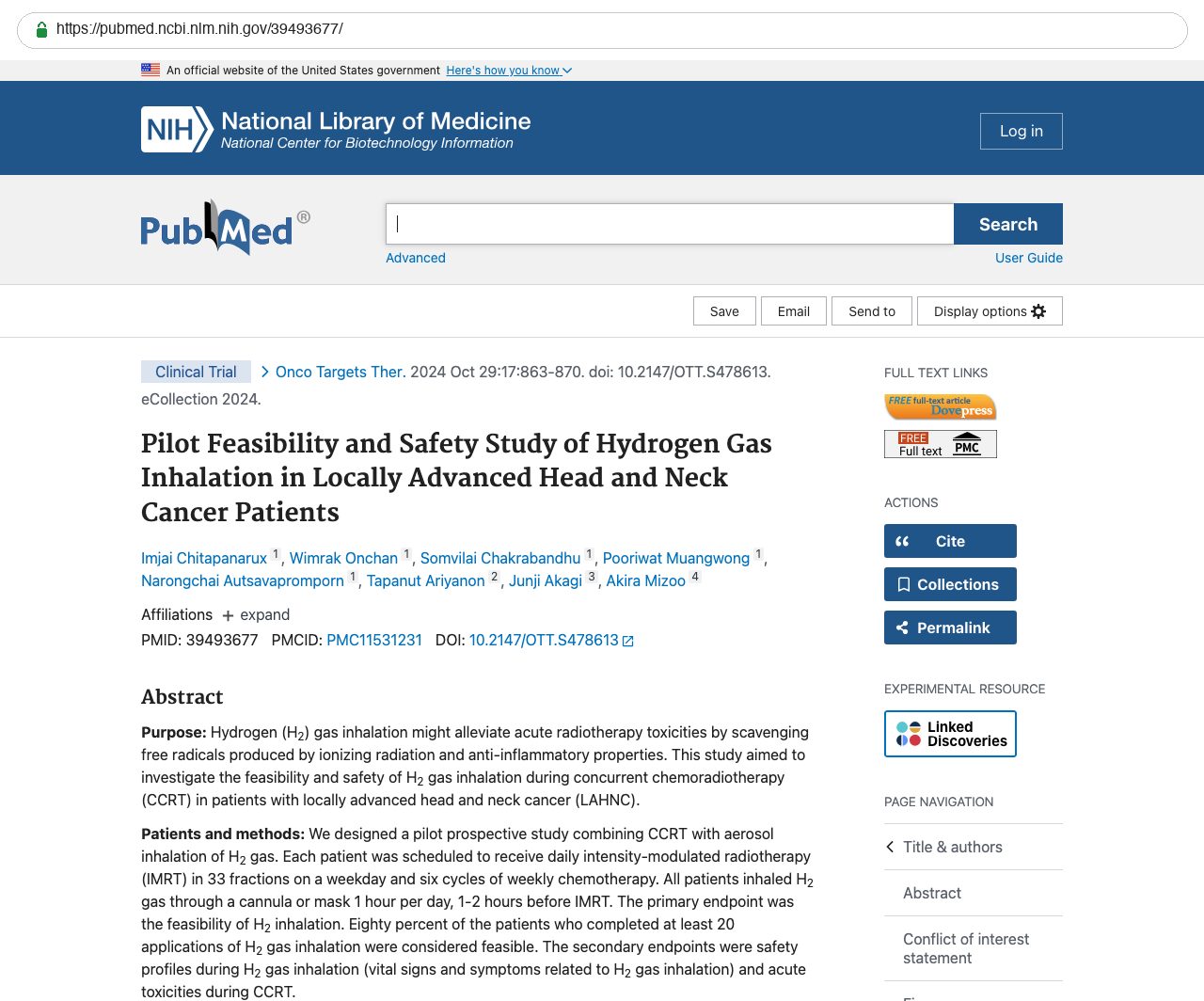
This page mirrors the published abstract (© the authors / publisher) for reference and citation. The canonical source is the PubMed record linked above. This is not medical advice.