2026 · Chitapanarux et al. — Metabolomic Alterations Associated with Adjunctive Hydrogen Gas Inhalation During Concurrent Chemoradiotherapy in Locally Advanced Head and Neck Cancer: A Pilot Study
Super-Abstract
In a randomised pilot study of 20 patients with locally advanced head and neck cancer, adding hydrogen gas inhalation to chemoradiotherapy was followed by numerically fewer moderate side effects and chemotherapy delays, without a statistically significant difference between groups (per full text). Serum metabolomics was exploratory: the drop in uric acid was numerically smaller with hydrogen, but this difference was not statistically significant. The abstract names no primary endpoint, and the study was not designed to assess tumour outcomes. (Cancers, 2026.)
Commentary
Hydrogen gas has been proposed as a way to limit oxidative damage from cancer treatment. This prospective pilot study randomised 20 adults with locally advanced head and neck cancer receiving concurrent chemoradiotherapy to treatment alone (10) or treatment plus hydrogen gas inhalation (10). Per full text, allocation used block randomisation and the physicians grading toxicities were blinded. Patients inhaled hydrogen gas from a generator for 1 hour daily via nasal cannula at 1.67 L/min, 1 to 2 hours before each radiotherapy session, over 30 to 33 fractions (per full text). The inhaled hydrogen concentration is not reported. The control group received no sham gas. One patient in the hydrogen group withdrew, leaving 19 for analysis. Serum taken before and after treatment was analysed by untargeted mass spectrometry metabolomics, and treatment-related toxicities, chemotherapy delays and overall treatment time were recorded. The abstract does not name a primary endpoint. Per full text, an earlier single-arm pilot by the same group tested feasibility.
Key quotes
- „Patients receiving adjunctive H2 gas inhalation tended to exhibit numerically lower frequencies of moderate treatment-related toxicities, fewer chemotherapy delays, and a shorter overall treatment duration than those receiving CCRT alone.“ — the main clinical observation, described only as numerical trends
- „Consistent with these findings, direct between-group comparison of within-subject changes (Δ = post - pre) indicated a numerically smaller reduction in serum uric acid levels in the adjunctive H2 gas inhalation group; however, this difference did not reach statistical significance.“ — the only direct between-group metabolite comparison, which was not significant
- „However, the study was not designed to evaluate oncological outcomes, and the metabolomic findings, particularly the pathway-level interpretations, should be considered exploratory because several pathway assignments were based on only one or a few mapped metabolites, together with the limited sample size, patient heterogeneity, and lack of independent external validation.“ — the authors' own limits on how far the results reach
Our assessment
The trial was randomised but small, and its clinical results are reported as numerical trends. Limitations: 20 patients (19 analysed), no sham gas, and per full text only the physicians grading toxicities were blinded. The abstract names no primary endpoint and gives no numbers or p-values for toxicities. Per full text, chemotherapy was delayed in 6 of 10 patients without hydrogen compared with 3 of 9 with hydrogen, and no toxicity difference was statistically significant. The metabolomic analysis compared values before and after treatment within each group. The one direct comparison between groups, uric acid, was not significant (p = 0.11 per full text). Per full text, patients differed in tumour site and stage, and chemotherapy regimens varied. The study cannot show an effect of hydrogen on side effects or tumour control. It can only generate hypotheses for a larger trial.
Study design
- Type: prospective randomised pilot study, assessor-blinded per full text · n: 20 randomised (10 per group), 19 analysed · H₂ delivery: hydrogen gas inhalation, per full text 1 hour daily via nasal cannula at 1.67 L/min before each radiotherapy session, concentration not reported
- Comparator: concurrent chemoradiotherapy alone, no sham gas
- Result: no primary endpoint named. Moderate toxicities, chemotherapy delays (per full text 6 of 10 vs. 3 of 9) and treatment time numerically lower with H₂, not statistically significant. Serum uric acid fell less with H₂ (p = 0.11 per full text, not significant). Other metabolomic changes exploratory and within groups only
Abstract
Background: H2 gas inhalation has been proposed as a selective modulator of reactive oxygen species (ROS), potentially mitigating treatment-related oxidative damage. This study investigated the effects of adjunctive H2 gas inhalation on serum metabolomic profiles and clinical toxicities in patients with LAHNC undergoing CCRT. Methods: Twenty patients were prospectively randomized to receive either standard CCRT alone (Group A) or CCRT combined with adjunctive H2 gas inhalation (Group B). Serum samples collected before and after treatment were analyzed using untargeted ultra-high-performance liquid chromatography coupled with ion mobility quadrupole time-of-flight high-resolution mass spectrometry (UHPLC-IM-QTOF-HRMS)-based metabolomics. Results: One patient in Group B discontinued participation, leaving 19 patients for the final analysis. Patients receiving adjunctive H2 gas inhalation tended to exhibit numerically lower frequencies of moderate treatment-related toxicities, fewer chemotherapy delays, and a shorter overall treatment duration than those receiving CCRT alone. Metabolomic profiling in the CCRT-alone group revealed exploratory alterations in metabolites associated with arginine metabolism, glutathione metabolism, and purine metabolism following treatment. Ornithine, uric acid, and tetrahydrodeoxycorticosterone were among the candidate discriminative metabolites with exploratory discriminatory performance after CCRT. In contrast, patients receiving adjunctive H2 gas inhalation showed a more limited pattern of pathway mapping, with exploratory evidence from an illustrative single-hit pathway assignment suggesting possible involvement of purine metabolism. Altered uric acid levels together with changes in several lipid-related metabolites may collectively reflect metabolic responses associated with treatment-related oxidative stress during CCRT. Consistent with these findings, direct between-group comparison of within-subject changes (Δ = post - pre) indicated a numerically smaller reduction in serum uric acid levels in the adjunctive H2 gas inhalation group; however, this difference did not reach statistical significance. Conclusions: Adjunctive H2 gas inhalation during CCRT may be associated with reduced moderate treatment-related toxicities and exploratory changes in systemic metabolic profiles in patients with LAHNC. However, the study was not designed to evaluate oncological outcomes, and the metabolomic findings, particularly the pathway-level interpretations, should be considered exploratory because several pathway assignments were based on only one or a few mapped metabolites, together with the limited sample size, patient heterogeneity, and lack of independent external validation. Further validation in larger, independent cohorts using comprehensive between-group metabolomic analyses is warranted.
Source & links
Screenshot of the PubMed page
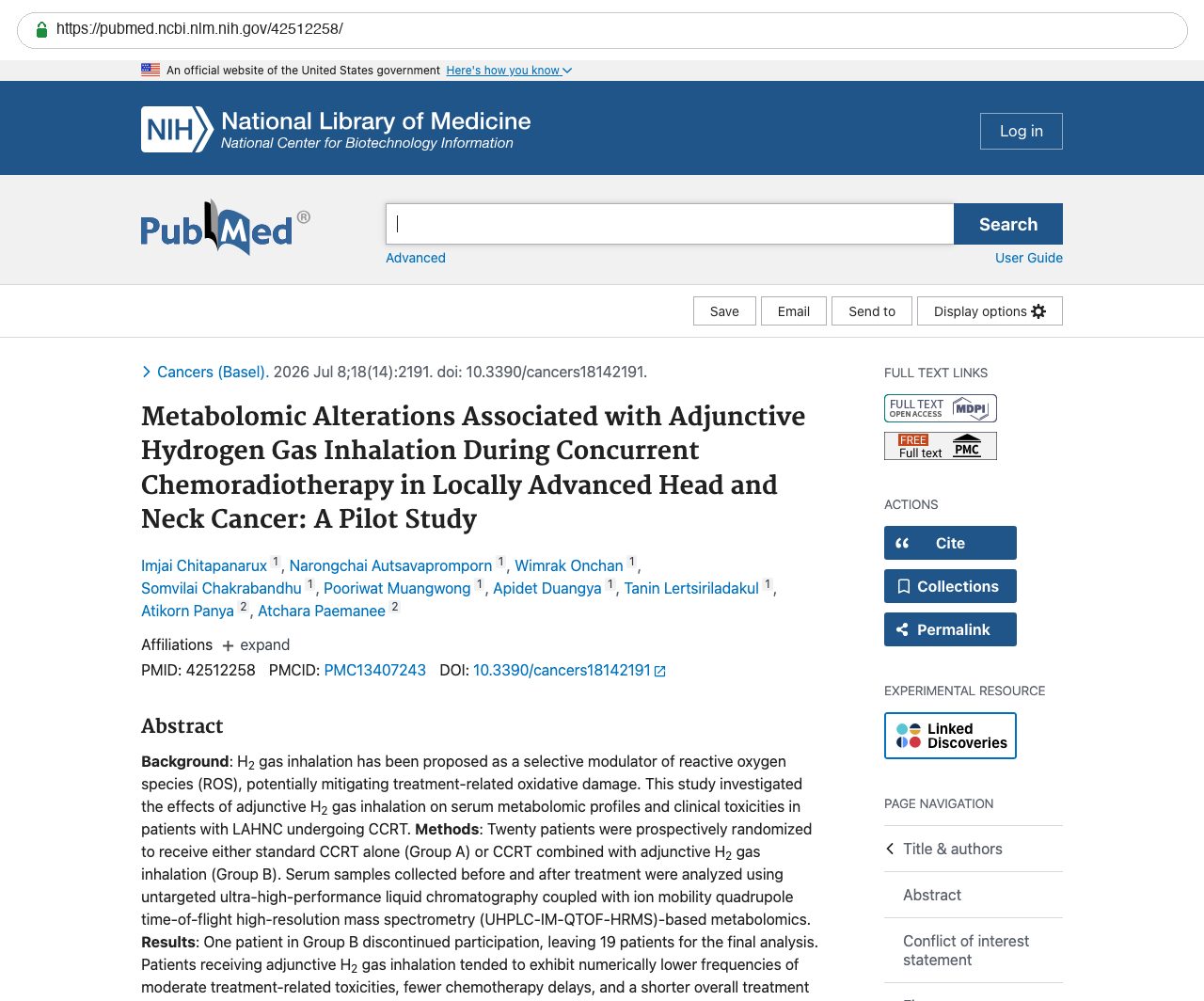
This page mirrors the published abstract (© the authors / publisher) for reference and citation. The canonical source is the PubMed record linked above. This is not medical advice.