2026 Journal of frailty, sarcopenia and falls Pilot / Observational Human H₂ therapy Drinking (HRW) Sports & Exercise
2026 · Harada et al. — Association of Self-Selected Hydrogen-Rich Water Consumption with 6-Month Changes in Chair-Stand Performance and Gait Speed among Community-Dwelling Older Adults Attending Community Salons
Super-Abstract
In 128 older adults in Japan followed for 6 months, those who chose to drink hydrogen-rich water had better adjusted chair-stand performance (1.85 more repetitions) and gait speed (0.07 m/s faster) than non-drinkers, but this observational design cannot show cause and effect. One-leg stance time and grip strength were also better, while the Timed Up and Go test did not clearly differ. Participants decided for themselves whether to drink the water, so the authors note that residual confounding remains possible. (Journal of Frailty, Sarcopenia and Falls, 2026.)
Commentary
Lower-extremity strength and gait are linked to falls in older adults. This prospective observational study followed 128 older adults attending community salons in Hiroshima, Japan. At baseline, participants were classified as consumers or non-consumers of hydrogen-rich water. Per full text, there were 64 in each group, and the water was distributed in the salons rather than assigned by the researchers. Per full text, the labelled hydrogen concentration was about 1.05 mg/L and intake was up to 600 mL per day, an upper estimate not based on measured intake. Outcomes were the 30-second chair stand test (per full text the primary outcome), Timed Up and Go, usual gait speed, one-leg stance time and grip strength, measured at baseline and after 6 months. The main analyses used analysis of covariance adjusted for baseline value, age, sex, fall history and walking-aid use. Mixed-effects and overlap-weighted models served as sensitivity analyses.
Key quotes
- „Compared with non-consumers, consumers had better adjusted 6-month chair-stand performance (1.85 repetitions, 95% confidence interval 1.11 to 2.59), gait speed (0.07 m/s, 0.04 to 0.10), one-leg stance time (1.78 s, 0.43 to 3.13), and grip strength (0.80 kg, 0.21 to 1.40).“ — the adjusted 6-month differences, including the primary outcome
- „Timed Up and Go did not clearly differ (-0.39 s, -1.23 to 0.45).“ — one of five performance tests showed no clear difference
- „Self-selected hydrogen-rich water consumption was associated with better chair-stand performance and gait speed in this pragmatic community setting, but residual confounding remains possible.“ — the authors' conclusion, worded as an association with a caveat
Our assessment
The study adds real-world data from older adults, with prespecified adjustment and sensitivity analyses that pointed the same way. It cannot show that hydrogen-rich water caused the differences. Limitations: no randomisation and self-selected exposure, so more health-conscious people may have chosen to drink the water. Per full text, salon attendance and exercise outside the salons were not systematically assessed, comorbidities and medication were not fully measured, and actual intake and hydrogen concentration were not verified. There was no comparison drink. Per full text, the chair-stand difference of 1.85 repetitions is slightly below the 2-repetition threshold the authors cite as clinically important. The study ran in one city and lasted 6 months. The abstract does not report adverse events.
Study design
- Type: prospective observational cohort study, not randomised · n: 128 (per full text 64 consumers, 64 non-consumers) · H₂ delivery: self-selected drinking of hydrogen-rich water; per full text about 1.05 mg/L (label) and up to 600 mL per day (estimate)
- Comparator: older adults from the same salons who did not drink hydrogen-rich water
- Result: adjusted 6-month differences favouring consumers: chair stand 1.85 repetitions (95% CI 1.11 to 2.59), gait speed 0.07 m/s (0.04 to 0.10), one-leg stance 1.78 s (0.43 to 3.13), grip strength 0.80 kg (0.21 to 1.40). Timed Up and Go -0.39 s (-1.23 to 0.45), no clear difference
Abstract
To examine whether self-selected hydrogen-rich water consumption was associated with 6-month changes in physical function among community-dwelling older adults attending community salons. This prospective observational study included 128 older adults in Hiroshima, Japan. Participants were classified as consumers or non-consumers at baseline and completed repeated assessments of the 30-second chair stand test, Timed Up and Go, usual gait speed, one-leg stance time, and grip strength. Primary analyses used analysis of covariance with robust standard errors, adjusting for baseline value, age, sex, fall history, and walking-aid use; mixed-effects and overlap-weighted models were sensitivity analyses. Compared with non-consumers, consumers had better adjusted 6-month chair-stand performance (1.85 repetitions, 95% confidence interval 1.11 to 2.59), gait speed (0.07 m/s, 0.04 to 0.10), one-leg stance time (1.78 s, 0.43 to 3.13), and grip strength (0.80 kg, 0.21 to 1.40). Timed Up and Go did not clearly differ (-0.39 s, -1.23 to 0.45). Self-selected hydrogen-rich water consumption was associated with better chair-stand performance and gait speed in this pragmatic community setting, but residual confounding remains possible.
Source & links
Screenshot of the PubMed page
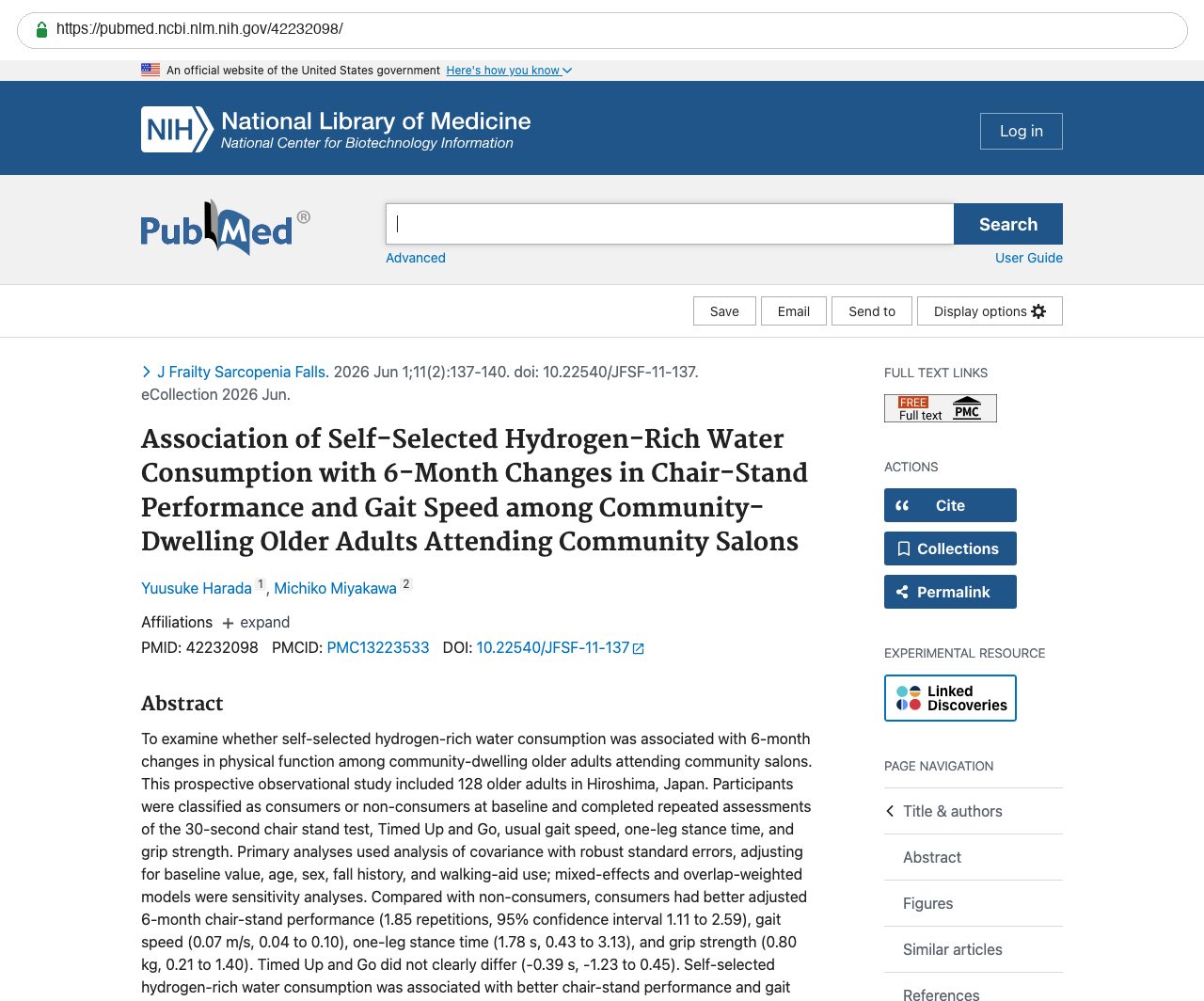
This page mirrors the published abstract (© the authors / publisher) for reference and citation. The canonical source is the PubMed record linked above. This is not medical advice.