2018 · Hirayama et al. — Inhalation of Hydrogen Gas Elevates Urinary 8-Hydroxy-2'-Deoxyguanine in Parkinson's Disease
Super-Abstract
Inhaling a low-dose hydrogen-air mixture (about 1.2 to 1.4% H₂) for 10 minutes twice a day for 4 weeks did not significantly change olfactory function, non-motor symptoms or activities of daily living in 20 patients with Parkinson's disease compared with placebo. Urinary 8-OHdG, which the authors discuss in the context of oxidative stress, rose by 16%. The authors read this as a possible sign of hormesis, a mild stress response that can trigger protective cell adaptations. The trial did not test this idea. (Medical Gas Research, 2018.)
Commentary
Hyposmia, a reduced sense of smell, is one of the earliest and most common symptoms of Parkinson's disease (PD), and the authors note that hydrogen gas had not been studied in PD patients. They ran a randomised, double-blind, placebo-controlled crossover trial in 20 patients with PD. Each patient inhaled either a hydrogen-air mixture with about 1.2 to 1.4% H₂ or placebo for 10 minutes twice a day for 4 weeks, with an 8-week washout between the two periods. Outcomes were olfactory function, non-motor symptoms, activities of daily living and urinary 8-hydroxy-2'-deoxyguanine (8-OHdG). The abstract does not name a primary endpoint, does not describe the placebo gas and does not report adverse events. The trial was approved by the ethics committee of Nagoya University Graduate School of Medicine and registered under UMIN000019082.
Key quotes
- „Inhalation of low dose hydrogen did not significantly influence the PD clinical parameters, but it did increase urinary 8-OHdG levels by 16%.“ — the main result: clinical measures unchanged, one laboratory marker increased
- „This increase in 8-OHdG is markedly less than the over 300% increase in diabetes, and is more comparable to the increase after a bout of strenuous exercise.“ — the authors compare the size of the rise with findings from other studies
- „Although we did not observe any beneficial effect of hydrogen in our short trial, we propose that the increased 8-OHdG and other reported stress responses from hydrogen may indicate that its beneficial effects are partly or largely mediated by hormetic mechanisms.“ — the authors' own interpretation, a hypothesis that this trial did not test
Our assessment
This is a small randomised, double-blind crossover trial. Inhaled hydrogen at this low dose showed no significant effect on olfactory function, non-motor symptoms or activities of daily living over 4 weeks. The 16% rise in urinary 8-OHdG is a laboratory finding. The comparisons with diabetes and strenuous exercise come from other studies, not from this trial, and the hormesis explanation is the authors' proposal. Limitations: only 20 patients and 4 weeks per treatment period. The dose was low, and inhalation lasted 10 minutes twice a day. The abstract names no primary endpoint, gives no p-value or confidence interval for the 8-OHdG change and does not describe the placebo. Adverse events are not reported, and the number of centres is not stated. A crossover design assumes that the 8-week washout removed any carry-over effect.
Study design
- Type: randomised, double-blind, placebo-controlled crossover trial with an 8-week washout · n: 20 patients with Parkinson's disease · H₂ delivery: inhaled hydrogen-air mixture with about 1.2 to 1.4% H₂, 10 minutes twice a day for 4 weeks
- Comparator: placebo inhalation (composition not described in the abstract); each patient received both in crossover
- Result: no primary endpoint named. Olfactory function, non-motor symptoms and activities of daily living: no significant change. Urinary 8-OHdG increased by 16% (no p-value given in the abstract)
Abstract
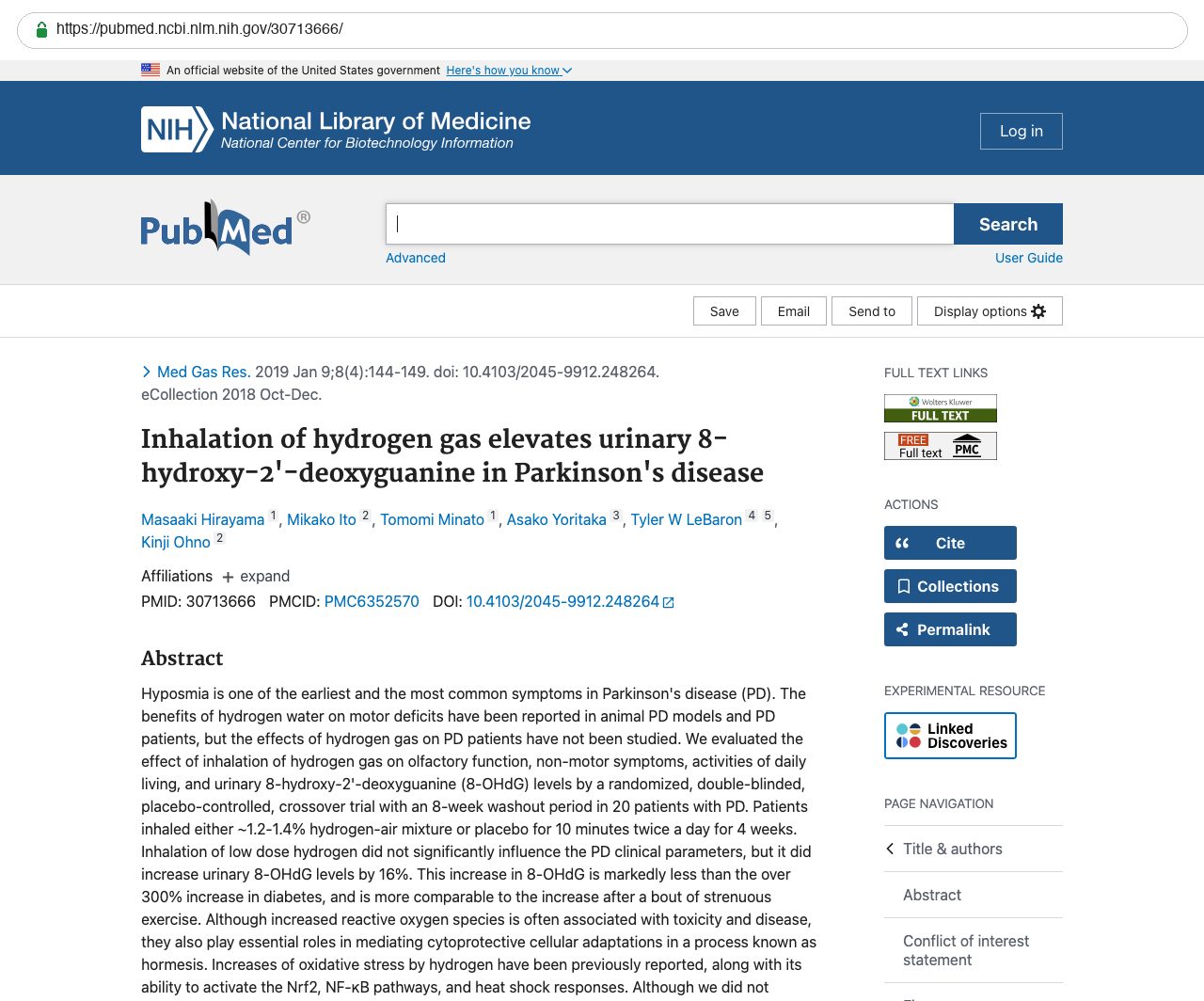
Hyposmia is one of the earliest and the most common symptoms in Parkinson's disease (PD). The benefits of hydrogen water on motor deficits have been reported in animal PD models and PD patients, but the effects of hydrogen gas on PD patients have not been studied. We evaluated the effect of inhalation of hydrogen gas on olfactory function, non-motor symptoms, activities of daily living, and urinary 8-hydroxy-2'-deoxyguanine (8-OHdG) levels by a randomized, double-blinded, placebo-controlled, crossover trial with an 8-week washout period in 20 patients with PD. Patients inhaled either ~1.2-1.4% hydrogen-air mixture or placebo for 10 minutes twice a day for 4 weeks. Inhalation of low dose hydrogen did not significantly influence the PD clinical parameters, but it did increase urinary 8-OHdG levels by 16%. This increase in 8-OHdG is markedly less than the over 300% increase in diabetes, and is more comparable to the increase after a bout of strenuous exercise. Although increased reactive oxygen species is often associated with toxicity and disease, they also play essential roles in mediating cytoprotective cellular adaptations in a process known as hormesis. Increases of oxidative stress by hydrogen have been previously reported, along with its ability to activate the Nrf2, NF-κB pathways, and heat shock responses. Although we did not observe any beneficial effect of hydrogen in our short trial, we propose that the increased 8-OHdG and other reported stress responses from hydrogen may indicate that its beneficial effects are partly or largely mediated by hormetic mechanisms. The study was approved by the ethics review committee of Nagoya University Graduate School of Medicine (approval number 2015-0295). The clinical trial was registered at the University Hospital Medical Information Network (identifier UMIN000019082).
Source & links
Screenshot of the PubMed page
This page mirrors the published abstract (© the authors / publisher) for reference and citation. The canonical source is the PubMed record linked above. This is not medical advice.