2012 Medical gas research Pilot / Observational Human H₂ therapy Drinking (HRW) Joints / RheumatologyOxidative stress
2012 · Ishibashi et al. — Consumption of Water Containing a High Concentration of Molecular Hydrogen Reduces Oxidative Stress and Disease Activity in Patients with Rheumatoid Arthritis: An Open-Label Pilot Study
Super-Abstract
In an open pilot study without a control group, 20 people with rheumatoid arthritis drank 530 ml of water with 4 to 5 ppm hydrogen daily for 4 weeks, and urinary 8-OHdG fell by 14.3% while disease activity (DAS28) fell from 3.83 to 3.02, both statistically significant. Both values also fell during the following 4-week wash-out without hydrogen water, which makes it hard to attribute the changes to hydrogen. In a second 4-week drinking period, DAS28 fell from 2.83 to 2.26, while urinary 8-OHdG did not fall further. (Medical Gas Research, 2012.)
Commentary
The authors start from the hypothesis that the hydroxyl radical is involved in rheumatoid arthritis and that hydrogen, as a selective scavenger of this radical, could complement conventional therapy by reducing oxidative stress. Twenty patients with rheumatoid arthritis drank 530 ml of water containing 4 to 5 ppm molecular hydrogen every day for 4 weeks. After a 4-week wash-out period they drank the same water for another 4 weeks. Urinary 8-OHdG, used as a marker of oxidative stress, and disease activity, measured as DAS28 with C-reactive protein, were assessed at the end of each 4-week period. The study was open-label and had no control group. The abstract also reports that this water seems to raise hydrogen levels in the body more than water saturated with hydrogen at 1.6 ppm, and it describes a subgroup of five patients with early disease. It does not describe the patients' other medication or report adverse events.
Key quotes
- „Urinary 8-OHdG was significantly reduced by 14.3% (p < 0.01) on average. DAS28 also decreased from 3.83 to 3.02 (p < 0.01) during the same period.“ — the main result of the first drinking period, measured against baseline without a control group
- „After the wash-out period, both the urinary 8-OHdG and the mean DAS28 decreased, compared to the end of the drinking period.“ — values also improved while no hydrogen water was taken, which complicates attribution
- „The results suggest that the hydroxyl radical scavenger H2 effectively reduces oxidative stress in patients with this condition. The symptoms of RA were significantly improved with high H2 water.“ — the authors' conclusion, which goes beyond what an uncontrolled pilot study can show
Our assessment
This pilot reports sizeable changes in a small group, but its design cannot separate an effect of hydrogen water from other influences. Without a control group, the improvements cannot be attributed to hydrogen. Both 8-OHdG and DAS28 also fell during the wash-out, when no hydrogen water was taken, so other factors such as the course of the disease or ongoing treatment may account for part of the change. The remission in all five patients with early, ACPA-negative disease comes from a very small subgroup. Limitations: a sample of 20, open-label design, no control group and no randomisation, two 4-week periods, a single marker of oxidative stress, other medication not described in the abstract, and no reporting of adverse events. The authors' conclusion that hydrogen effectively reduces oxidative stress goes further than this design allows.
Study design
- Type: open-label pilot study without a control group, two 4-week drinking periods separated by a 4-week wash-out · n: 20 with rheumatoid arthritis · H₂ delivery: drinking 530 ml of water with 4 to 5 ppm H₂ daily
- Comparator: none. Values were compared with baseline and between periods
- Result: first period: urinary 8-OHdG down 14.3% (p < 0.01), DAS28 from 3.83 to 3.02 (p < 0.01). Both fell further during the wash-out. Second period: DAS28 from 2.83 to 2.26 (p < 0.01), 8-OHdG not reduced further but still below baseline. All five patients with early, ACPA-negative disease reached remission, four of them became symptom-free
Abstract
BACKGROUND: Rheumatoid arthritis (RA) is a chronic inflammatory disease characterized by the destruction of bone and cartilage. Although its etiology is unknown, the hydroxyl radical has been suggested to be involved in the pathogenesis of RA. Recently, molecular hydrogen (H2) was demonstrated to be a selective scavenger for the hydroxyl radical. Also, the method to prepare water containing extremely high concentration of H2 has been developed. We hypothesized that H2 in the water could complement conventional therapy by reducing the oxidative stress in RA. METHODS: Twenty patients with rheumatoid arthritis (RA) drank 530 ml of water containing 4 to 5 ppm molecular hydrogen (high H2 water) every day for 4 weeks. After a 4-week wash-out period, the patients drank the high H2 water for another 4 weeks. Urinary 8-hydroxydeoxyguanine (8-OHdG) and disease activity (DAS28, using C-reactive protein [CRP] levels) was estimated at the end of each 4-week period. RESULTS: Drinking high H2 water seems to raise the concentration of H2 more than the H2 saturated (1.6 ppm) water in vivo. Urinary 8-OHdG was significantly reduced by 14.3% (p < 0.01) on average. DAS28 also decreased from 3.83 to 3.02 (p < 0.01) during the same period. After the wash-out period, both the urinary 8-OHdG and the mean DAS28 decreased, compared to the end of the drinking period. During the second drinking period, the mean DAS28 was reduced from 2.83 to 2.26 (p < 0.01). Urinary 8-OHdG was not further reduced but remained below the baseline value. All the 5 patients with early RA (duration < 12 months) who did not show antibodies against cyclic citrullinated peptides (ACPAs) achieved remission, and 4 of them became symptom-free at the end of the study. CONCLUSIONS: The results suggest that the hydroxyl radical scavenger H2 effectively reduces oxidative stress in patients with this condition. The symptoms of RA were significantly improved with high H2 water.
Source & links
Screenshot of the PubMed page
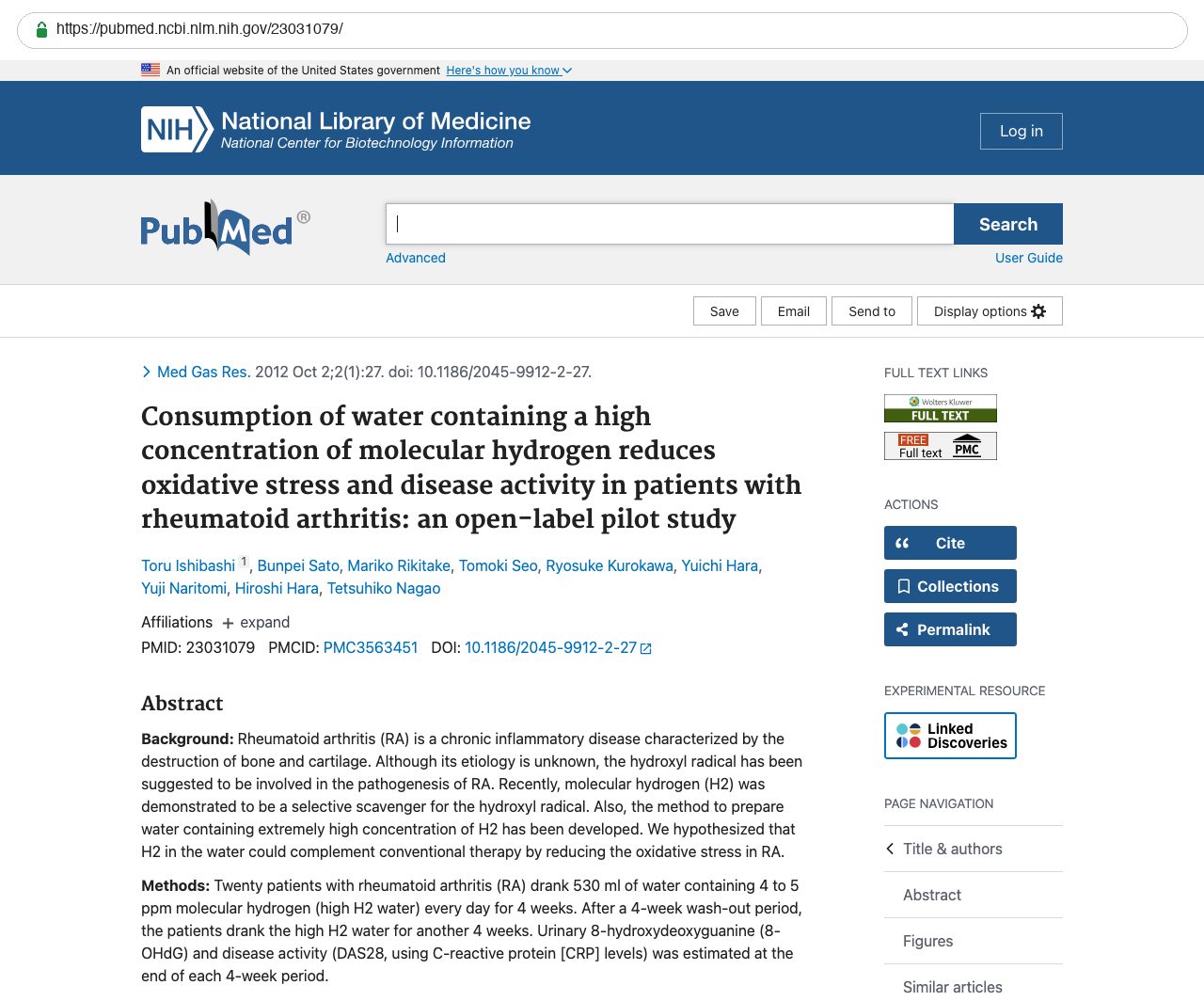
This page mirrors the published abstract (© the authors / publisher) for reference and citation. The canonical source is the PubMed record linked above. This is not medical advice.