2019 · Javorac et al. — Short-Term H2 Inhalation Improves Running Performance and Torso Strength in Healthy Adults
Super-Abstract
In 20 young adults, inhaling 4% hydrogen for 20 minutes a day for 7 days did not change the primary endpoint, running time to exhaustion, compared with room air (per full text), although peak running velocity rose by up to 4.2% (P = 0.05). The abstract itself does not report the primary result. Serum IGF-1 fell by 48.2 ng/mL after hydrogen and rose by 59.3 ng/mL after placebo, but both confidence intervals include zero. Per full text, handgrip and leg strength, bench press endurance and maximal oxygen uptake did not differ, and no adverse events were reported. (Biology of Sport, 2019.)
Commentary
The study tested whether a week of hydrogen inhalation affects exercise performance and blood hormone and inflammation markers in young adults. Twenty volunteers (physically active per full text), 10 women and 10 men with a mean age of 22.9 years, took part in a randomised, double-blind, placebo-controlled crossover pilot trial registered as NCT03846141. Each inhaled 4% hydrogen gas or room air for 20 minutes once a day for 7 days, with a 7-day washout between the two phases. Per full text, the gas was given through a mask at about 45 mL/min, diluted with ambient air. The primary endpoint was the change in running time to exhaustion in an incremental maximal test from baseline to day 7. Other performance tests and blood markers were measured at baseline and after each phase. Per full text, these included peak running velocity, isometric strength tests, bench press endurance, maximal oxygen uptake and serum markers such as IGF-1 and ferritin.
Key quotes
- „Breathing 4% hydrogen for 20 min per day resulted in increased peak running velocity (by up to 4.2%) as compared to air inhalation (P = 0.05).“ — a secondary result at the significance threshold, while the primary result is missing
- „Hydrogen inhalation resulted in a notable drop in serum insulin-like growth factor 1 (IGF-1) by 48.2 ng/mL at follow-up (95% confidence interval [CI]: from -186.7 to 89.3) (P < 0.05), while IGF-1 levels were elevated by 59.3 ng/mL after placebo intervention (95% CI; from -110.7 to 229.5) (P < 0.05).“ — the hormone result, with confidence intervals that include zero
- „Inhalational hydrogen appears to show ergogenic properties in healthy men and women. Gaseous H2 should be further evaluated for its efficacy and safety in an athletic environment.“ — the authors' conclusion, which does not mention the primary endpoint
Our assessment
The trial is randomised, double-blind and placebo-controlled, with a registered protocol and a named primary endpoint. According to the full text, that primary endpoint, running time to exhaustion, did not differ between hydrogen and room air, and the abstract does not report it. The positive findings are secondary: peak running velocity (P = 0.05, at the threshold) and, per full text, a smaller drop in torso strength. The other strength and endurance tests showed no difference (per full text). Limitations: pilot trial with 20 participants and one week per phase. Many secondary outcomes were tested without correction mentioned in the abstract. The IGF-1 confidence intervals include zero although P < 0.05 is reported, which makes the hormone result hard to interpret. The title's claim of improved running performance rests on secondary outcomes. Per full text, no participant reported adverse events.
Study design
- Type: randomised, double-blind, placebo-controlled crossover pilot trial (registered NCT03846141), 7-day washout · n: 20 (10 women, 10 men) · H₂ delivery: 4% hydrogen gas inhaled for 20 minutes once a day for 7 days, per full text by mask at about 45 mL/min
- Comparator: room air on the same schedule
- Result: primary endpoint (change in running time to exhaustion) not reported in the abstract, per full text no difference between interventions (η2 = 0.002). Peak running velocity up to 4.2% higher with hydrogen (P = 0.05). IGF-1 down 48.2 ng/mL with hydrogen and up 59.3 ng/mL with placebo (P < 0.05 each, confidence intervals include zero). Per full text: smaller drop in torso strength, larger drop in ferritin (6.4 vs. 5.6 μg/L) and CRP (1.0 vs. 0.7 mg/L). No difference in handgrip or leg strength, bench press endurance or VO2max
Abstract
In this randomized, double-blind, placebo-controlled, crossover pilot trial, we evaluated the effects of 7-day H2 inhalation on exercise performance outcomes and serum hormonal and inflammation profiles in a cohort of young men and women. All participants (age 22.9 ± 1.5 years; body mass index 23.4 ± 2.5 kg m-2; 10 women and 10 men) were allocated to receive either gaseous hydrogen (4%) or placebo (room air) by 20-min once-per-day inhalation for 7 days, with a wash-out period of 7 days to prevent the residual effects of interventions across study periods. The primary treatment outcome was the change in running time-to-exhaustion in the incremental maximal test from baseline to day 7. Additionally, assessment of other exercise performance endpoints and clinical chemistry biomarkers was performed at baseline and at 7 days after each intervention. The trial was registered at ClinicalTrials.gov (ID NCT03846141). Breathing 4% hydrogen for 20 min per day resulted in increased peak running velocity (by up to 4.2%) as compared to air inhalation (P = 0.05). Hydrogen inhalation resulted in a notable drop in serum insulin-like growth factor 1 (IGF-1) by 48.2 ng/mL at follow-up (95% confidence interval [CI]: from -186.7 to 89.3) (P < 0.05), while IGF-1 levels were elevated by 59.3 ng/mL after placebo intervention (95% CI; from -110.7 to 229.5) (P < 0.05). Inhalational hydrogen appears to show ergogenic properties in healthy men and women. Gaseous H2 should be further evaluated for its efficacy and safety in an athletic environment.
Source & links
Screenshot of the PubMed page
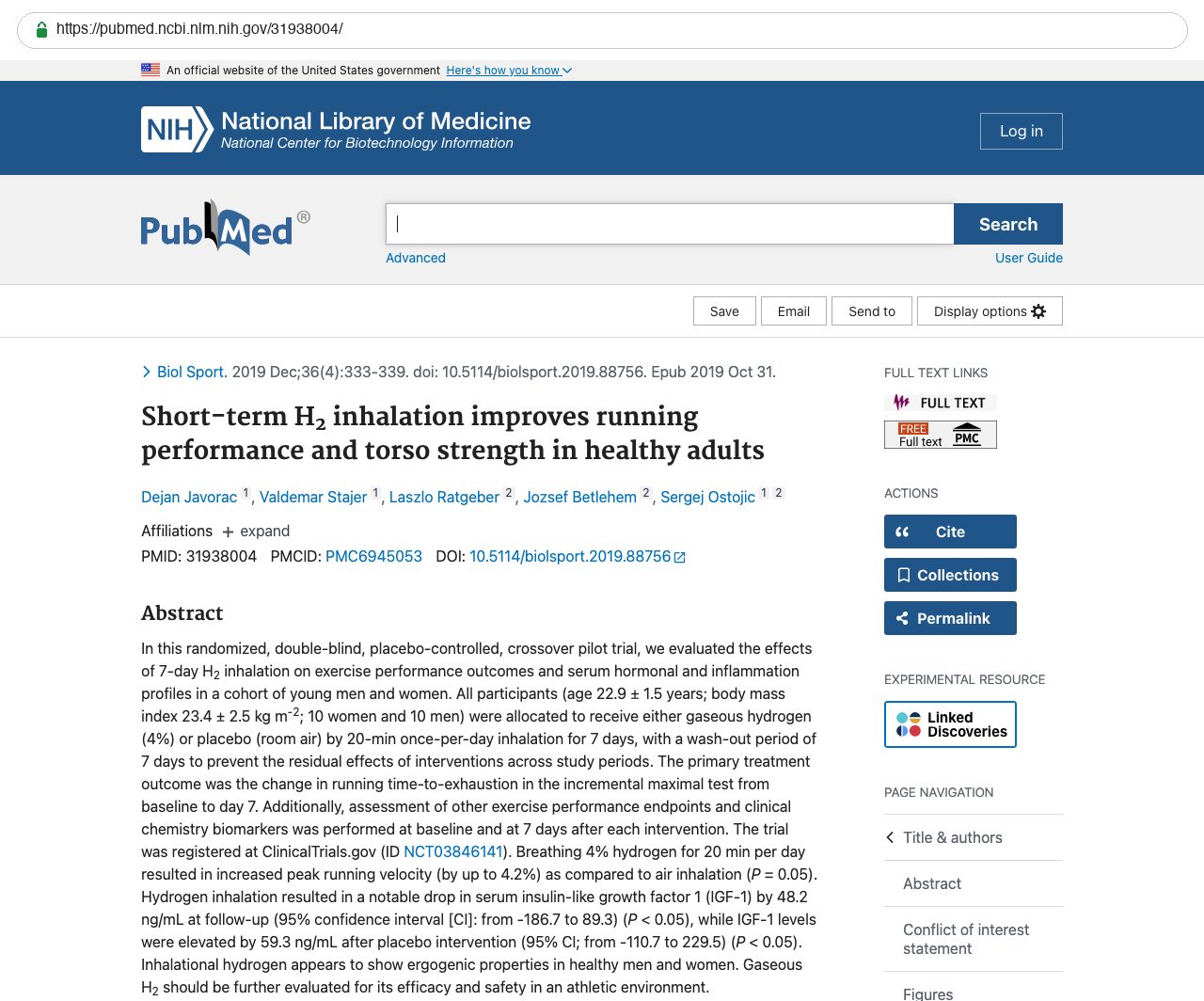
This page mirrors the published abstract (© the authors / publisher) for reference and citation. The canonical source is the PubMed record linked above. This is not medical advice.